|
Editorial comment: Resistance to this highway project is as urgent and environmentally important as it has ever been. There is still hope that this "greatest global example of biodiversity" can be saved, if the highway can go around the Serengeti instead of right through this vitally important wildlife area. - SON
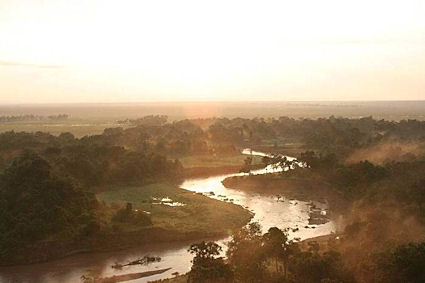 |
| Serengeti National Park in northern Tanzania in the rainy season |
The forty mile road through the Serengeti will adversely
affect the fragile ecosystem at the expense of mining interests around
the Lake Victoria region.
Tanzania’s Arusha Times (December 18, 2010 – January 14, 2011)
reports efforts are underway by environmental NGOs to stop the
government’s building of a 40 mile road through the Serengeti National
Park. The African Network for Animal Welfare (ANAW) has filed a motion
with the East African Court of Justice, requesting an injunction
stopping the proposed Arusha-Musoma highway. The Serengeti, known as
“the place where the land moves on forever,” is home to an animal
kingdom often referred to as the greatest global example of
biodiversity. But the proposed road would benefit commerce, notably the
global trade in rare metals.
Tanzania’s Mineral Resources Impact the Arusha-Musoma Highway
Beyond the confines of the Serengeti, mining interests produce
gemstones like tanzanite as well as metals such as coltan, a vital part
of cell phones and laptop computers. Although coltan mining has been
associated with the Congo for many years and linked to child slave
labor, numerous companies operating in Tanzania advertise coltan on
trade websites.
Because many cell phones are made in China, Tanzania’s export
business shows China to be the largest buyer of products after India,
followed by Japan. A Canadian metal importer seeking to purchase coltan
stated on an industry website, “Final user is in China.”
In Tanzania, Gala Group Ltd, with branches in Uganda and the Congo,
advertises “The best coltan from West Tanzania.” Gala is one of several
similar mining concerns like Kapiri Mining, Armatrade Metal Impex, JL
Mining Company and others that deal in coltan.
On December 28, 2010, NBC journalist Richard Engel ended his report
on the Serengeti highway referring to the “rare earth minerals” being
mined in the Lake Victoria region. The new road through the Serengeti
habitat would better facilitate such commercial traffic.
Serengeti Highway Could Pose an Environmental Disaster for East Africa
IPP Media in Tanzania reported December 30, 2010 that the Lawyers
Environmental Action Team (LEAT) is actively lobbying against the road
because it, “…would threaten the existence of the wildebeest migration…”
This migration is central to the preservation of the “Serengeti-Mara
ecosystem of Tanzania…”
LEAT also suggests that the highway is political. The organization
proposes an alternative route for the highway in the south of the
Serengeti. The alternative route, according to IPP, would actually
connect more adjacent communities and serve more people.
If the road goes forward, the future of the national park will be in
doubt. ANAW’s website predicts that, “The high speed traffic will indeed
be a death trap for many of the animals crossing whilst the road will
pave way for easy access for many poachers.” But ANAW admits, “…the
highway is a crucial agenda for the government.”
Is the Arusha-Musoma Highway an Example of Neo-Imperialist Exploitation?
Under the guise of connecting Tanzanian communities, the proposed
highway will vastly benefit commercial mining interests at the expense
of a UNESCO World Heritage site. Although the Tanzanian government will
reap handsome profits, the greater profits are made by countries
importing Tanzania’s resources. Such transnational connections do not
raise the living standards of East Africans.
As seen in the Congo and published in dozens of United Nation’s
reports on child slave labor in Africa, such export agreements only
benefit the ultimate recipients of African resources, notably citizens
in fully developed societies. Yet how many of these citizens will give
up their cell phones, laptops, or other electronic devices? The
Serengeti highway must be re-evaluated. Although the U.S. had minimal
clout in the region, pressure should be exerted on governments
exploiting Tanzania’s resources.
Source: http://mtwarakumekucha.blogspot.com/
Source: simbadeo 2000
See: Save the Serengeti to join the Serengeti Watch
|





 Print This
  Print This