Istanbul has become a battlefield covered by tear gas. The police, no doubt at the behest of the Prime Minister Tayyip Erdogan
and his AKP government, have been attacking protestors in the centre of
the city, near Taksim Square, for five consecutive days. This would
have been no news at all: Turkish police are famous for their brutality
in dealing with demonstrations unwelcome to the government. Only a month
ago, on May Day, they had dispersed a gathering of thousands of workers
and unionists using tear gas unsparingly. So nothing new on the police front. This time is different for another reason.
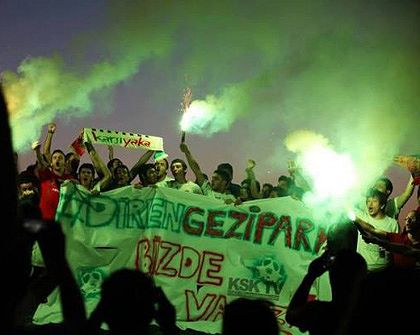 |
| [Source: occupygezipics.tumblr.com] |
The difference lies in the determination and audacity of the
protestors. The first four days saw a growing number of people, reaching
many thousands Thursday night, that is, the fourth day of action, set
up a camp each night on the so-called Promenade near Taksim Square.
Every night, in the small hours of the morning, the police attacked the
campers and dismantled their tents, burning them on the last third and
fourth nights. The protestors are trying to protect life, the life of
very precious trees right in the middle of a city with extremely limited
green area. The Metropolitan Municipality of Istanbul, under AKP rule,
has been busy preparing the ground to build a shopping mall (in the
guise of a historic building) in the place where the Promenade stands
now.
The sheer brutality of the police and some plainclothes thugs
claiming to be municipal police (it is they who burnt down the tents)
provoked the people of Istanbul to run to the aid of the attacked
protestors. Istiklal, a major artery that runs from Taksim several
kilometres south, a pedestrian zone that is the heart of culture,
politics, entertainment and lately tourism, was soon packed full of
people from one end to the other, Taksim Square itself being controlled
by the police. Istiklal resounded to chants against the government, some
going somewhat rashly as far as predicting its imminent fall.
There have been demands for some time that the Foreign Minister,
responsible for the criminal policy of the government in Syria, and the
Interior Minister, whom we call the “Chemical Muammer,” as a reference
to “Chemical Ali” of the Saddam administration, be removed from office.
The removal of the latter has now already come squarely on the agenda.
There were already unconfirmed rumours tonight that the chief of police
for Istanbul has been dismissed. Even if this were true, which is too
optimistic, this is not where the cleansing should stop!
The working-class, left forces and the youth of Turkey are coming out
of a period of extreme political passivity. But for the incessant
struggle waged by the Kurdish people, Turkey has been a desert in terms
of mass struggles for the past 15 years at least, interrupted
exceptionally by the struggle of the Tekel workers
(the tobacco and alcoholic drinks company, privatized earlier) in
winter 2009-2010, unfortunately sold out by the union bureaucracy. So it
would be rash to say that the movement is already at a point of no
return. But the spirit is definitely one of regained self-confidence on
the part of the masses. What is most important is to see how the
organized working-class will react. There have been several important
industrial actions lately. These may very well radicalize the attitude
of some sections of the working-class, including the workers of Turkish
Airlines. They have been on strike for a fortnight putting forth serious
demands, albeit with limited participation. Their central demand is the
reinstatement of 305 from among the work force, fired a year ago for a
wildcat strike protesting the partial prohibition of strikes in civil
aviation, which has always been a recognized right in the last half
century. The prohibition of strikes has had to be rescinded, but the
workers laid-off have yet to be reinstated.
More Strikes
Another strike is waiting in the wings, one with potentially
devastating consequences for the government. This is the metal workers’
strike which has already been announced (a legal precondition), but not
yet put into practice. If all the workers involved go on strike (for
legal reasons this has to be some time in the course of June), this will
amount to over one hundred thousand workers, in a sector that has
become the main export engine of the country's manufacturing industry in
recent years. Although there are immensely complicated factors to be
taken into account when analysing this potential strike, not least the
clearly reactionary political stance of the ruling bureaucracy in the
major union in the industry, the results may be dire in the context of
this explosive situation.
History seems to be aiding the popular masses of Turkey. KESK, the
Federation of Public Employees’ Unions, one of the fighting
organizations within the union movement, had already declared a
sector-wide strike for 5 June. This needs to be transformed into a
general strike, adopted by the whole union movement, putting forth
demands in the political sphere as well as voicing the considerable
grievances of the workers of different sectors and industries. The
present moment witnesses a people's revolt in the face of the arrogance
and repressive practice of the government. Should this be combined with
an insurgent working-class movement, Turkey would become open to all
kinds of revolutionary change.
It cannot be exaggerated how a revolutionary transformation of Turkey
will have a tremendous impact on the rest of the Middle East and North
Africa. Under Erdogan, Turkey has become a decisive actor in the region,
a “model ally” of the U.S., role model for the newly fledgling Muslim
governments of Egypt and Tunisia, frontline fighter for the Sunni front
established by the Saudi and Qatar kingdoms in a potentially disastrous
sectarian confrontation between the Sunni and Shiite fronts in the
region and a growing economic and military power with a hegemonic
project. The elimination of this reactionary actor and its possible
replacement by a progressive force at the helm of this NATO member will
have immense repercussions throughout the region. Solidarity with the
mass movement of Turkey will definitely be helpful to the progressive
and revolutionary agenda in the whole Middle East.
Istanbul, 3 a.m.
I have just left another central square of Istanbul, itself not far
from Taksim. The place is packed with people and thousands, even tens of
thousands of cars are still slowly moving toward that square. There
would have been nothing extraordinary about this – were it not almost
three o'clock in the morning. Ankara, the capital city, was out
protesting today as well. Izmir, the third biggest city on the Agean
sea, is still alive, with street fighting going on.
One blogger said tonight: “Well, Tayyip Erdogan, through his
arrogance, has at last united Turk and Kurd, Sunni and Alevi and
secular!” Well, this is what we have been saying all along. This was
what happened when the Tekel workers entered their two and a half month
fight. This is what is now happening on a much more gigantic scale.
This is not yet Tahrir. But demonstrations on the two continents of
Istanbul, Asia and Europe at three in the morning, that is decidedly
unusual and gives one a taste of Tahrir. This is not yet a revolution,
but it is not only tear gas that marks the air in Istanbul. It is also a
scent of revolutionary aspirations.
Sungur Savran is editor of the newspaper Isci Mucadelesi (Workers' Struggle) in Istanbul, Turkey. Source: socialistproject.ca
|





 Print This
  Print This