John Ross is a Latin American correspondent and activist who's been living in and writing about
Ross has written eight books of fiction and non-fiction and is one of the few surviving Beat poets with nine chapbooks of poetry in and out of print, the latest of which is due out soon called Bomba. He's also been called a new John Reed (who wrote the classic 10 Days that Shook the World on the Russian Revolution) covering a new Mexican revolution playing out around the country from its most indigenous, impoverished South in Chiapas and Oaxaca to the streets of its capital in Mexico City.
Ross' books include the Annexation of Mexico, From the Aztecs to the IMF and his eyewitness frontline trilogy on the Zapatista rebellion beginning with Rebellion From the Roots, Indian Uprising in Chiapas in 1995 for which he received the American Book award; The War Against Oblivion, The Zapatista Chronicles; and his latest work and subject of this review - Zapatistas, Making Another World Possible, Chronicles of Resistance 2000 - 2006 just published. Its subtitle is taken from the misnamed anti-globalization citizens' movement for global justice from
The book's theme is the heroic ongoing Zapatista struggle for autonomy and liberation as "a dramatic and inspiring effort to make this possibility a reality" matched off against a made-in-Washington world of permanent wars for conquest and domination from the sands and streets of Iraq and desolate rubble of Afghanistan to the Israeli genocidal terror war against the Palestinians to the streets of Mexico City and Oaxaca and the mountains and jungles of Chiapas.
This book comes after Ross' Murdered by Capitalism, A Memoir of 150 Years of Life & Death on the American Left in 2004 for which he received the Upton Sinclair award. Ross is a gifted writer whose prose is passionate and poetic. From its beginning, he documented the Zapatista "rebellion from the roots," and in his latest book covers it from the July, 2000 election of corporatist Vincente Fox through the mid-2006 stolen presidential election, unresolved when the book went to press. He notes like all other elections in the country, it was orchestrated "before, during, and after the ballots (were) cast" just like they are in the belly of the bestial empire in el Norte whose current high office incumbent Ross calls "an electoral pickpocket (twice over)."
He also reminds us of past events that may foretell
The Zapatistas' Chronicles of Resistance - From Its Beginning
Ross begins his book with a Preamble of the Zapatistas' own words saying: "We are the Zapatistas of the EZLN (who) rose up in January 1994 because we were tired of all the evil the powerful did to us, that they only humiliated us, robbed us, killed us, and no one ever said or did anything. For all that we said 'Basta' (enough) we weren't going to permit that they treat us worse than animals anymore." The Zapatista commentary continues saying they want democracy, liberty and justice for all Mexicans, and to get it they organized to defend themselves and fight for it. And so they have. Their spirit of resistance continues in their ongoing struggle for autonomy and freedom.
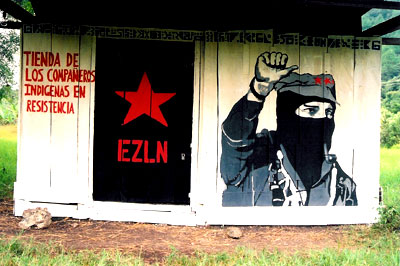
Ross begins volume three of his trilogy in year 2000, but let's go back to where it all began to understand its roots. The Zapatista Army of National Liberation (EZLN) was founded in 1983 taking its name from the Liberation Army of the South led by Emiliano Zapata Salazar, the incorruptible Mexican Indian peasant rebel leader who supported agrarian reform and land redistribution in the battles of the Mexican Revolution. It began in 1910, went on till 1921, and saw Zapata betrayed and executed by government troops in 1919. It wasn't before he got new agrarian land laws passed that for a time returned to the people what President Porfirio Diaz confiscated to sell off to foreign investors the way things work today where everything's for sale under market-based rules. It's the reason for indigenous Mexican impoverishment today the way it is everywhere and why modern-day Zapatistas began their campaign to end centuries of imperial repression to liberate their people.
They planned quietly for years learning from successes and failures of earlier peasant struggles. The were all crushed or co-opted by the ruling Institutional Revolutionary Party (PRI) showing real change in Chiapas could only come through struggle from outside the political process that time and again proved those in power can't be trusted even though the Zapatistas gave the system a chance to prove otherwise knowing it would let them down which it did. It's the way it is in all developing states and most elsewhere as well.
Ross chronicled the Zapatistas' struggle in two previous books beginning January 1, 1994 when 2,000 from the EZLN marched into
Rebellion for change erupted in the open the first day NAFTA went into effect. Zapatistas in
Their action stunned the nation and world, and President Carlos Salinas de Gortari responded ferociously against Chiapans cutting short his planned celebration. The Zapatistas weren't to be denied as they stated in their manifesto that "We are a product of 500 years of struggle...against slavery....against Spain (and then) to avoid being absorbed by North American imperialism... later the dictatorship of Porfirio Diaz (so) people rebelled and leaders like Villa and Zapata emerged, poor men just like us (so we continue the struggle for our) inalienable right (under the Mexican constitution) to alter or modify their form of government (and set up) liberated areas (in which the people will have) the right to freely and democratically elect their own administrative authorities."
They weren't alone as hundreds of thousands of supporters flooded
A single event may have inspired the EZLN's shot heard round the world launching their armed rebellion for autonomy. It was the
Repealing Article 27 changed everything for what the Revolution had "giveth," Carlos Salinas had "taketh" away by ending land distribution to the landless. His action drove a "final nail in the revolution's coffin" polarizing indigenous peoples and igniting the uprising beginning the day NAFTA became law. Rewriting the Article was a key condition of NAFTA that would henceforth deny indigenous peoples' right to the land so the state could sell or lease it to private investors (aka corporate predators), mostly from el Norte.
It meant trouble always affecting the most vulnerable poor the most. It hit
As predicted, things got much worse under NAFTA-imposed trade rules. They hit the rural poor the hardest especially the country's farmers crushed under the weight of heavily subsidized Northern agribusiness they can't compete against including for corn, "maiz," the sacred crop, the struggle for which went to the root of the Zapatista rebellion also against made-in-the-USA neoliberal new world order rules of the game rigged against them.
They include Washington Consensus market uber alles diktats that led to
The Zapatistas got hammered by it with no relief when economic conditions improved. It caused mass discontent and anger making the country ripe for rebellion as an elite few grew rich at the expense of the great majority sinking deeper into poverty and no where more than in indigenous rural areas like
The Oakland Institute think tank specializing in social, economic and environmental issues documented the harm done. Their researchers reported heavily subsidized
The worst is still to come in
Ross laid out the other ugly damage from NAFTA's first 10 years through 2003:
-- All Mexican banks controlled by foreign corporate giants, mainly from the
-- All the railroads sold off to Union Pacific with former President Ernesto Zedillo now on its board as his reward.
-- The country's mines and airlines in private hands.
-- Two million hectares of tropical forest destroyed for private development with junk tree plantations sprouting up throughout Southern Mexico controlled by corporate behemoths like International Paper and Temple-Inland.
-- Homegrown industries, especially in textiles and plastics, shut down unable to complete with US giants.
-- Even the "Maquiladora Miracle" once creating 2 million jobs on the
-- Real wages down 20% over 10 years with the disparity of wealth far greater than in 1994 when the Zapatista struggle began.
-- 600 Wal-Mart megastores crushing small homegrown retailers and Mexican chains. Wal-Mart de Mexico SAB is the country's largest private employer and biggest retailer in
-- The Mexican landscape littered with thousands of McDonald's, Burger King's, Wendy's, and other
-- The importation and consumption of genetically modified (GMO) corn presenting a clear danger to "the People of the Corn" by displacing and contaminating locally-grown varieties cultivated for thousands of years as dietary and cultural staples. The GMO poison from el Norte is now spreading like an uncontrollable infestation from indigenous cornfield to cornfield.
Add to the above, former President Vincente Fox's Plan Puebla-Panama (PPP) that so far flopped but isn't dead. He proposed it early in his term as a multi-billion dollar development scheme to turn Southern Mexico (including
The area planned for development is enormous and so far stalled. It covers 102 million hectares with 64 million inhabitants in eight countries few of whom would benefit from a scheme to exploit masquerading as infrastructure and private development and more without consent of the people the way it's always done. It's the reason the plan went nowhere - so far. It's irrelevant to the poor, rural South gaining nothing except picking up the tab so corporate predators can take their land for private gain selling back to the people what's already theirs like Chiapas' fresh water that's 40% of the country's total Coca-Cola is dying to get its hands on. It would also destroy the last significant tropical rain forest in
An Enduring Struggle for Liberation and Autonomy
The EZLN struggled to win redress for their major demands, but the Zedillo government in the 1990s reneged on a promise to address them. The key betrayal came in 1996 when EZLN leaders thought they had a deal known as the San Andres Accords. It was a landmark document based on the International Labor Organization's Resolution 169, the universally accepted benchmark for defining an indigenous people stipulating they have both territory or habitat and "territoriality" meaning they have autonomy over their own lands free from government control.
Had it passed, it would have given Mexico's 57 distinct indigenous peoples local autonomy over all aspects of their lives - agrarian policy, natural resources, the environment, health and educational institutions, judicial system, and their overall social and cultural rights. It needed to be legislatively approved by changes in state, federal, local laws and the Mexican Constitution committing the government to eliminate "the poverty, the marginalization and insufficient political participation of millions of indigenous Mexicans." But like before and always, it wasn't to be as PRI President Zedillo, an "inflexible globophile" and technocratic servant of empire, upheld Mexico's business as usual mal gobierno (bad government) dark forces reneging on the deal as fast as he could unleash Mexican army troops against the people of Chiapas stepping up his "dirty war" on them to undermine their popular support and end the EZLN rebellion.
"PRIista" Zedillo failed, biting off more than he could chew, because the Zapatistas then and now aren't giving up their struggle or going away. Their response was a greater effort to mobilize broader support throughout the country. In 1999, the collective Zapatista Revolutionary Indigenous Clandestine Committee (CCRI) leadership made up of 23 commanders and spokesperson Subcommandante Marcos organized a national consulta, or referendum, for indigenous rights and implementation of the San Andres Accords that were signed in 1996. More than three million Mexicans participated with 95% of them endorsing the EZLN's demands providing the kind of mass support hard to ignore.
In December, 2000, National Action Party's (PAN) Vincente Fox (and former Coca-Colaista big cheese) had to address it. He shook Mexico's political firmament in the July elections becoming the country's first president able to end the PRI's stranglehold single party 71 year rule under a system known as "Presidentialism." After taking office, he arrogantly promised to cut the Gordian knot deadlock with the EZLN and would meet with Subcommandante Marcos to "fix things up in 15 minutes" by committing to submit the San Andres Accords or La Ley Cocopa Indian Rights Law to Congress for resolution where almost for certain they'd be none.
Still, the Zapatistas and their supporters went on the road for it for 16 days going from
La Otra Campana - The EZLN's Other Campaign
The Zapatista's Other Campaign grew out of the organization's Sixth Declaration of the Lacandon Jungle (the Sexta) issued June, 2005 calling for a new approach outside traditional party politics the EZLN rejects because it doesn't work for ordinary people. The idea was to build a grand alliance of all jodidos (the "screwed" over people) to include Indians and the "real left" to join in solidarity from the bottom up outside the political process and call a constitutional convention to write a new anti-neoliberal document protecting the nation's land and resources as well as enact an Indian Rights law.
The Other Campaign went on the road to all parts of the country during the 2006 electoral period working outside the political process withholding support for opposition Party of the Democratic Revolution (PRD) presidential candidate and ex-PRIista Andres Manuel Lopez Obrador, popularly known as ALMO.
Ross calls him El Peje, his nickname, noting while serving as Mexico City's popular mayor he eschewed ostentation; provided essential social services for the people like free milk for young mothers; shelters for the homeless; and jobs for tens of thousands. He also cut deals with the business class from Mexico's Council of Businessmen (CMHN) made up of the country's 37 richest men like he did with billionaire tycoon Carlos Slim showing he was a "demon in disguise, a demagogue, (a) dreaded politician. A danger, in short, for
Working through the system always turns out the same. The dominant PRI and PAN are
Ross' criticism is even harsher calling the PRD "mortally flawed, venomously venial and vulnerable to splintering into brittle battle over scraps of power." In his judgment, if ALMO became president (he didn't, but it was unresolved at press time), the dominant business class, Washington, and even the Church would slap him down each time he proposed overly generous crumbs. And if he managed doing more than thought possible, Ross adds an exclamation point - "Think Salvadore Allende" who was no match for Nixon-Kissinger the way a Mexican progressive today would be out of his league against the demon-duo Bush-Cheney, even meaner and nastier than their uglier-than-sin predecessors.
They don't daunt the EZLN's 13 year resolve against mal gobierno, running strong and gaining strength with the Other Campaign continuing throughout 2006. It's still ongoing in the new year with the country now under PAN president-by-mass-electoral-fraud Felipe Calderon. Ross will pick up the story in his next book, sure to come, continuing his chronicle of rebellion for a better world Zapatistas are in the vanguard for.
La Otra Campana grew out of planning meetings and is comprised of many thousands of supporters including Indians, farmers, workers, social movements, NGOs, autonomous collectives, all groups on the left and all others willing to join a social movement for change. The plan was to take Subcommandante Marcos (who's mestizo, not Indian) and a 16 member Sexta commission on a six month barnstorming blizzard, beginning January 1, 2006, to all 31 Mexican states to meet and listen to a diverse range of people, groups and organizations. They want their ideas as input to use toward building broader support toward the goal of real change in a country stultified by decades of corruption and mass exploitation.
This was the fifth time the Zapatistas left their
The Other Campaign aims high continuing into 2007. It calls for enacting a new constitution barring privatization of public resources and getting rid of the whole array of neoliberal poison served up by Washington-controlled international lending agencies and WTO one-way "bunko game" free trade deals unmasked as unfair. It also wants indigenous autonomy for
The Other Campaign is still ongoing aiming toward its longer range goal for a new constitution with regional autonomy run from the bottom up outside the political process it wants no part of. Today the EZLN is the most interesting, radical and important grass roots democratic movement in the world. Subcommandante Marcos believes new fraudulently elected Mexican president Felipe Calderon "is going to start to fall from his first day (December 1 and) we're on the eve of a great uprising or civil war." He believes the Mexican people will join him in "spontaneous uprisings, explosions all over, civil war" the way it's gone on uninterrupted in
It's the way all social revolutions take root that begin from a committed core, then broaden into a unified network of mutual support for real democratic change. The spirit of resistance is alive in
It isn't easy, and since early 2007 Zapatista communities have been up against increasing opposition from a government-allied paramilitary group called the Organization for the Defense of Indigenous and Peasant Rights (Opddic). It uses threats of violence, land invasions, crop thefts, beatings and kidnappings to expropriate Zapatista land so private developers can exploit natural resources and develop large tourist projects. Opddic has been around since the late 1990s but grew more powerful while Vincente Fox was president. Its present activities signal what's ahead from the Calderon government's policy to seize Zapatista land, weaken the movement, and give corporate predators an open field to develop the land indigenous Chiapans claim as their own.
Zapatistas say they'll defend their lands against Opddic incursions but up till now have avoided violence. That may not last as attacks continue that may be intended to provoke a response strong enough to set up the ominous possibility the government may step in with force making things very ugly.
It won't step in to help the Chiapas-based
Ross ends his current chronicle in 2006 where it began - in
Stephen Lendman lives in
Also visit his blog site at sjlendman.blogspot.com and listen each week to the Steve Lendman News and Information Hour on The Micro Effect.com Saturdays at noon US central time.
4 comments:
-
I think Stephen Lendman is a great writer.
Nice blog, btw...I read your Milion Deaths post yesterday...
Thank you,
-Alice -
Jason has a real tender spot for this little section of the universe. The defeat of the poor Aztecs rates high on his list of tears. I feel sorry for Mexico too. I wish I could send it to a better place in the universe free of charge. Some place where the old men of Mexico on streets could pinch all the young teen butt they wanted to and some place where they could date all the 13 year olds they desire. Even a place where a woman's place is still barefoot and knocked up. Not that that is really unnatural - not according to the last 70,000 years of mankind's existence. Its just that we northern folk (in the last 80 years) got it into our heads that 18 years old should be a good starting place for all that stuff, at least in regards to our own older men.
Yes, I lay awake at night and worry about the way the USA stole most of the West from Mexico, and paid them $10 million. And as soon as they can pay us back that $10 million, adjusted for inflation of course, I will be the last person to suggest that we should send American panzer divisions and nukes to retain the Southwest.
Actually let them just have it - most of them are better family people (butt pinching aside) than a whole barrel of our Saxon and Viking population. Maybe we should just give the Southwest back to the Indians here. Yeah, and give Mexico back to the Indians there, and send all the Spanish back to Spain and send all the Nordics back to Europe, and leave the Celts here – since their cool.
Anyway you cut this, I smell ethnic cleansing. Left to itself I believe the Saxons, and Vikings will melt away anyway - in 200 years tops. Of course everyone will melt away in 200 years. Or the new GMO humans will do away with all of us Homo sapiens. What will the Mexican Indians do when the GMO people arrive - with cat night vision, eagle sight, canine olfactory nerves, ape muscles, blue, purple, and red iris', and skin in multiple shades that can alter in color to advertise their favorite products or vulgar philosophies. What will they do then - in the year 2045?
http://civillibertarian.blogspot.com/2007/03/review-of-john-ross-zapatistas.html