When Venezuela nationalized the country's petroleum resources with proven reserves that exceed those of any other country in the world, we watched as other oil corporations in Venezuela accepted the generous offer given them by the Chávez administration. Exxon-Mobil refused to cooperate, demanding that it continue to strip the Venezuelan people of their oil as they have done in decades past. They have taken the Venezuelan government to foreign courts, attempting to freeze their assets abroad. Rafael Ramirez, Venezuela's Oil Minister, called Exxon's action, "judicial terrorism" and replied that these foreign court actions, "don't have any direct affect over our operations, over our assets".
In an article yesterday titled, Court Bars Sale of Billions in Oil Assets by Venezuela, the New York Times boldly declared:
"The oil giant Exxon Mobil has won court orders freezing as much as $12 billion in petroleum assets controlled by Venezuela’s government in an escalation of a dispute over efforts by President Hugo Chávez to assert greater control over the country’s oil industry." (full NYT article at bottom of page)
The statement is not true just as the NYT title of the article is not true. The government of Venezuela quickly responded with the first article, republished below. Throughout the NYT article, words are parsed, painting another picture of a failing Venezuelan economy and government. We have lifted a few examples from the NYT article and added our emphases on words we believe are meant to skew the truth:
"The oil giant Exxon Mobil has won court orders freezing as much as $12 billion in petroleum assets controlled by Venezuela’s government in an escalation of a dispute over efforts by President Hugo Chávez to assert greater control over the country’s oil industry."
"Mr. Chavez's government ... could face a protracted legal battle with Exxon preventing the government from raising cash through the sale of refineries abroad if the economy here slows after years of torrid growth. "
"Investors are also increasingly concerned about the financial health of the national oil company, Petróleos de Venezuela, amid reports that its debt is ballooning as its output declines."
"“This is a big blow against Venezuela,” said Pietro Pitts, an oil analyst who publishes Latin Petroleum, an industry magazine based here. 'It could set an important precedent for other multinationals threatened by Venezuela’s government'.”
And the Venezuelan government flatly denies the opening statement by NYT (again):
"In recent days, Exxon won a court order from the High Court of London prohibiting Petróleos de Venezuela from selling assets worldwide up to a value of $12 billion, Margaret Ross, an Exxon spokeswoman in Houston, said in a statement. Exxon won similar orders in the Netherlands and the Netherlands Antilles for assets worth up to $12 billion."
In fact, what has been frozen is $300 million in a New York court and even this is subject to any of a number of the powerful responses available to PDVSA, Venezuela's national oil company.
Once again, the corporate media has attacked the government of Venezuela with half-truths and innuendo. We have often observed that the capitalist-based attacks almost always declare what President Chávez will do in the future, predicated on their half-truths or outright deceptions. But rarely do they report on the positive things Chávez has already accomplished for the Venezuelan people, including lifting millions out of illiteracy and poverty, a booming economy and strong currency (the Bolivar) and formation of coalitions of Latin American countries for independence from foreign control.
The NYT article works hand-in-hand with the capitalist courts to reinforce the corporate media mosaic. The mosaic is fabricated to convince the world that Venezuela has a weakening economy, despite 16 quarters of 11.5%+ growth, to malign Chávez and demoralize those who support his administration. The NYT and other corporate media are obviously concerned first and foremost in advancing the anti-Chávez agenda, not in reporting "the truth, the whole truth and nothing but the truth".
-Les Blough, Editor
* An Axis of Logic reader cites an article written in Spanish on Apporea (Economista de Deutsche Bank considera que Exxon Mobil muestra debilidad en negociación)
The reader writes the following note:
"The compensation situation between PDVSA and Exxon-Mobil is due to go to an international arbitration court later this year. If this is the case why did Exxon-Mobil try to freeze PDVSA assets abroad? The NYT article does not mention this and it would appear that the legal action taken by Exxon-Mobil is indeed "hostile". According to the economist of Deutsche Bank, Exxon-Mobil's case is weak since other international companies negotiated deals with PDVSA."
Venezuela denies oil asset freeze
BBC, February 8, 2008
Venezuela took over the oil project as part of a nationalisation drive.
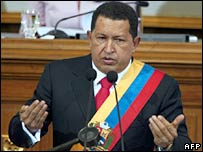
Venezuela took over the oil project as part of a nationalisation drive. (photo: afp)
Venezuela's state-run oil firm has denied that US oil giant Exxon Mobil had won a court order to freeze up to $12bn (Ł6bn) of its assets. PDVSA said that while it accepted that $300m in cash had been frozen, this was only a "transitory measure".
Exxon has been fighting for monetary compensation since Venezuelan President Hugo Chavez seized its stake in heavy oil projects in the country last June.
Arbitration between the two firms is due later this year.
Oil Minister Rafael Ramirez accused Exxon of "judicial terrorism" but said the court actions "don't have any direct affect over our operations, over our assets".
An Exxon spokeswoman said the firm had no comment on Mr Ramirez's comments.
'Proven reserves'
Venezuela took over the oil project as part of a nationalisation drive.
President Chavez's government took control of exploration projects in the Orinoco Belt, which had been among the last privately-run fields in the country.
Exxon has taken action in New York, London and the Netherlands challenging the terms of the nationalisation.
It has not said how much compensation it wants for the 41.7% stake in the Orinoco Belt oil field - worth an estimated $750m (Ł370m).
The Orinoco Belt is the country's most important oil area, with massive potential.
There are proven reserves of at least 80 billion barrels, but there could be enough there to make Venezuela the world's biggest source of oil.
Four major companies - US-based Chevron, the UK's BP, French group Total and Norway's Statoil - accepted the government's move.
Only Exxon and ConocoPhillips refused to accept the terms of the deal, which made them junior partners in the project, by the June deadline.
http://news.bbc.co.uk/2/hi/business/7235653.stm
Court Bars Sale of Billions in Oil Assets by Venezuela
By Simon Romero
Published: February 8, 2008
CARACAS, Venezuela — The oil giant Exxon Mobil has won court orders freezing as much as $12 billion in petroleum assets controlled by Venezuela’s government in an escalation of a dispute over efforts by President Hugo Chávez to assert greater control over the country’s oil industry.
Venezuela’s dollar-denominated bonds suffered their steepest drop in six months on Thursday on concerns that Mr. Chávez’s government could face a protracted legal battle with Exxon, preventing the government from raising cash through the sale of refineries abroad if the economy here slows after years of torrid growth.
Investors are also increasingly concerned about the financial health of the national oil company, Petróleos de Venezuela, amid reports that its debt is ballooning as its output declines.
The oil company is the largest single source of revenue for Mr. Chávez’s government, financing an array of social welfare projects and foreign aid to leftist allies.
“This is a big blow against Venezuela,” said Pietro Pitts, an oil analyst who publishes Latin Petroleum, an industry magazine based here. “It could set an important precedent for other multinationals threatened by Venezuela’s government.”
After Mr. Chávez’s move to take control of large oil ventures last year, Exxon dug in for a fight. While Chevron and other companies accepted the terms imposed by Mr. Chávez, Exxon aggressively sought to prevent Venezuela from transferring control of foreign-based oil assets to entities here ahead of arbitration proceedings.
In recent days, Exxon won a court order from the High Court of London prohibiting Petróleos de Venezuela from selling assets worldwide up to a value of $12 billion, Margaret Ross, an Exxon spokeswoman in Houston, said in a statement. Exxon won similar orders in the Netherlands and the Netherlands Antilles for assets worth up to $12 billion.
And in New York, Exxon won an order freezing $300 million of Petróleos de Venezuela’s assets. Despite a deterioration of political relations between Caracas and Washington, Venezuela remains a major trading partner with the United States, ranking as its fourth-largest supplier of imported crude oil.
Venezuela’s government also controls Citgo Petroleum of Houston, which operates refineries in Illinois, Louisiana and Texas.
Mr. Chávez’s government has compensated American companies in previous nationalizations of their assets when it was faced with the possibility of losing control of Citgo and other foreign assets in retaliation.
A spokesman for Petróleos de Venezuela did not return calls seeking comment. The company is expected to appeal the rulings. The dispute may raise borrowing costs for Petróleos de Venezuela, which is being reconfigured by Mr. Chávez to focus on pressing social concerns.
http://www.nytimes.com/2008/02/08/business/
worldbusiness/08oil.html?_r=1&ref=americas&oref=slogin