Editor's Note: Who can forget those amazing 48 hours in Venezuela 6 years ago when the U.S.-backed opposition in Venezuela, attempted to overthrow democratically-elected, President Hugo Chávez Frias, killing people in the streets of Caracas and kidnapping the president? During the weekend past, the people of Venezuela again memorialized April 11-13, 2002 in demonstrations across Venezuela. Raw footage of the failed coup D'État blanketed the television screens of popular stations like TeleSur, VTV, Vive TV and ANTV.
This weekend, as we sat in the living rooms of Chávistas who represent the majority of Venezuelanos, our friends pointed out that the private TV stations were a different story. With the exception of Globovision which briefly presented a skewed version of the April, 2002 events, the abundant private, anti-Chávez stations still in operation continued to push values spawned in Hollywood and New York throughout the weekend. Their normal broadcasting of superficial entertainment, soap operas, game shows and "news" propaganda did not give place to the most important event in Venezuelan history since Bolivar.
The failed coup of April, 2002 was a time when Venezuela and the world turned a corner, revealing the true force of "el pueblo". Neither, Venezuela nor the world has been the same since. For the first time in centuries, the world saw that the people are capable of confronting, condemning and continuing a revolution that has stopped the U.S.-led empire from achieving its imperialist objectives. Since then, the engine of the Bolivarian Revolution has been "deepened" as President Chávez promised when he was again elected in his last landslide victory at the polls.
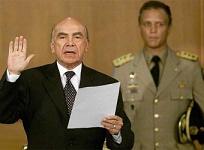
Pedro Carmona, then president of Fedecamaras, sworn in to replace President Chávez on the day of the coup. Fedcamaras is Venezuela's Federation of Chambers of Commerce.
In the article by Dexy García (below), read about the damage done by the opposition and about what they tried to do via the infamous, "Carmona Decree". Through their sheer arrogance and outright stupidity on April 11, 2002, the beast was fully exposed but none of their deceptions since then can change their true nature. Obtain the now-famous videos that depict their actions and the response of the people in April, 2002 from Axis of Logic.
The Bolivarian Revolution continues to develop socialist programs for the people - programs that succeed in spite of the ongoing attempts to infiltrate, undermine and attack this South American democracy. The revolution continues to spread to other Latin American countries through ALBA, TeleSur, PetroSur, Banca del Sur and other international programs. It now brings in trading partners and industrial and commercial development from the Middle East, Asia and Europe and the Venezuelan economy has never in history been this strong. While the imperialist dangers to the revolution are many and not to be taken lightly, the revolution's head of steam continues to build and there are no signs of stopping this extremely well-organized revolution of the people. ¡Avancé!
- Les Blough, Editor
|
|
|
Pedro Carmona (back shown) and Carlos Fernandez in a victory embrace immediately following the ill-fated April 11, 2002 coup d'état. At the time, Carmona was president and Fernandez, former president of Fedecamaras. Fernandez is now a fugitive from justice in Florida. |

Originally published on April 9, 2008
Pro-opposition sectors continue resorting to the so-called reasons that led to the April 2002 coup d’État, as we can see in the so-called “Carmona Decree”, whose content justified this action by using accusations such as: support of the Venezuelan government to the FARC, attacks to freedom of expression and violation to human rights and property.
April makes the Venezuelan people remember the failed 2002 coup d’État, which became a chapter of our recent history.
Events
Strong demonstrations and a general indefinite strike called by Fedecámaras (Venezuela’s Business Chamber) were the prelude to April 11, 2002, a date remembered for the Dantesque events known as The Massacre of Llaguno Bridge (bridge located two blocks east from the Miraflores Presidential Palace).
On April 11, 2002, Venezuelan pro-opposition leaders, concentrated at the offices of the Venezuelan state-run oil company PDVSA in Chuao (Caracas’ East), called a rally that was later detoured to the Miraflores Presidential Palace, (Caracas’ downtown), where Chávez followers were concentrated.
The final result was the killing of nearly 20 people, a coup d’ État, and the self-proclamation of businessman and president of Fedecamaras, Pedro Carmona Estanga, as the President of the Republic.
Opposition political parties, private media, members of the Catholic Church’s hierarchy, the Venezuelan Workers’ Confederation (CTV, Spanish acronym), businessmen and women, and representatives of the military were involved in the development of these events.
So far, some people endorsing the “Carmona Decree” denied their participation though Venezuela and the world saw them on TV backing with their presence in Miraflores the first dictatorship they tried to impose in the country since 1958.
Faults
The Decree details an array of false arguments that helped them establish a dictatorship. Each argument was based on the alleged culpability of President Hugo Chávez:
The dead
“Considering that yesterday, April 11, 2002, a date that will be remembered with deep indignation and national mourning, violent events unfolded in the city of Caracas due to orders given by the government of Hugo Chávez to attack, repress and assassinate innocent peaceful demonstrators near the Miraflores Presidential Palace, thus committing serious human crimes against the Venezuelan people.”
Alleged violation of freedom of expression
“Considering that Hugo Chávez and his government have systematically lessened human rights guaranteed in the 1999 Constitution and international treaties, pacts and agreements related to human rights ratified by the Republic, up to the point that the Inter American organizations protecting human rights have received – as never before – so many denounces based on the violation of these rights in the last three years, particularly denounces related to the right to life, due process, freedom of expression and information and the right to information.”
Alleged Violation of Private Property
“Considering that Hugo Chávez and his government has promoted and incited crimes by promoting all kinds of violations to private property, and obstructing investigations and sanctions to civilians and military officers following the regime and that have committed crimes against the State in a flagrant violation to the principles of the Rule of Law and opposed important elements of democracy such as transparence in the government’s activities , integrity and responsibility regarding public management.”
Social Confrontation
“Considering that Hugo Chávez and his government irresponsibly promoted a climate of social violence, opposing national unity, democratic pluralism, respect to democratic values and principles, as well as all the institutions and sectors of the Venezuelan society.”
Alleged Support to the Revolutionary Armed Forces of Colombia (FARC)
“Considering that Hugo Chávez and his government have drawn up and executed a foreign policy opposed to the high economic, political and social interests of the country; which caused an exclusion of serious consequences for Venezuela; keeping an ambiguous management before the international terrorism scourge and developing irrefutable links with the Colombian narco- guerrilla.
Alleged resigning
“Hugo Chávez presented yesterday his resign to the charge of President of the Republic before the High Command of the Army; and the Vice-president of Venezuela abandoned his workplace; which represents a constitutional emptiness of power aimed at re-establishing democracy and fill in the emptiness of power so the government can adapt to the constitutional demands and principles established in the Inter-American Democratic Chart.”
Wishes come true
The aforementioned allegations made the protagonists and ideologists of the coup d’État decline the will of millions Venezuelan people by revoking the Constitution of the Bolivarian Republic of Venezuela, as a result of a consensus of the majority.
The so-called “Decree of Carmona” established to from a transition government which designated Carmona Estanga as President.
These measures, that were immediately applied, were intended to give back the social, political and economic privileges to the old group of power. These measures were: revoking the Constitution approved by a referendum including its 48 laws created by enabling law; suspension of the Parliament’s deputies, who were democratically elected; the Attorney General and the General’s Comptroller, as well as the change of the official name of the country (Bolivarian Republic).
By revoking laws they tried to revert the progresses of the fight against the large state and control PDVSA.
Total support
The decree was signed by persons involved with the Church, the Armed Forces, politicians, entrepreneurs and NGO’s members, among others.
The current governor of Zulia state (northwest) and pro-opposition presidential candidate in 2006, el social-democrat Manuel Rosales; María Corina Machado, president of the SUMATE organization; the former governor of Táchira state (southeast), the social-Christian Sergio Omar Calderón; el politician and professor José Vicente Carrasquero, manager of the Rosales’ presidential campaign in 2006; the deceased Cardinal Ignacio Velasco; Carlos Fernández, former vice-president; Miguel Ángel Martínez, executive of private media; Julio Brazón, former president of CONSECOMERCIO (Trade and Service National Council); Ignacio Salvatierra, former president of the Union Bank and the Bank Association of Venezuela, and Luis Henrique Ball, former president of the Business Council of Venezuela-USA.
Some truths that they want to hide today
President Chávez was accused a priori for the people who died in the march: they did not even mention the participation of the Metropolitan Police (PM at that moment, this police was ruled by the Metropolitan Major’s Office, led by pro-opposition major Alfredo Peña) and the snipers.
The media, basing on the manipulation of images, showed “their version” of what happened in Llaguno Bridge, and accused a group of people aligned to the government for the deaths.
Months later, thanks to the videos and photographs of independent reporters, the truth emerged.
Otto Neustadtl admits manipulations of his videos
The Peruvian journalist Otto Neustadtl was working at CNN en Español in Venezuela: months after the coup d´État he was invited to a forum on journalism in the Universidad Bicentenaria de Aragua (Bicentennial University of Aragua) Aragua state (weast of Caracas).
In this event, he told his story about the coup d’État. He explained that on April 10th he received a phone call (later on he did not say who called him) and he was told: “Otto: tomorrow 11, there will be a video of Chávez, the march is going to Miraflores Presidential Palace, there will be some deaths and there will also be a group of 20 military members asking for the resigning of the President (…).”
Tomorrow morning, Neustadtl relates, they tell me: “We don’t know anymore if there are 20 military or more who are going to show themselves against Chávez; but it’s still an important number of high officers who are going to ask Chávez to resign; and everything is as it was programmed: there will be a video, some deaths, military will speak.”
Once this video was showed in Neustadtl’s conference in Maracay, he said that the audio-visual material had been manipulated by the government in order to give their opinions a political side. Nevertheless, he ratified the facts he narrated in the university.
During his confessions and the planning of the number of deaths and the detour of the pro-opposition march from Chuao towards Miraflores on April 11; he also mentioned a person who was responsible of transcribing the communiqué through which some military demanded President Chávez to resign.
In fact, the communiqué was read by the Vice-admiral Hector Ramírez and on April 12 he was named Defense Minister of Carmona Estanaga government. “I was with these persons, with the people who showed themselves against President Chávez, I stayed with them at least for two hours before the deaths started,” he said.
Neustadtl narrated that the conversations he heard while being with them. “The things I heard among them: “Has the building been controlled? Yes, it’s done. Do we take planes out? No, don’t do that since we need the people in the streets. I had recorded the proof, but unfortunately I don’t have it anymore. By that proof you can see that they talk about deaths when there are not.” (i.e. They talked about the deaths before the deaths occurred, which shows that they were planned by the opposition.)
By: Dexy García / dgarcia@minci.gob.ve / MinCI