(2 news articles below)
Venezuela’s Unemployment Declines by 7.6% in 8 years
 |
Current unemployment rate is 7.6%. It was 15.2% in February 1999. Such drop is in keeping with the last four years of economic growth.
The unemployment rate in the Bolivarian Republic of Venezuela has declined 7.6% since February 1999 according to an analysis made by economist César Aristimuńo, based on figures issued by the National Institute of Statistics (INE, Spanish acronym), and published on April 29, 2008.
The INE’s figures show that Venezuela’s unemployment rate has dropped 7.6% since February 1999, when it was 15.2%.
According to Aristimuńo, if we analyze the unemployment rate until now, we will see that January is the month with the highest unemployment rate (except in 2003, when February was the month with the highest unemployment rate) since most of the companies take vacations once Christmas is over, and many people provisionally employed are fired once they contract expire.
“December is precisely the month with the lowest unemployment rate since businesspeople hire more people in order to increase their sales at Christmas, a season when people use a great part of their money to buy goods and services,” stressed Aristimuńo.
According to he Venezuelan economist, the year 2003 has been the year with the highest unemployment rate due to the oil boycott. In 2003, the average annual unemployment rate was 17.8%, and February registered the highest rate (20.7%), while December registered the lowest rate (14.6%).
Meanwhile, the year 2007 has been the year with the lowest unemployment rate (8.5%), being January the month with the highest rate (11.1%) and December the month with the lowest (6.2%).
According to Aristimuńo, we must not forget that Venezuela has shown a strong economic growth for four consecutive years: 17.9% in 2004, 9.4% in 2005, 10.3% in 2006 and 8.4% in 2007, resulting in a higher employment level in the country.
In this sense, he explained that the term “unemployment” includes those people aged 15 years or above (15+) currently seeking work or available for work, but not working.
Finally, he highlighted that population above 15 is divided in two groups: working or work-seeking population and non-working population such as students, housewives, pensioners, and disabled people.
Bolivarian News Agency (ABN)
Ministry of Communication and Information (MINCI), Caracas
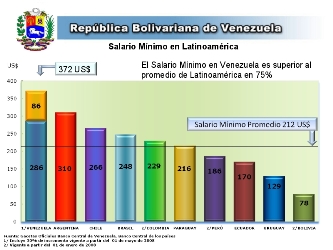 |
| The latest 30% increase in minimum wage places Venezuela ahead of Argentina, Chile, Brazil and Colombia (listed in that order in the graph). |
A 30 percent raise came into force on May 1 and it will reach 5 million workers and 1.2 million pensioners. Expropriation of Venezuela’s largest steelmaker, Sidor, becomes official.
The President of the Bolivarian Republic of Venezuela, Hugo Chávez, raised Venezuela’s minimum wage by 30% on May 1, 2008.
During a national broadcast, the Venezuelan president also announced that all public employees’ wages will be increase by 30% and the salary scale will be adjusted. This event also included the swearing-in ceremony of the new Minister of Popular Power for Work, Roberto Hernández.
On this occasion, this raise gives Venezuela the highest minimum wage in Latin America and increases it from US $ 285 to US $ 372. President Chávez said such raise is justice and will include workers from both the Venezuelan public and private sectors in rural and urban areas.
”We’ll defeat inflation, but not at the expense of workers,” he stressed.
Venezuelans’ minimum wage moves from the second to the first place in Latin America, whose minimum wage average is US $312. In addition, Venezuelan workers earning minimum wages also receive US $186 in food stamps.
The monthly minimum income of Venezuelan workers will total US $558, which is 2.6 times higher than the average minimum wage of any worker in the region.
President Chávez explained that the Venezuelan State will invest over US $ 2.5 billion in this move, thus benefiting 5,333,726 workers representing 20% of the Venezuelan population.
He added that in the public sector 328,288 administrative employees and workers providing technical support; 268,569 professionals and technicians and 168,411 workers, as well as 1.2 million pensioners, will be benefited.
”I think I have the morals to ask the country’s workers to join the construction of the Bolivarian socialism,” said President Chávez.
Sidor joins public sector
At the same event, President Chávez signed a Decree that orders the nationalization of the largest Venezuelan steelmaker Siderurgica del Orinoco (Sidor, Spanish acronym), which was privatizwed in 1997 and controlled by the Italian-Argentinean company Ternium.
In this regard, he assured the Bolivarian Government has followed all the legal procedures regarding this measure.
“Sidor has been recovered by the Venezuelan government. Let’s turn Sidor into a socialist company, belonging to the socialist State and workers,” highlighted the Venezuelan president.
Sidor, located in Bolívar state (Venezuela’s southeast), has a payroll of 4,500 workers, produces 85% of the Venezuelan steel and is the most important steelmaker in the Andean and Caribbean regions.
Presidential Press Office