 |
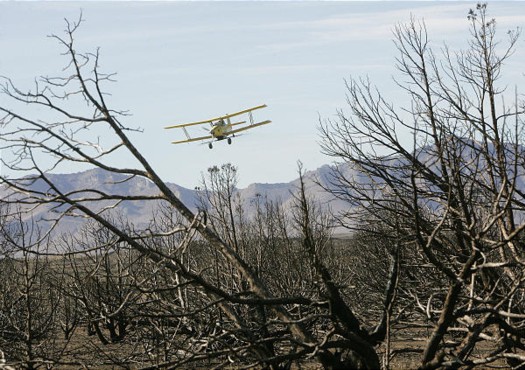
| A crop plane flies over a burned area of the Milford Flat Fire near Cove Fort, reseeding the area. |
SALT LAKE CITY (Deseret News) - Global warming and past forest management are making forests in the western United States more susceptible to fire, while large wildfires, like two in Utah last year, are blamed for making climate change worse and putting unnatural stress on ecosystems, according to a report released Thursday.
In the National Wildlife Federation's 2008 "Increased Risk of Catastrophic Wildfires: Global Warming's Wake-Up Call for the Western United States," the report claims global warming is increasing the risk of fires via rising temperatures, drier conditions, more lightning from stronger storms, added dry fuel for fires and a longer fire season.
Those factors, combined with "decades of fire suppression that allowed unsafe fuel loads to accumulate, severe bark beetle infestations that are rapidly decimating trees, and ever expanding human settlements in and near forests, the result is increasing vulnerability to major fires," the report states.
During a teleconference Thursday, National Wildlife Federation climate scientist Amanda Staudt said the number of wildfires has increased fourfold each year since the mid 1980s. Their impact on global warming is considered significant throughout the country and in Utah.
Last year's 363,000-acre Milford Flat fire alone, for example, burned for about two weeks in July and is estimated to have released into the atmosphere more than 186,400 tons of carbon dioxide, or CO2, considered the most abundant of greenhouse gas emissions impacting climate change."I think CO2 emissions from fires are significant," said Brock LeBaron, technical analysis manager for the Utah Division of Air Quality. "It's something that needs to be considered in greenhouse gas emissions inventory as we go forward."
Comparatively, the DAQ reported that in 2005, vehicles on Utah roads emitted about 15.1 million tons of CO2 (methane gases are factored into that amount) into the air throughout the state. There is a developing regional effort by members of the Western Climate Initiative who are calling for more regulation of carbon emitters, including industrial polluters.
Watchdogs say hotter and longer summers in the West aren't helping matters.
University of Montana College of Forestry and Conservation's Steven Running said during the teleconference how forests are starting their summer "dry down" early in the spring, melting away snow that he called "the best fire retardant ever invented." He recalled a wildfire that burned near Billings last January. Summer rains throughout the West, however, are doing little to hydrate forest ecosystems, while areas that have burned don't get enough water and come back as grasslands or landscapes defined by shrubs.
Missoula-based National Wildlife Federation regional executive director Tom France on Thursday said there needs to be more efforts to keep people from increasing the wildland-urban interface.
"Unfortunately, many of our policymakers don't seem to have taken that message to heart," France said. "We need to be looking at new policies that look to reduce the human footprint in forest landscapes."The trend is that more structures are being claimed by wildfires, according to San Bernardino City Fire Department disaster preparedness coordinator Don Feser. "It's not just California that's experiencing these problems, it's throughout the western United States," he said.
Among recent fires listed in the report, Utah's 2007 Milford Flat fire is mentioned, noting how it cost $4 million to fight the blaze that burned 363,000 acres. The report does not mention last year's Neola fire, which burned more than 43,000 acres in Utah.
This year's wildfire season in Utah has been comparatively mild, but in California this year alone, more than 1 million acres has burned, and there has been, so far, $300 million in state lands costs.
Although naturally occurring fires can be beneficial to forests and grasslands, the report notes that drought-fueled wildfires can "dramatically" alter habitat for fish and wildlife.
Forests do a fine job of accruing carbon dioxide, and in the 1990s they removed one-third of the global warming pollution released into the air during those 10 years, the report states. Catastrophic wildfires like those listed in the report, however, release "tremendous" amounts of CO2 into the atmosphere, requiring decades before enough forest can grow back and provide the same benefit again.
The National Wildlife Federation recommends that policymakers, industry and individuals "take steps to reduce global warming pollution from today's levels by at least 2 percent each year and by 20 percent by 2020. Science tells us that this is the only way to hold warming to no more than 2 degrees Fahrenheit in the next century."The group's report also advises jump-starting forest regrowth after catastrophic fires that leave an area susceptible to wind- and rain-driven erosion.