 |
|
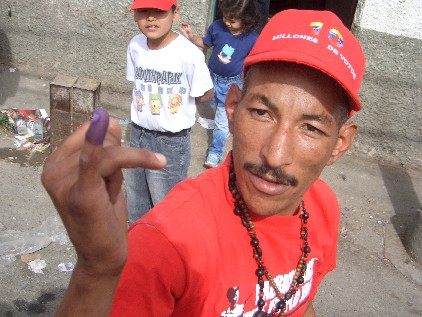
A Venezuelan voter in Barrio Petare, Caracas, lets us know |
Stay tuned to Axis of Logic for up-to-date Election Results!
Embassy of the Bolivarian Republic of Venezuela
Press Office / November 20, 2008
Over 130 international observers to monitor regional elections in Venezuela
Nearly 17 million Venezuelans will be able to exercise their right to vote on Sunday, November 23rd, in regional elections to select governors, mayors and members of legislative councils. The National Electoral Council (CNE) reported that over 130 international election observers from the Americas, Europe, Africa and Asia are already in Venezuela.
Germán Yépez, Director of the CNE, emphasized the role of international observers, who will be able to learn about “everything the Electoral Branch has done in terms of audits, from reviews of the electoral registry to those conducted on the data transmission system, which took place well before the elections and during a voting simulation. This process allows us to test the whole system; in other words, it is a complex testing process.”
CNE officials noted the increase of female participation in these elections; women make up 49.75% of candidates this year, compared to 18% in 2004. This is the result of initiatives promoted by the electoral agency that established that approximately half of the candidates must be women.
Members of opposition parties have recognized that Venezuela’s electoral system is trustworthy and functions as it should.
In the past five years the CNE has increased the number of polling centers by 38%.
Venezolana with her child in Barrio Petare, pleased
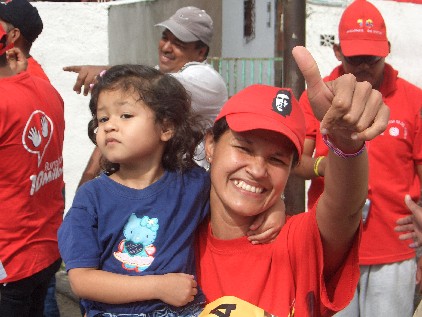
with the process and her vote in the last referendum.
(Photo: Axis of Logic)
All Your Questions Answered
about Venezuela's November 23rd Regional Elections
Fact Sheet
On November 23rd, 2008, Venezuelans will vote in regional elections to elect governors, mayors and members of state legislative councils. Regional elections are held every four years and candidates elected on the 23rd will serve from 2008 to 2012.
Over 4,000 candidates are running for 603 positions, including 233 legislative council seats, 328 mayoralties and 22 governorships.1
Legal Framework
Electoral norms and regulations are primarily established in the Organic Law for Suffrage and Political Participation. This law is designed to guarantee the adequate functioning of the National Electoral Council (CNE) and the rights of citizens to exercise their vote in a fair, free and transparent manner.
Other laws which regulate Venezuelan elections include: the Electoral Statute for Public Power, the Organic Law for the Electoral Branch, and the Law for Political Parties, Public Meetings and Demonstrations.
For the November 23rd elections, the campaign period began on September 23rd, 2008 and ends on November 21st.
National Electoral Council
The CNE is an independent body which is in charge of overseeing elections. It has several responsibilities, including the following:2
-
Interpreting electoral law.
-
Setting campaign periods and financing regulations.
-
Applying sanctions when infractions occur.
-
Running elections and maintaining a registry of voters.
-
Certifying a final vote count in any electoral process.
Opposition candidates recognize that the CNE is functioning as it should and believe that Venezuela’s electoral system is trustworthy.3
Candidate Eligibility
Eligibility requirements for candidates for regional or local office include the following:4
-
Candidates must either be born in Venezuela or be a naturalized citizen with at least 15 years of uninterrupted residence in the country.
-
Candidates must be at least 25 years old (21 for state legislative council members).
-
Candidates cannot be members of the clergy.
-
Candidates must not be subject to civil prohibition, administrative disqualification or certain criminal penalties.5
-
Additionally, candidates for state legislative council cannot hold any other government position and cannot own or manage firms that handle state contracts.
1 National Electoral Council (CNE),
2 El Poder Electoral, CNE, (as established in Article 293 of the 1999 Constitution)
3 “Dirigente opositor del MAS reconoció que sistema electoral venezolano es confiable,” Agencia Bolivariana de Noticias (ABN), November 18, 2008,
4 Características de los Sistemas Electorales en Venezuela, CNE,
5 For more information about disqualifications from holding office, please read our fact sheet at Embassy of the Bolivarian Republic of Venezuela
6“Poder Electoral democratiza distribución de centros de votación en todo el país”, CNE, February 2006,
7 “Encuestas revelan masiva participación en elecciones del 23 de noviembre,” Radio Nacional de Venezuela (RNV), November 7, 2008,
8 The capital district does not have a governor, but citizens vote for a district mayor, as well as for mayors of municipalities within the district.
Voter Participation
As of August 2008, nearly 17 million Venezuelans were registered to vote. Over the past ten years the government has promoted increased political inclusion through efforts such as Misión Identidad, an initiative that, among other things, allows Venezuelans to register to vote, and expansion of voting stations throughout the country.
To be able to vote in November, Venezuelans had to be registered by August 25th. As part of a voter registration drive, 201,116 Venezuelans registered to vote in July.
The National Electoral Council (CNE) has increased the number of polling stations by 38% over the past 5 years. Over the long-term, the CNE plans to increase opportunities for political participation by having no more than 3,500 registered voters per station and by creating new stations so that a majority of voters have to travel no more than one kilometer in order to vote.6
It is important to note that voter turnout for regional elections tends to be markedly lower than for presidential elections or referenda on constitutional reforms. In the 2006 presidential elections, almost 75% of registered voters participated, yet in the 2004 regional elections, turnout was slightly less than 50%. However, analysts are expecting high voter turnout for this year’s elections.7
Electoral System
Venezuela is divided into 23 states and 1 capital district. Each of these is then divided into municipalities, which are then divided into districts. A typical citizen will cast four different types of votes: one for governor, one for mayor, one for a single candidate for legislative council, and one for a party list for legislative council.8
Venezuelan governors and mayors are elected in the same way as governors and mayors in the U.S.—citizens vote for a single candidate and whoever gets the most votes wins.
Elections for legislative council seats are slightly different. These elections use single candidate voting in addition to party lists. Voters select a candidate (or multiple candidates, depending on the district), and winners are decided by simple majority vote. They also select a party list; legislative council seats are allocated proportionally from this party list vote. In each region, 60% of legislative council seats are decided by single candidate election, while the other 40% are decided by party list.
Participation by Women
In an effort to promote women’s rights and participation, in 2008 the CNE set a policy that declared that approximately half of the candidates in this election must be women. Moreover, roughly 50% of the candidates on party lists must be female. The lists are ordered so that candidates of different genders are alternated; this prevents the practice of placing female candidates at the bottom of the list, which would make their election unlikely. According to the CNE, there has been an increase in the proportion of female candidates, from 18% in 2004’s regional elections to 49.75% in this year’s elections, as a result of this policy.
9 Jennifer McCoy, Testimony Prepared for the Hearing on “Venezuela: Looking Ahead” House Committee on Foreign Affairs, Subcommittee on the Western Hemisphere, July 17, 2008,
10 Sandra Oblitas, “Simulacro de votación ha sido exitoso,”ABNs, October 26, 2008,
11“Auditoría pre-despacho certifica exactitud en la intencioón de voto del electorado,” CNE¸ November 16, 2008,
12 “Al aire microcadenas del CNE sobro cómo votar,” CNE, November 13, 2008,
13 Plan para el contacto popular con la tecnología electoral, CNE,
14 “CNE desplegará operativo especial para los observadores durante las elecciones del 23-N,” RNV, November 11, 2008
Voting Machines
Voting in Venezuela is conducted entirely through use of electronic voting machines. Although electronic voting has a bad reputation in certain countries, the system in Venezuela has proved to work well. In a hearing on Venezuela held in the U.S. Congress in July, a representative of the Carter Center stated that Venezuela has “one of the most advanced electronic [voting] systems in the world.”9
A nation-wide voting simulation conducted on October 26th encountered no problems.10
Furthermore, the machines produce receipts which voters must then deposit into a secure box; this guarantees a paper trail should the electronic system fail. Finally, each voting center is equipped with a backup generator in case of a power outage.
As of November 16th, the CNE, along with representatives of political organizations, has undertaken 53 audits to review everything related to the voting process, from voting machines to the indelible ink used on receipts.11
Voting Process
Upon entering a polling station, voters are fingerprinted to prevent fraud. Following this process, voters are directed to a voting table, where an official will then direct them to a voting booth. Voters are allocated 3 minutes once insider the voting booth, but can request an additional 3 minutes should the need arise. To speed the process up, voters are allowed to bring a voting guide into the booth. After casting their electronic ballots, voters receive a receipt which they can review but are then required to deposit in a secure box.
The CNE has taken various steps to make the voting process easier and to guarantee that Venezuelans who want to vote are able to do so. First, the CNE has produced segments that are airing on national television and radio that remind people when and how to vote. The nearly 5 minute long productions also explain how the voting process works, how the electronic machines work and what the ballots are like.12 Second, the CNE has guaranteed that polls will remain open past the official closing time if people are still in line waiting to vote. Third, in the months prior to the election the CNE has set up over 1,500 sample voting machines around the country so people can become familiar with them prior to election day.13
Election Invitees
Members of the Venezuelan and international communities have been invited to view the CNE’s efforts to guarantee transparent, free and fair elections. National NGOs include: Ojo Electoral (Electoral Eye), Universitarios por la Equidad (University Students for Equality), Asamblea de Educación (Educational Assembly) and Electores Activos (Active Voters).14
15 “About 130 foreign observers in local elections,” El Universal, November 12, 2008,
The CNE has also invited 130 members of the international community to accompany the electoral process. These guests represent the following: Mercosur, the Council of Electoral Experts of Latin America, election oversight agencies of various countries, member states of the Organization of American States, U.S. leaders and professionals and others. 15
Conclusion
Over the past 10 years, Venezuelans have participated in 10 electoral processes. These votes have been certified as free and fair by organizations including the European Union, the Carter Center and the Organization of American States. The government of the Bolivarian Republic of Venezuela has taken steps to ensure that the November 23rd elections are free, fair, transparent and offer ample opportunity for participation.
November 14, 2008
For more news and information about Venezuela, please visit our Embassy Website
Embassy of the Bolivarian Republic of Venezuela
1099 30th Street, N.W., Washington D.C. 20007
http://www.embavenez-us.org
Tel: (202) 342-2214 Fax: (202) 342-6820