Editor's Note: Our current focus on Pakistan is due to President Barack Obama's attempt to take the U.S. "war on terror" into Pakistan. The Obama regime has done so by trying to link Pakistan with Afghanistan, and by logical extension, to the 9/11 attacks, etc. He is following through with his campaign promise to redeploy U.S. troops from Iraq to both countries and he has already carried out attacks inside Pakistan, killing civilians with unmanned drone-missile strikes. Axis of Logic Columnist, Talha Mujaddidi lives in Pakistan and has written a series of articles for our readers which unravel the mysteries that have left many people confused by the corporate media in the West. Recently, another Axis Columnist, Robert Thompson, wrote about the use of the term "complicated" by those are obfuscating issues rather than clarifying them with the simple truth. We are grateful to Talha Mujaddidi for this excellent treatise which helps us fulfill our mission, i.e. "Finding Clarity in the 21st Century Mediaplex". Talha kindly agreed when we asked him to begin this report on current events in Pakistan by giving us a Glossary of Terms which facilitates understanding for our readers.
- Les Blough, Editor
Glossary of Terms
Geographic Areas covered in this report: The North West Frontier Province (NWFP) and the Swat Valley.
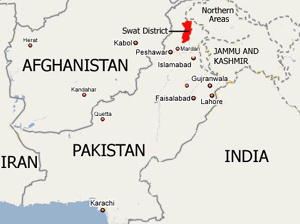
Organisations and Political Parties
- National Reconciliation Ordinance (NRO) is the brainchild of Condi Rice, Richard Boucher, and John Negroponte. The NRO brought the current Pakistan government under President Zardari into power. One of the key functions of the NRO was to "baptized" all the corrupt politicians of the past, erasing their crimes and misdeeds.
- The Pakistan Peoples Party (PPP) is the ruling political party under President Zardari.
- The Peoples National Party (ANP) is the local government of NWFP. In Pakistani terms it is the Awami (peoples) National Party. The ANP is a party based on Marxist ideology. When Pakistan was being created, the ANP didn’t want to be part of Pakistan. This appears to be changing.
- Tehrik-e-Taliban Pakistan (TTP) is the main anti-government party in Pakistan at the moment. Because the TTP bears the name "Taliban" the western media often confuses them with the Taliban in Afghanistan. This is a grave mistake. The Afgan Taliban rejects the TTP. The TTP views the ANP to be pro-US and part of the pro-US Pakistan government. The TTP is a group based on Takfiri ideology (a Mulim who believes that all other Muslims, even orthodox Muslims are not true Muslims. They view all others as collaborators with the West. All Muslim scholars are unanimous in declaring Takfiris ‘heretics of Islam’.
- Tehrik-e-Nizam e Shariat e Mustafa (TNSM) is the movement for implementation of Islamic laws in Swat. Sufi Mohammad is the original leader of the Swat Islamic courts movement and leader of of the TNSM.
- Darul Qaza is the name of the Islamic appellate court which Sufi Mohammad wants as the adjudicating body for legal issues in Swat.
Leaders
- Asfandyar Wali the party chair of ANP, the local government in NWFP.
- Abdullah Mehsud - Founder of the TTP, the main anti-government party. Abdullah was killed by the Pakistan Army
- Baitullah Mehsud is the cousin of the late, Abdullah Messud. Baitullah over the TTP after Abdullah Mehsud was killed.
- Nek Mohammad was the militant leader of the TTP. He achieved a comprehensive peace agreement between the government and Taliban militants in 2004. After the agreement ratified, the U.S. killed Nek Mohammad with a U.S drone-fired hellfire missile. This ended the 2004 peace agreement.
- Maulvi Fazalullah (also known as "Radio Maulvi") is the current leader in charge of militants in Swat. He is a follower of the TTP and its current leader, Baitullah Mehsud. Maulvi is son-in-law of Sufi Mohammad, head of the movement to establish an Islamic court system in Swat. Unlike Sufi Mohammad, Maulvi has not renounced the use of force and armed struggle.
- Sufi Mohammad has moved into Swat with 9000 followers. He is the original leader of the Swat Islamic Courts Movement and the current leader of the the Movement to Implement Islamic Laws in Swat under the name, Tehrik-e-Nizam e Shariat e Mustafa (TNSM). Sufi Mohammad had virtual control over Swat during the 90’s but now no military power on ground.
- Mullah Umar is the leader of the Taliban in Afghanistan. He has told his followers to disassociate themselves from Baitullah Mehsud and the TTP.
- Gen. Ashfaq Kayani is the Pakistan Army Chief.
- Benazir Bhutto 12th and 18th Prime Minister of Pakistan and the only woman ever to serve as Prime Minister. She was the eldest child of former prime minister Zulfikar Ali Bhutto. She was assassinated on December 27, 2007. She was the leading candidate against then president, Pervez Musharraf.
- Pervez Musharraf is former dictator-turned- president of Pakistan. He was forced out of office due to the assassination of Benazir Bhutto and his loss of support by his former sponsor, the U.S. government.
- Asif Ali Zardari is the current president of Pakistan. He is the former husband of Benazir Bhutto and came into power on her coat tails after she was assassinated. He is also the son of veteran politician Mr. Hakim Ali Zardari. Mr. Zardari is commonly known in Pakistan as "Mr. Ten Percent" due to his well-known cuts on various government deals.
- Syed Yousaf Raza Gillani is the current Prime Minister of Pakistan with Zardari as president. Both are members of the ruling political party, the PPP. He was elected as Prime Minister, unopposed. This was a singular and unprecedented event in Pakistan's political history.
Swat: From Chaos to a Peace Agreement
By Talha Mujaddidi*
Axis of Logic
After two years of brutal conflict in Swat, Pakistan, a complicated peace deal has been achieved. Before we get to this peace deal let me continue on expansion of some facts from my previous article on Swat. A lot has been discussed in Pakistani media on Swat and the causes of militancy there. Based upon various television reports and articles appearing in the local newspapers here it is clear that Pakistan government has made some moves that can only be described as "suspicious". Just like in former Yugoslavia, law enforcement funds were cut off to different provinces; similar steps have been taken in Pakistan. Hamid Mir, famous journalist/anchor of Geo Television (Pakistan’s top news channel) reported that local police and law enforcement agencies in Swat are facing the biggest shortfall in terms of arms, ammunition, troop morale, equipment such as police vehicles, bullet proof vests, etc. Also, in the past year, the town police officer has been rotated repeatedly. As mentioned in my earlier article “Playing with fire in Pakistan”, Pakistan is being given the same medicine that was given to former Yugoslavia.
In his Global Research article, The Destabilisation of Pakistan (Dec 20, 2007), Michael Chossudousky wrote:
“Already in 2005, a report by the US National Intelligence Council and the CIA forecast a 'Yugoslav-like fate' for Pakistan ...
"in a decade with the country raven by civil war, bloodshed and inter-provincial rivalries, as seen recently in Balochistan." (Energy Compass, 2 March 2005).
"According to the NIC-CIA, Pakistan is slated to become a 'failed state' by 2015, as it would be affected by civil war, complete Talibanisation and struggle for control of its nuclear weapons.”
The reports about lack of police equipment and funds are not only limited to the Swat Valley, but to the entire North West Frontier Province (NWFP) which envelopes Swat. The question is why is the government not releasing more funds to improve law and order in this region? Why are the funds withheld?
The answer lies in the fact that this government came into power under National Reconciliation Ordinance (NRO). NRO was a deal that was brainchild of Condi Rice, Richard Boucher, and John Negroponte. One of the first orders of business for the NRO was to cleanse all politicians of Pakistan of all their past crimes of corruption, lies, deceit, murder, and political persecution of opposition. In short, NRO baptized all the corrupt politicians of Pakistan. It was brokered between former President of Pakistan Musharraf and slain leader Benazir Bhutto.
The CIA suspected that both Musharraf and Benazir were unreliable for their purposes and their combination at Presidency and Prime minister posts, respectively, would mean a disaster for CIA’s motives in Pakistan. As we all know, Benazir was removed from the scene once and for all on December 27, 2007. The investigation into her assassination is still being conducted by UN special commission. The fallout from Benazir’s assassination was sufficient to eventually push Musharraf out of office. In came her former husband, Mr. Zardari (commonly known in Pakistan as "Mr. Ten Percent" due to his cut on various government deals). Zardari has been given a task, that offers more to the U.S, more than anything that Benazir would have or could have done and all that Musharraf wouldn’t or couldn't deliver for the U.S.
The Main Government-Opposition Party
In order to understand what is happening in Pakistan, it will be important to become acquainted with some names of organisations and their leaders whose unfamiliar names may require some effort by our English language readers.
Tehrik-e-Taliban Pakistan (TTP) is the main anti-government party in Pakistan at the moment. The history of the TTP is interesting and essential for understanding the current situation in Swat and the NWFP. The TTP was founded by Abdullah Mehsud, cousin of the current leader Baitullah Mehsud. The U.S. grabbed the former, Abdullah Mehsud, in Afghanistan after US invasion of Afghanistan, and took him to the prison at Guantanamo Bay. Then they released and sent back to Pakistan. Their reasons for releasing him are obscure. Why did the US release him? Was he a double agent? As soon as Abdullah returned to Pakistan, he organized and founded TTP. Mullah Umar, the leader of real Taliban in Afghanistan told his followers to disassociate themselves with Mehsud. Abdullah Mehsud was later killed by Pakistani Army when he was entering Pakistan from Afghanistan not in Tribal Areas but in border area of Zhob, Balochistan. If the U.S. ordered his assassination by the Pakistan Army, it's unclear why they didn't kill him with one of their drone-fired missiles which are very active in the region. Clearly, they could have tracked his movements when he was giving press statements on regular basis. After Abullah's assassination, his cousin Baitullah Mehsud took over the leadership of TTP. Finally, Maulvi Fazalullah is also part of the TTP story as he is the militant leader of Swat, loyal to the TTP and Baitullah Mehsud.
The Turmoil in Swat
The turmoil in Swat seems to have subsided for a while. When the Pakistan Army entered Swat, they realized that it will not be easy to take control of Swat area without incurring many civilian casualties. The Tehrik-e-Taliban Pakistan (TTP) militants have been scattered all over the valley. They were using human shields with ease, often setting up positions on roof tops of residential homes. People began to move out of the area fearing full-scale intense fighting.
The Local Government of the Northern Provinces
The local government of NWFP is the Awami (peoples) National Party (ANP). The ANP is a party based on Marxist ideology. When Pakistan was being created, the ANP didn’t want to be part of Pakistan. But the majority of Pukhtoon population wanted to accede to Pakistan, since it was to be a Muslim-majority country. During the Afghan Jihad, when Osama Bin Laden was Washington's blue eyed boy, the ANP was the only party in Pakistan which was against the Mujahedeen fighting against the USSR.
Surprisingly now, the ANP has become pro-US party and is in coalition with ruling PPP (political party of Pakistan president Zardari). In the year past, the TTP (identified above) has begun a campaign of killing ANP members, especially elected members of provincial and national parliament. The TTP views the ANP to be pro-US and part of pro-US Pakistan government. There have also been a few attempts on the life of Asfandyar Wali, ANP's party chair. Note that all these complexities are not the result of what would have been the natural political developments in Pakistan. Instead, they are a direct result of meddling in the domestic affairs of a sovereign country by the CIA and other foreign elements who have their own agenda for Pakistan.
The Current Peace Agreement
The ANP, local government of the North West Frontier Province (NWFP) finally came to the conclusion that in order to control its province it was imperative that Swat be reverted back to Islamic courts. The Pakistan Army also suggested to the government that there is still time to give peace a chance in Swat. Reluctantly government of Pakistan planned or rather ill-planned a peace deal for Swat. Please consider the basic elements of that peace deal:
Sufi Mohammed and the Implementation of Islamic Laws
The peace deal is not between Pakistan government and TTP. The deal is between local NWFP government and Sufi Mohammad (the original leader of the Swat Islamic courts movement and leader of Tehrik-e-Nizam e Shariat e Mustafa (movement for implementation of Islamic laws (TNSM). Sufi Mohammad commands respect of the local population, and Fazalullah (militant leader of TTP) is his son in law. Because of their relationship, it can be assumed that Sufi will will be able to negotiate with Fazalullah successfully and lasting peace will be achieved. Fazalullah has already announced a ten day cease fire.
Demand for Islamic Court System
According to investigative journalist, Ansar Abassi:
“Sufi Muhammad, chief of (TNSM), had assured the authorities two months ago that he would ensure peace in Swat only if his demand of setting up of an Islamic appellate court named Darul Qaza is met to ensure quick justice. The president (Zadari), who was initially scared of the expected international pressure in case he approves the Shariah system in Swat but has now agreed to this and given a go-ahead to the Frontier regime to sign and announce the peace deal.”
A Fragile Peace is Developing
The peace deal between the local, ANP government of NWFP and TNSM has been approved, and recently the situation in Swat has moved toward normalization. Schools, shops are open; people have started to restock their supplies and are trying to assess the damage done by the fighting.
President Zardari, the Pakistan Army and the Parliament
President Zardari has not yet officially approved the peace deal. If it works, he will take credit for it. If it fails he will say that I knew it would fail - that is why I didn't support it. The Pakistan Army has said that it will not remove troops from the areas under its control unless "real peace" is established and TTP militants disarm themselves. Sufi Mohammad has taken his followers and moved into Swat and has started negotiations with Fazalullah on behalf of the NWFP government. The public opinion in Pakistan is that Fazalullah, who has been responsible for killing numerous people and destroying lot of property, should be brought to justice.
The peace deal at the moment allows Fazalullah to escape with impunity. Some commentators are rightly pointing out the Pakistan Army is skeptical of this peace deal. Personally, I think that this deal should have been decided by vote in either NWFP parliament or in the National Assembly of Pakistan if it were to have had real legitimacy. But then again, the very corrupt parliament of Pakistan has been unable to deal with most disturbing issues facing Pakistan in the past so it's naive to assume that they would do otherwise this time around.
U.S. Involvement in Pakistan's Internal Affairs
Most interesting was the reaction of U.S. Secretary of State Hillary Clinton, who was cautious in her comments when speaking to reporters in Japan. She said Pakistan's efforts still needed to be "thoroughly understood" before she could comment. Christine Fair, a South Asia specialist with the RAND Corporation, said, "The real reason for [Hillary] being silent is there's really no good answer" in Washington for what is happening in Pakistan.
The last time a comprehensive peace deal was done between the Pakistan government and pro-Taliban militants was in 2004, in a place called Shakai in tribal areas of Pakistan. The deal was between Nek Mohammad who was then a TTP militant - and Pakistan government. After the agreement was reached, a U.S drone-fired, Hellfire missile and killed Nek Mohammad and the deal was surely finished. Will a U.S drone again hit a missile at TTP leaders or Fazalullah, or Sufi Mohammad?
Future of the Peace Accord
Sufi Mohammad has moved into Swat in form of a large convoy of reportedly 9000 people, all of whom are his followers. Note that the followers of Sufi Mohammad and Fazalullah are not in the best of terms with each other either. Sufi Mohammad had virtual control over Swat during the 90’s. Now he has no power on ground. If the peace deal dies, will we see a conflict between Sufi Mohammad and Fazalullah? What happens then? Which side will Pakistan support? Or will the TTP and TNSM join hands?
These are some disturbing questions which are very difficult to answer at this moment. At this time, the biggest concern is that people who had left the area need to be brought back in their old homes. Major construction work needs to be done to rebuild the area into what it once was. Just one example is the need to restore the ski resort which is an important recreational resource and source of income for the people. But all that can only happen when this peace pact is has matured and been in place for a while. Recently, Sufi Mohammad has been negotiating with Fazalullah but they have not yet reached a breakthrough. Fazalullah is asking for removal of the Pakistan Army from the valley. The Pakistan Army is unlikely to agree. Already Pakistan Army Chief has met with the Prime Minister and President and they agree that Army must remain on ground in Swat. In the meantime, just one day after ceasefire in Swat, a local correspondent for Swat's Geo TV was shot and killed by unknown gunmen. He had been covering the Swat chaos for last two years. This has bought angry protests from the journalists and people from all walks of life. As of February 21st, Fazalullah has agreed to a long-term cease fire in talks with Sufi Mohammad.
The new line taken by U.S is that Pakistan is the root cause of trouble in Afghanistan. The Barack Obama regime in Washington has adopted a new doctrine which it calls "AfPak", a term that couples two sovereign countries as one for the foreign policy agenda of the U.S. This is seen as arrogant and degrading by Pakistani public. Instead of dealing with Pakistan as an independent nation, they are confusing the history and issues of Pakistan and Afghanistan. In effect, "AfPak" does not respect the history or sovereignty of either country. To be sure, in Pakistan we have our problems and our international image as a country has not always been. But most people around the world have an image of Afghanistan that includes perpetual wars, Taliban, Osama bin Laden, the 9/11 attacks, poppy fields and heroin traffic, warring tribes, chaos, etc.) "AfPak" overlays this image on Pakistan.
The root cause of all trouble in this region is U.S occupation of Afghanistan. The suspicion shown by U.S on Swat peace deal is not new. U.S has always been skeptical of peace deals in Pakistan’s tribal areas. The reason is that permanent peace deals will result in more stability in Pakistan and less Washinton control. More on AfPak, Afghanistan turmoil, and Pakistan-India relations next time.
Editor's Note: A great deal has taken place in this saga in Pakistan between the writing and publication of this article on Axis of Logic. An update by Talha Mujaddidi is forthcoming for publication on Axis of Logic. - LMB
© Copyright 2009 by AxisofLogic.com
This material is available for republication as long as reprints include verbatim copy of the article its entirety, respecting its integrity. Reprints must cite the author and Axis of Logic as the original source including a "live link" to the article. Thank you!
*Talha Mujaddidi is a writer/analyst, living in Pakistan and a columnist for Axis of Logic. He received his training as an electrical engineer in the United States. He was named "Who's Who" in American Colleges and Universities 2004. Talha has worked in inter-faith dialogue group at Michigan Technological University (MTU) and is former Chairman of the IEEE at MTU. He has also worked in the automobile and telecommunications industries in the U.S. and in Pakistan. He was part of the Boston-based non-profit Association for Development of Pakistan (ADP) which gathers funds for sustainable small development projects in rural areas of Pakistan. Talha likes to follow current affairs, politics of Middle East and South Asia. Talha is currently working on different small projects that range from spreading public opinion against disastrous effects of globalization, trying to motivate Pakistani people to rise up against corrupt Pakistani politicians, managing his own blog, and doing research for his book which that will come out in future. Talha can be contacted at: talhamujaddidi@gmail.com
Read more essays by Talha Mujaddidi
Now or Never!! Pakistan must change its position on the “war on terror”.
View from Pakistan: Brutal Silence of Western and Arab Governments on carnage in Gaza