 |
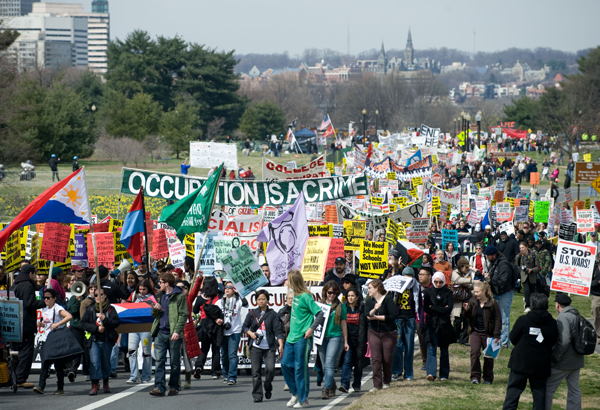
| The predominantly young crowd continued to grow as the day proceeded. Bill Hackwell |
On Saturday, March 21, 2009 the anti-war movement held its first national mobilization against U.S. militarism since the inauguration of Barack Hussein Obama. Marking the sixth anniversary of the Iraq war, about 10,000 people participated in the March on the Pentagon, organized by the ANSWER Coalition. While there were radical groups in attendance that viewed Obama as being little different from Bush, Obama supporters comprised a sizeable contingent of protesters.
Kate Walsh, unofficial leader of Students Against War in Des Moines wasn’t old enough to vote for Obama last year, but she did help get him elected. "I think I would have voted for him because I’d rather use my vote for a candidate who has a chance rather than voting for a third party," said Walsh who held a t-shirt and blanket stitched peace banner adorned with supportive signatures from Des Moines students. Whether Obama gets her first presidential election vote, however, will depend upon his Iraq and Afghanistan policies. "I’m really opposed to the Iraq war and I don’t believe that we should move troops to Afghanistan," said Walsh. "I want Obama to know that my generation isn’t with him if he’s going to continue the wars there."
Holding a sign reading "I am shocked and awed," veteran Harry Parks of North Carolina echoed Walsh’s position. "[I’m here] to remind the [Obama] administration that we still want the war to end," said Parks who served in the Army for 28 years including 30 months flying helicopters in Vietnam. "This is the most tragic blunder in American history—this past administration and its foray into the Middle East. I’m a retired military veteran and I believe that defending the country is essential, but what we’ ve been doing is not defending the country. We’ve actually been occupying countries for the wrong reasons."
Parks said he voted for Obama and believes that he is best suited to rectify the foreign policy debacle Bush left behind. "I just don’t want (Obama) to lose site of the fact that we absolutely must get out of the Middle East and let those people determine what kind of government they want not the kind of government we’re trying to give them."
Micael Bogar of Washington DC may have been dressed as a clown but her impetus for attending the march was as solemn as it gets. Donning a red wig and nose, white face paint, blue dress, and red and white stockings, Bogar said that her younger brother Jason Bogar, a U.S. soldier, died in Afghanistan on July 13, 2008. "These are his dog tags," she said lifting them from her neck to show. Holding a sign as colorful as her outfit, Micael Bogar said that losing her brother transformed her life and led her to realize "that fighting against war doesn’t work." "What does work for me is loving, and understanding the way of the world and reality. And letting everyone else catch up." Clowning, she said, is an important part of that creative process. "And peace is a very courageous act and it takes creativity to get there, to find peace in your life. So I’m demonstrating what my peace looks like."
Marking a new phase of the 21st century anti-war movement, protesters’ criticisms were not limited to Iraq but encompassed general U.S. military foreign policy. Activists condemned the U.S.’s role in Afghanistan and Pakistan, and its financial and political backing of Israel’s assault on Gaza and continued occupation of Palestinian territory. A relatively new but prevalent mantra was that U.S. military spending came at the expense of desperately needed funding for jobs, education and basic human needs
In addition to professionally crafted signs made by organizing groups, protesters brandished a plethora of handcrafted signs and banners reading: "Obama it’s your war now," "America is losing its soul in Gaza," "U.S. out of Afghanistan, Iraq, and Pakistan NOW," "College not combat," "Hey Obama take a stand, U.S. out of Afghanistan" and "OK Democrats, now stop the war."
 |
| Protesters brandished a plethora of handcrafted signs and banners reading: "Obama it’s your war now," "America is losing its soul in Gaza," "U.S. out of Afghanistan, Iraq, and Pakistan NOW," "College not combat," "Hey Obama take a stand, U.S. out of Afghanistan" and "OK Democrats, now stop the war." Bill Hackwell |
After rallying across the street from the Lincoln Memorial from about noon to 2pm protesters marched across the Memorial Bridge on their way to the Pentagon. Anti-war protesters were met with less than a dozen counter protesters who held up an effigy of Jane Fonda on a noose with a sign reading: "Jane Fonda, American Bitch Traitor." Others held signs reading "Che is dead get over it," "Al Qaeda Appeasers on Parade," "Peace thru strength," and "Anti-American Peaceniks think sedition is patriotic."
Along the march route protesters bellowed chants such as "Hey Obama, yes we can. Troops out of Afghanistan" and "Barack, Barack, Barack, Afghanistan's the same as Iraq." Protesters also called for broad ethnic unity chanting "Blacks, Latinos, Arab, Asian, and whites, no racist war no more, no more, defend our civil rights." Other chants addressed the economic situation: "Bail out the workers, not the war makers."
While much of the March on Pentagon, like most demonstrations, was well-rehearsed, there were a handful of occasions when truly organic outbursts of democratic will occurred. At one point, the march came to a halt as activists spontaneously formed a large dance circle and moved to what may have been the most popular chant of the demonstration: "Get up! Get down! There’s an anti-war movement in this town!"
This pause in the march, however, was used by a small group of activists to stage a protest within the March on the Pentagon. A small group of activists who questioned organizers’ commitment to opposing racism, flanked by a group of anarchists, created a blockade in the route, bottling up the protest. The group soon drew the ire of participants and ANSWER volunteers who diligently worked to funnel frustrated and confused marchers past the blockade. Further along the route one protester from the anarchist contingent threw a hammer into an apartment window. Some were displeased with such tactics.
Crescenzo Scipione, 17, of Rochester, New York said that the blockade of the route wasn’t constructive. "All it did was alienate anarchists, which is the last thing that the broader movement needs," said Scipione. "I hate it because it perpetuates, mainly among liberals and socialists this kind of baiting of anarchists. We need to stop doing shit like that."
March organizers dramatized the tragic consequences of U.S. military intervention around the world by creating about one-hundred cardboard coffins draped with flags representing the homeland of those killed. Coffins representing fallen American soldiers were also on hand.
Protesters carried the coffins along the route, through the Pentagon north parking lot into downtown Crystal City where they delivered them to defense contractors Boeing, Lockheed Martin, General Dynamics and KBR amid an army of riot-gear clad police officers.
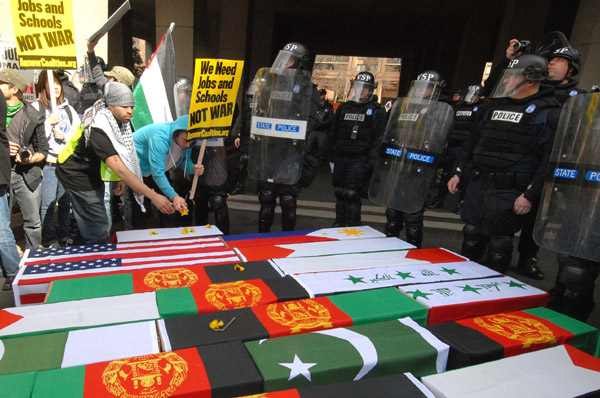 |
| The Arlington County Police mobilized in full riot gear in an attempt to block the demonstrators from delivering symbolic coffins at the doorsteps of the war corporations. |
Though unreported by most media outlets the end of the march was marked by a tense standoff between protesters and Arlington County Police. In an attempt to prevent activists from placing the makeshift coffins on the proverbial doorstep of General Dynamics-KBR dozens of police officers created a virtual wall around the facility. A contingent of activists took direct action, however, charging toward the entrance from an unguarded side of the building. A brigade of officers responded by cutting off their path. Activists settled on leaving the coffins at officers’ feet. On the street, supportive marchers looked on.
While activists sought to deliver the coffins to General Dynamics-KBR activists gathered nearby erupting in spontaneous song. Codepink activists led marchers in singing "Ain’t Gonna Let Nobody Turn Me Round" and "Solidarity Forever."
Excluding United for Peace and Justice’s half-a-million person protest in January 2007, the first Washington protest of the Obama administration was about one-tenth the size of ANSWER’s September 15, 2007 march. Asked how she felt about the considerably smaller turnout of protesters compared to the better attended marches in 2007, Rachelle van Wyck of St. Pete, Florida said that the numbers were less important than getting the message out. "It’s that people are still committed," said van Wyck who donned an "I can’t believe I’m still protesting this crap!" sticker. "That we still get the message out to this president that America is concerned about getting the troops home and that this needs to be a priority in his making policies. He needs to know that this is not what America wants and we have spoken. And we still say ‘bring the troops home.’"
In his March 27, 2009 article, "The Angry Left," published in the Atlantic, Will DiNovi writes that the anti-war movement’s most significant obstacle is the formation of a coherent message. "Though withdrawal from Iraq and Afghanistan was ostensibly the theme of the day, Saturday's featured speakers railed against causes as disparate as the embargo of Cuba, U.S. policy towards Sudan, and Israel's recent incursion into Gaza. As protesters made their way from the National Mall toward the Pentagon and a hub of defense contractors in Arlington, the march devolved into a vague condemnation of ‘the military industrial complex’ rather than a targeted attack on the president's foreign policy."
While DiNovi may bemoan the anti-war movement’s "vague condemnation of ‘the military industrial complex’" it is worth noting Dr. Rev. Martin Luther King contention that just such a comprehensive analysis was needed to achieve significant, lasting change and peace. Indeed, just ten days before his death King commented that the growth of the military industrial complex was the worst consequence of the Vietnam War. In a March 25, 1968 interview with Rabbi Everett Gendler Dr. King said: "One of the greatest tragedies of the war in Vietnam is that it has strengthened the military- industrial complex, and it must be made clear now that there are some programs that we can cut back on—the space program and certainly the war in Vietnam—and get on with this program of a war on poverty. Right now we don’t even have a skirmish against poverty, and we really need an all out, mobilized war that will make it possible for all of God’s children to have the basic necessities of life."
Toward Freedom
Answer Coalition- Act Now to Stop War and End Racism