“We do not want to go back to a dark past,” Mr. Obama said, in which military coups override elections. “We always want to stand with democracy,” he added.
|
The United States has a history of backing rival political factions and instigating coups in the region, and administration officials have found themselves on the defensive in recent days, dismissing repeated allegations by President Hugo Chávez of Venezuela that the C.I.A. may have had a hand in the president’s removal.
Obama administration officials said that they were surprised by the coup on Sunday. But they also said that they had been working for several weeks to try to head off a political crisis in Honduras as the confrontation between Mr. Zelaya and the military over his efforts to lift presidential term limits escalated.
The United States has long had strong ties to the Honduras military and helps train Honduran military forces. Those close ties have put the Obama administration in a difficult position, opening it up to accusations that it may have turned a blind eye to the pending coup. Administration officials strongly deny the charges, and Mr. Obama’s quick response to the Honduran president’s removal has differed sharply from the actions of the Bush administration, which in 2002 offered a rapid, tacit endorsement of a short-lived coup against Mr. Chávez.
|
During a more formal meeting afterward, they discussed Mr. Zelaya’s plans for a referendum that would have laid the groundwork for an assembly to remake the Constitution, a senior administration official said.
But American officials did not believe that Mr. Zelaya’s plans for the referendum were in line with the Constitution, and were worried that it would further inflame tensions with the military and other political factions, administration officials said.
Even so, one administration official said that while the United States thought the referendum was a bad idea, it did not justify a coup.
“On the one instance, we’re talking about conducting a survey, a nonbinding survey; in the other instance, we’re talking about the forcible removal of a president from a country,” the official said, speaking on the condition of anonymity during a teleconference call with reporters.
As the situation in Honduras worsened, Assistant Secretary of State Thomas A. Shannon Jr., along with Hugo Llorens, the American ambassador to Honduras, spoke with Mr. Zelaya, military officials and opposition leaders, administration officials said. Then things reached a boil last Wednesday and Thursday, when Mr. Zelaya fired the leader of the armed forces and the Supreme Court followed up with a declaration that Mr. Zelaya’s planned referendum was illegal.
|
Still, administration officials said that they did not expect that the military would go so far as to carry out a coup. “There was talk of how they might remove the president from office, how he could be arrested, on whose authority they could do that,” the administration official said. But the official said that the speculation had focused on legal maneuvers to remove the president, not a coup.
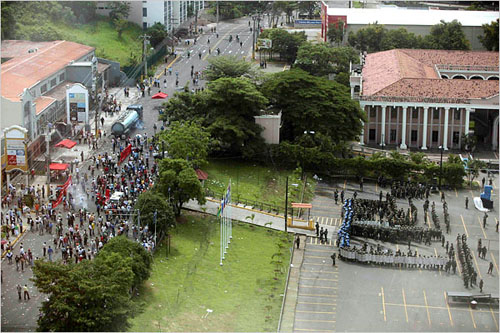
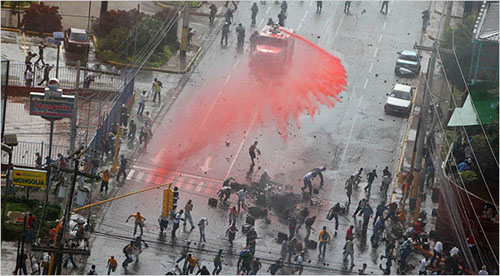
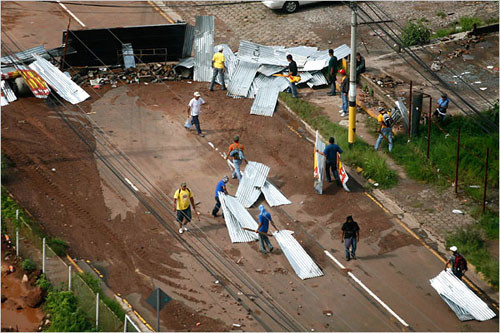
Whether Mr. Zelaya merited removal remains a strong point of debate in Honduras. Fierce clashes erupted Monday between thousands of soldiers and thousands of Mr. Zelaya’s backers. The protesters blocked streets, set fires and hurled stones at the soldiers, who fired tear gas in response. But opponents of Mr. Zelaya said they intended to rally Tuesday in support of his ouster.
|
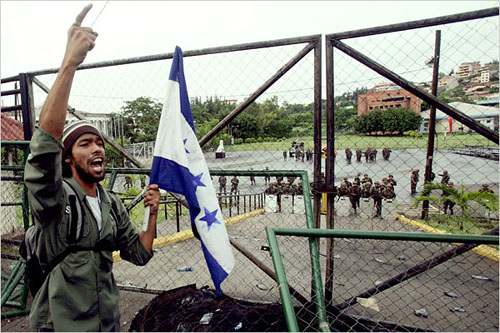
In the face of criticism from across the hemisphere, the new government hunkered down in Mr. Zelaya’s old office, ringed by soldiers and defending its actions as a bid to save the country’s democracy, not undermine it.
Roberto Micheletti, the veteran congressional leader who was sworn in by his fellow lawmakers on Sunday to replace Mr. Zelaya, seemed to plead with the world to understand that Mr. Zelaya’s arrest by the army had been under an official arrest warrant based on his flouting of the Constitution.
“We respect the whole world, and we only ask that they respect us and leave us in peace,” Mr. Micheletti said in a radio interview, noting that previously scheduled elections called for November would go on as planned.
Mr. Zelaya said from Nicaragua late Monday that he would return to Honduras on Thursday with the secretary general of the Organization of American States, José Miguel Insulza, Reuters reported.
“He’s the former president of Honduras now,” said Ramón Abad Custodio, the president of the National Commission of Human Rights, who defends the replacement of Mr. Zelaya as constitutional. “He may feel like he’s still president, but he’s a common citizen now.”
Helene Cooper reported from Washington, and Marc Lacey from Tegucigalpa, Honduras. Simon Romero contributed reporting from Bogotá, Colombia, Elisabeth Malkin from Mexico City, and Blake Schmidt from Managua, Nicaragua.
New York Times