|
Interior Minister Besir Atalay told Parliament the government wants to remove all restrictions on the use of the once-banned Kurdish language, create a committee to fight discrimination, restore Kurdish names of villages and establish an independent body to deal with complaints against security forces.
"It is an open-ended, dynamic process," Atalay said.
The rebel Kurdistan Workers' Party, or PKK, launched its fight for autonomy in 1984 and tens of thousands of people have died, with human rights abuses committed by both sides. Fighting has ebbed, but Turkey's civilian and military leaders have acknowledged that force alone cannot solve the problem. Making peace with its Kurdish opponents would also help Turkey in its struggling bid to join the European Union.
Some of the proposed measures would require legislative approval. The ruling party of Prime Minister Recep Tayyip Erdogan has a strong majority in parliament, and would likely pass the measures despite opponents who say the plan would ignore the sacrifices of slain soldiers and undermine the unity of the state.
"We aim to expand all our citizens' political rights and freedoms," Atalay said. "The democratic overture does not intend to harm our unitary state and national unity, but to strengthen it."
He said Kurdish politicians would be allowed to speak their language during election campaigns, reversing a policy that exposed pro-Kurdish politicians to prosecution if they spoke Kurdish in public settings.
The minister made no mention of a possible new amnesty for fighters and rebel leaders, a key demand of the PKK. Rebel chief Abdullah Ocalan, a hated figure among many Turks, is serving a life sentence in jail. Persuading thousands of fighters, many of whom operate from bases in northern Iraq, to lay down their arms is likely to be a long and difficult process.
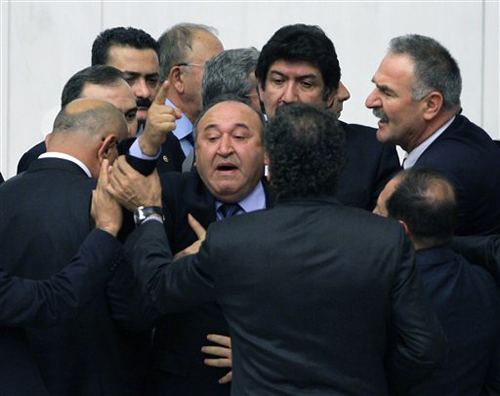
Opposition lawmakers, who had disrupted Atalay's speech on the Kurdish issue in Parliament earlier this week, listened this time in silence. In a speech, hardline nationalist leader Devlet Bahceli accused the government of negotiating with the rebels, who are labeled terrorists by Turkey, the European Union and the United States.
Ahmet Turk, the leader of the pro-Kurdish Democratic Society Party, said the government should halt military operations against the rebels.
"The government's insistence on military operations has not stopped the deaths," Turk said. "We hope that the issue will no longer be relegated to the army."
Erdogan was expected to speak in Friday's session.
Last month, authorities released a small band of Kurdish rebels who had surrendered in a peace gesture. Scenes of Kurdish celebrations of the surrender angered hardline nationalists.
Kurds make up about 20 percent of Turkey's more than 70 million people and dominate the country's poor southeast region.
Google Hosted News