|
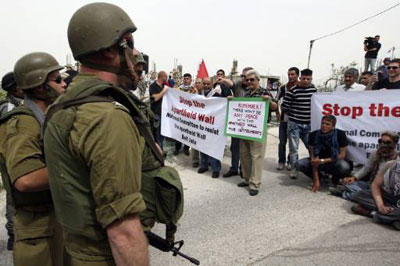
Israel army on Monday declared two Palestinian villages "closed military zones" in an attempt to halt foreign activists who join weekly protests against "shame wall" in the occupied West Bank.
The
two villages lost farmland to the separation wall and have become
international symbols of the fight against the wall condemned
internationally.
International Criminal Court in the Hague
ruled on 9 July 2004 that Israel's separation wall should be demolished
in a decision that were all agreed by the judges by a margin of 14-1.
"Dozens of masked soldiers raided the West Bank villages of Bil'in and
Ni'ilin Monday morning to post decrees designating the village's lands
closed military zones on Fridays from 8.00 a.m. and 8.00 p.m for a
period of six months", residents said.
Israel may use this decree as an excuse for arrests or deportations of foreign and local rights activists.
"Illegitimate"
The verdict, requested by the UN's general assembly says "Israel's wall is illegal, it must be removed and adequate compensation paid," Israel has ignored this and pressed on with its construction.
The wall leaves some 80 percent of Jewish settlements on the Israeli
side, leading the court to conclude that the route of the wall
threatened to create "de facto annexation", with the wall itself
described as severely impeding "the exercise by the Palestinian people
of its right to self-determination".
"People have the natural
right to demonstrate. This decision will not prevent people from going
into their lands," Nilin Mayor Ayman Nafie told Reuters.
"Protesters do not see this decree as legitimate, but it could be a
sign of heightened pressure on the popular resistance than we've seen
so far," Jonathan Pollak, an Israeli who coordinates anti-barrier
protests, told Reuters.
Palestinian news agency quoted
Lawyer Gaby Lasky, who represents residents of the villages as saying,
that "this is yet another illegal measure taken by the Army, which
makes ill use of its authority in order to suppress dissent and
infringe on the already volatile freedom of speech in the Territories.
Closed military zone orders are not meant to deal with demonstrations,
which are clearly in the civic rather than the military realm."
Palestinians refer to the barrier as the "apartheid wall" and view it
as nothing more than a land grab by Israel to help support and expand
settlements in the West Bank.
"Live rounds"
Israeli troops wounded 10 Palestinians on Monday as they opened fired
on dozens of students at a West Bank checkpoint, Palestinian medics and
witnesses said.
Witnesses and medics said the soldiers had fired live rounds at the demonstrators but the Israeli military denied this.
|
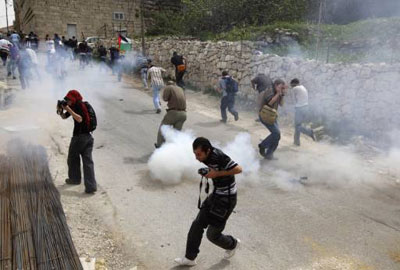
The Palestinians had marched to the checkpoint from the nearby Birzeit University. Dozens of them hurled rocks at the soldiers.
The medical sources said two of the men were hit by bullets at Atara checkpoint, north of Ramallah.
Israel has banned Palestinians from crossing into the city from the West Bank until Tuesday.
An Israeli military spokeswoman said one soldier was lightly wounded.
She declined to say whether live rounds were used against Palestinians.
Israeli troops sometimes fire live rounds to disperse demonstrations in
the West Bank while mostly using means like tear gas, stun grenades and
rubber bullets.
"Aqsa call"
Meanwhile, tensions remain high as Israeli officials plan to rededicate
a synagogue 330 meters from the Al-Aqsa Mosque compound in the Old
City. The decision to rededicate the building on Monday was condemned
as an act of aggression by Palestinian religious officials.
Palestinian leaders in the city mobilized residents to gather at the Al-Aqsa Mosque.
Israel has deployed heavily policemen in Jerusalem's Old City during
the reopening of a 17th century synagogue near the Al-Aqsa Mosque
compound.
Palestinian national and Islamic groups in Jerusalem
released a statement calling on Jerusalemites and Palestinian citizens
of Israel to go to the Al-Aqsa Mosque. Observers expect a growing crowd
to remain in the mosque overnight on Monday and likely Tuesday.