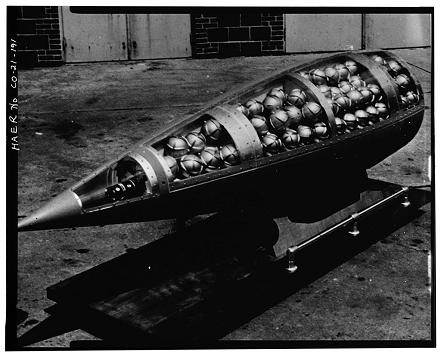
Cluster bombs are like big containers with hundreds of small, hand grenade sized, often brightly colored bomblets inside. When dropped from the air, they spread over an area several hundred square meters wide, and explode before reaching the ground, causing the largest possible number of casualties. In expired ammunition, bomblets do not explode in the air. They reach the ground where they effectively become anti-children mines. Because they have odd shapes and bright colors, it is children who are most attracted to them, and who tend to be the first victims. For more see Cluster Bomb Treaty and the World’s Unfinished Business, By Ramzy Baroud* Axis of Logic Saturday, Dec 13, 2008
(photo, comments and link added by Axis of Logic)
U.S. and major powers urged to join cluster munitions pac
by Stephanie Nebehay, Reuters.
July 29, 21001
GENEVA - Activists called on the United States and other major powers on Thursday to join a global treaty banning cluster munitions that goes into force on August 1.
A cluster bomb found in a field by a team working for a British demining firm lies in Hallusiyeh village, southern Lebanon, July 9, 2007. (REUTERS/Jamal Saidi)Dropped from aircraft or fired from artillery or rockets, the weapons scatter bomblets over a wide area, but have limited military impact today as they were designed to attack tanks on an open battlefield, an increasingly rare scenario, they said.
Also See: Banning Cluster Bombs: Light in the Darkness of Conflicts by Rene Wadlow, writing for "Toward Freedom"
Cluster bombs often fail to detonate immediately and can explode years after a conflict, killing or maiming civilians in Laos, Kosovo and Lebanon, according to humanitarian groups.
"These weapons are a relic of the Cold War. They are a legacy that has to be eliminated because they increasingly won't work," Peter Herby, an arms expert at the International Committee of the Red Cross (ICRC), told a news conference.
Support is growing for the Convention on Cluster Bombs, adopted in May 2008 and ratified by 37 states including Britain, France, Germany and Japan, which all have significant stocks.
But the United States -- the world's largest producer with the biggest stockpile of 800 million submunitions -- has shunned the treaty, although it says it will ban the weapon from 2018.
China and Russia have also stayed away and don't disclose their stocks.
"We call on countries that haven't yet signed to join this treaty without delay," said Thomas Nash, coordinator of the Cluster Munition Coalition which links 350 activist groups.
"We're already seeing that the practice of these countries is changing. The U.S. has an export moratorium in place that (Barack) Obama signed into law as one of his first acts as president," he added.
In all, 107 countries have signed the pact banning the use, production, stockpiling and transfer of cluster bombs which also sets deadlines for the clearance and destruction of stockpiles.
"It is the most important disarmament and humanitarian convention in over a decade," Jody Williams, 1997 Nobel Peace prize laureate and landmines campaigner, said in a statement.
MADE IN THE USA
"The majority of cluster bombs out there that you would step on if you were in an affected country would be made in the USA," Nash said.
Four of the five types used by Israel in its 2006 war in southern Lebanon were American-made, he said.
NATO is not using them in Afghanistan out of concern over civilian casualties, in line with a policy since 2003, he said.
Most countries are turning away from the weapon because they kill too many civilians and undermine political objectives, according to Nash. Lockheed Martin and Alliant Techsystems are among U.S.-based companies known to have produced cluster bombs in the recent past, he said.
Israel's use of the weapon against Hezbollah militants in southern Lebanon in 2006 and Britain's own review of their use in Kosovo -- revealing they had destroyed just 15 military pieces of equipment -- had shown their limited military value, said Herby of the ICRC, a neutral humanitarian agency..
"After using something approaching 3 million cluster munition units in southern Lebanon, Israel was still being fired upon by about 100 missiles a day from southern Lebanon. So what is the use?" he said.
Source: Reuters
Editor's Note: The Reuters article above again presents Israel as the victim. A close look at the cluster bombs that the Israelis dropped on Lebanon show that they were manufactured around the time of the Vietnam War and that they were long past their expiration date. Some say that Israel was trying to save on its military waste disposal bill by dumping the expired ordinance into Lebanon. Hundreds of Lebanese children have been killed or maimed by these bombs since the Israeli attack in August 2006. - LMB