Editor's Note: There is much more to be learned about the ;paramilitary death squads in Colombia and the underlying motives for murdering ;tens of thousands of Colombian peasant farmers during the 1990s and the first decade of 2000. Throughout this period, Alvaro Uribe was involved, first as mayor of Medellín (1982); then as Senator (1986-1994) and Governor of Antioquia (1995-1997); and then as President of Colombia in 2002 until this year when he was replaced by his Defense Minister, Juan Manuel Santos. In the report below, Constanza Vieira uncovers the sinister plot in which right wing paramilitaries killed peasants on behalf of individuals who then stole the land and had their "ownership" legalized with the help of government officials. Ostensibly, the paramilitaries who did the killing were in service to the US/Colombian "war on drugs", when in reality, Alvaro Uribe was deeply involved in Colombia's illegal cocaine industry for decades, an industry now being used as a pretext for US militarization and aggression against the Bolivarian Republic of Venezuela.
- Les Blough, Editor
BOGOTA, Aug 21, 2010 ;- An unknown number of agribusiness owners and public employees at all levels, as well as far-right paramilitaries, have a common link with rural people who have been forced off their farms or killed in Colombia: the land stolen from the latter group in the armed conflict.
|
|
|
Former paramilitary chief |
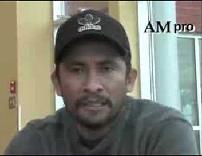
"It was a conspiracy. There were the ones doing the killing, others who would follow behind, buying up the land, and the third wave, who would legalise the new ownership of the land," said former paramilitary chief Jairo Castillo or "Pitirri", who has lived in exile for 10 years and is serving as a key protected witness in the trials of legislators and other political leaders implicated in the "parapolitics" scandal for their ties to the paramilitary groups.
Pitirri is one of those asking the justice system why it is only focusing on "the ones doing the killing"; why it is not inquiring into who seized 5.5 million hectares of land, according to figures from the Commission to Monitor Public Policies on Forced Displacement, set up on the initiative of civil society groups.
The testimony of Pitirri was presented Thursday in a congressional debate on political control over land, paramilitarism and forced displacement, by leftwing legislator Iván Cepeda.
Álvaro Uribe, who governed Colombia from 2002 to Aug. 7, 2010 -- when he was succeeded by his former defence minister President Juan Manuel Santos -- partially demobilised the armed wing of paramilitarism through talks with the group's leaders. The Law on Justice and Peace was passed to govern the demobilisation process.
Under the law, a unit of the attorney general's office was set up to obtain "complete" confessions from hundreds of former combatants who must confess to all of the human rights abuses and other crimes they committed and make reparations to the families of their victims in order to be eligible for reduced sentences and other benefits, as required by the Constitutional Court.
"The Justice and Peace Unit has done a formidable job in the midst of budget and logistical limitations," Guillermo Rivera, a governing Liberal Party legislator, said in Thursday's debate.
According to him, the attorney general's office has discovered something unexpected.
He noted that the demobilised paramilitaries, who were supposedly the owners of vast tracts of land with which their victims were to be compensated, reported that they actually owned small properties. As a result, they have handed over just 6,600 hectares so far.
Rivera provided the following summary of the "conspiracy," as Pitirri described it:
"Under the pretext of fighting the leftwing guerrillas that have been active in this South American country since 1964, paramilitary groups expanded as never before between 1994 and 2000, killing tens of thousands of campesinos (peasants) and forcibly displacing millions of others, who fled to the overcrowded slums ringing Colombia's large cities."
The campesinos lost their food security when they fled their land, which was taken over by paramilitary mafias that purchased it at ridiculously low prices or occupied it by force, Rivera said.
The Uribe administration's demobilisation negotiations with the paramilitary chiefs took place on a farm in Santa Fe de Ralito, a town in the northeast, from 2002 to 2005.
While the talks proceeded in Santa Fe de Ralito, most of the millions of hectares of land that had been seized were put in the name of dummy companies and front men or sold to businesspeople.
The aim was to keep the properties from being registered in the victim reparations funds to be created under the Law on Justice and Peace, to avoid handing them over in compensation, as part of the process of restoration of stolen property, Rivera said.
From 2005 to 2006, the Justice and Peace Unit of the attorney general's office found evidence that a number of businesspeople had taken over land that originally belonged to displaced peasants, while other property was found in the names of dummy corporations and front men.
The phenomenon outlined by Rivera came full circle in a chilling way: a certain number of these front men became beneficiaries of the state, mainly through the Ministry of Agriculture, which offered them soft loans and farm subsidies under the Agro Ingreso Seguro ("stable farm income") programme -- a corruption scandal that broke out in the last stretch of the Uribe administration.
Later -- again, according to Rivera -- these beneficiaries financed the election campaigns of close Uribe allies, such as former presidential hopeful Andrés Felipe Arias, the former president's agriculture minister.
In the congressional debate, Rivera and Cepeda provided the names of individuals, companies and supposed civil society organisations that reportedly formed part of the "conspiracy."
During his term in office, Uribe himself instructed his allies in Congress, who formed a majority, to block passage of a bill that would have provided for, among other things, reparations and restoration of stolen property to victims of the paramilitaries.
The bill, he argued, would entail costs too heavy for the state coffers to handle.
On numerous occasions, the Constitutional Court ordered that the assets seized from the victims of forced displacement -- who number between three and over four million, depending on whether the source of the estimate is the government or civil society -- be returned to them.
Rivera called for expedited transitional legal mechanisms to return the property of victims. In order to do that, he said, it is necessary "to shift the burden of proof in the disputes over land ownership."
He argued that it is not the state that should have to prove that corruption occurred in a business or land property transaction, but the individuals or companies currently using the property who must demonstrate that they are the legal owners.
* With additional reporting by Helda Martínez. (END)
* Additional editing, photo and related comment by Axis of Logic.
Source: Inter Press Service
Related
Paramilitary terror ignored and promoted by the Colombian state
 Arturo Rosales in Caracas. Axis of Logic.
Many Axis of Logic readers have probably heard about the guerrillas and paramilitary bands in Colombia. Drug running, murder of civilians and labor leaders, terror of the civilian population and more recently the “parapolitics” scandal are the daily bread in large swathes of Colombia. Members of the Senate and Congress... » read this article
Colombia: Mass killings of civilians by military little cause for concern
Arturo Rosales. Axis of Logic
Back in January 2010 the first reports started appearing on internet about the discovery of a mass grave about 120 miles south of Bogotá in La Macarena, in the department of Meta. Some 2000 bodies were mentioned in initial reports ;and the Colombian Attorney General has spoken about 25,000 “disappeared”.... » read this article