|
Occupation of Dewey Square, Boston, October 1, 2011 |
|
|
|
|
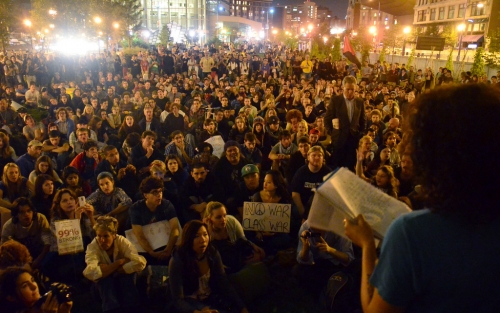
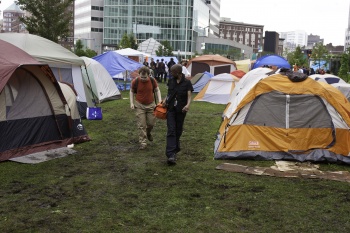
October 2, 2011 - Last evening about 1000 people occupied Dewey Square near South Station in Boston. Most people were in their 20’s, I am happy to report. The generation maligned for being apathetic is rising up angry! The crowd’s feelings were expressed by a woman who addressed them saying,
‘We need to end rule by the bankers, the 1%’ ; ‘We are not represented in the government’; ‘We are the 99%’ ; ‘we will reach out to the public and spread our message.’ The most exciting and most important thing she said was this: “We have no demand; everything must be fundamentally changed.”
This is essentially a call for revolution, rather than this-or-that reform. It represents a huge positive development that can be the basis for a truly revolutionary movement that really does mobilize the 99%. Narrow reform demands cannot do this because they address only a small fraction of the concerns that the 99% have, and because it is often the case that the ruling class can persuade the general public that a given reform will benefit some but only at the expense of others (e.g. if wages go up so will prices, if the war ends people employed in arms industries will lose their jobs, if there is medicare for all then taxes will rise and doctors won’t be compensated fairly, etc.)
Only an entirely different, non-capitalist, organization of society can address the material and non-material concerns of the entire 99%. What is lacking in the movement today is this vision of a new world, so that when people say “everything must be fundamentally changed” they will have a vision of what they actually mean, and will have the confidence to reject anything short of that. Otherwise they will end up accepting some superficial change that the ruling class will no doubt come up with and the movement will fail. We need to beware of those who try to turn this movement away from its revolutionary goals towards narrow demands.
This is why I hope you will join with me in promoting a vision of a new world, with a non-capitalist economy based on equality. Please consider printing some copies of this flyer and going to an occupation near you (there are some in many different cities, with details at Occupy Together and handing them out. People took them from me last evening as fast as I could hand them out. Another weakness of the movement is that many people in it accept the wrongheaded philosophy of nonviolence.
The ruling class has pushed this philosophy for obvious reasons and they have been quite successful, unfortunately. Most people in the movement fail to distinguish between violence in self-defense on the one hand and violence to oppress or violence against unarmed civilians on the other hand. They fail to consider that while the latter is immoral the former is not. When I discuss this with people who say they are for nonviolence it turns out, usually, that they simply have not thought carefully about the question. They readily admit they would use violence to defend their child under attack. And they are surprised to hear that Gandhi said,
“Hitler killed five million Jews. It is the greatest crime of our time. But the Jews should have offered themselves to the butcher’s knife.”
Or that he also contradictorily said,
“I do believe that where there is a choice between cowardice and non-violence I would advise violence. Thus when my eldest son asked me what he should have done, had he been present when I was almost fatally assaulted in 1908, whether he should have run away and seen me killed or whether he should have used his physical force which he could and wanted to use, and defended me, I told him that it was his duty to defend me even by using violence.”
This self-contradictory and morally wrong philosophy of nonviolence (in particular the notion, promoted by the ruling class, that says violence in self-defense is immoral) needs to be challenged, lest it become the Achille’s Heel of the movement. There will, in all likelihood, be times when the revolutionary movement will need to use violence in self-defense. Our goal needs to include persuading so many soldiers and sailors to join the movement that we will be able to prevail in this self-defense. Unless people are clear that this is moral and necessary, the movement will be defeated.
This is why the mainstream media always praise the “Arab Spring” and now the “American Autumn” for being nonviolent, even when the reality is that the Egyptians in Tahir Square used violence in self-defense when they were attacked violently and Egyptian workers burned down police stations.
The movement needs to be aimed at winning, at defeating the power of the 1%. We should avoid getting arrested when possible, and avoid as much as possible getting into violent confrontations with the authorities until we have built our movement so large—tens of millions of people with huge support from soldiers and sailors and other rank-and-file “security’ personnel—that we can forcibly prevail in such confrontations. This is very different from, as the philosophy of nonviolence advocates, appealing to the 1% to stop oppressing, by voluntarily seeking to be arrested and going limp when handcuffed to demonstrate the sincerity of our convictions.
John Spritzler is co-editor with Dave Stratman of New Democracy World based in Boston, Massachusetts.