In order to educate the children properly we must separate them from their families. Some people may say that this is hard but if we want to civilize them we must do that.
Hector Langevin,
Public Works Minister of Canada, 1883
Take a Canadian aboriginal kid away from its parents, inculcate him or her with the values of European superiority, and what you get is an apple – Red on the outside and White on the inside. At least that’s the way it was explained to me when I lived in Regina, Saskatchewan (pop. around 190,000, about 12% aboriginals and Métis although this is probably an understated statistic). Take that kid and try to make him white, and he soon finds himself shunned by both societies.
But that didn’t stop white Europeans from trying. And no one was more diligent than the churches. They received the blessing of the Government of Canada, and then proceeded to grow apples.
For over a century, generations of Aboriginal children were separated from their parents and raised in overcrowded, underfunded, and often unhealthy residential schools across Canada. They were commonly denied the right to speak their language and told their cultural beliefs were sinful. Some students did not see their parents for years. Others—the victims of scandalously high death rates—never made it back home. Even by the standards of the day, discipline often was excessive. Lack of supervision left students prey to sexual predators. To put it simply: the needs of tens of thousands of Aboriginal children were neglected routinely. Far too many children were abused far too often.
They Came for the Children:
Canada, Aboriginal Peoples, and Residential Schools
March 2012
Still, Canada thinks it has earned itself a little credit by making an attempt – very late in the day – to redress some of the wrongs. Not much could be further from the truth.
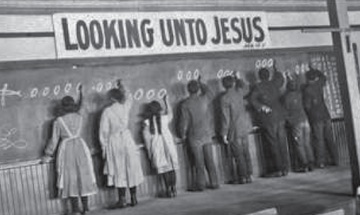 |
| In his 1899 book The Indians: Their Manner and Customs, Methodist missionary John Maclean wrote that while the Canadian government wanted missionaries to “teach the Indians first to work and then to pray,” the missionaries believed that their role was to “christianize first and then civilize.” This photograph was taken at the Methodist school at Red Deer, Alberta, sometime between 1914 and 1919. The United Church of Canada Archives, 93.049P850N. |
Background
Historically, aboriginal peoples in Canada have been the responsibility of the federal government. Even to this day there is a federal Department of Indian Affairs and Northern Development – usually known as Aboriginal Affairs and Northern Development Canada (or AANDC) because that seems ‘friendlier’. But for much of its history, the government of Canada has not exercised its duty with any sense of fairness or justice. [Leave aside that aboriginal people are not like a herd of cattle; they don’t really need to be ‘managed’ by anyone but themselves.]
To make matters worse, many of the things aboriginal society needs are managed at the provincial level, and the two levels of government simply point fingers at each other so that often nothing gets done.
A classic – and recent – example occurred in the province of Ontario in the autumn of 2011. The northern aboriginal community of Attawapiskat declared a state of emergency due to unsafe living conditions – no running water, no sewage treatment, people living in unheated tents or lean-tos for as much as two years. Neither AANDC nor the government of Ontario did anything but wring their hands in sympathy. Instead, the Red Cross stepped in. It is the legal responsibility of those governments to provide for certain basic needs for aboriginal people who choose to live within the reserve system. Neither AANDC nor the province had been useful for this community for a very long time. And Attawapiskat is not alone – there are other communities across the country with similar tales to tell.
The worst part of this recent experience is that few Canadians were horrified by the situation. We see the Red Cross as providing help in war-torn countries or areas stricken by disaster, but we failed to see the disaster brewing right under our noses. And even when we learned about it, we tended to blame the victims. Racism against aboriginal people bubbles to the surface quite easily in Canada.
In the province of Manitoba, one of the First Nations groups (that’s how aboriginals are identified here) launched a lawsuit against both the provincial and federal governments due to flooding. Manitoba has a sophisticated water management program to deal with annual spring melts and flooding (our equivalent of what happens on the Mississippi River every year), but sometimes Nature brings more than the system can handle. So in 2011, the government made a decision to allow some lands to be flooded rather than try to move the water away, out of fear that they would not be able to handle it all. Guess whose land they deliberately allowed to be left under water?
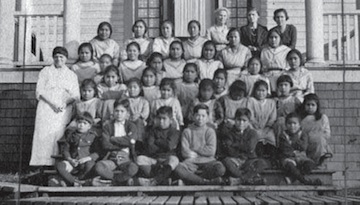 |
| Pupils and staff of the Elizabeth Long Memorial House in Kitimaat, British Columbia, in 1922. In that year, parents pulled their children out of the school following the death of a student. The United Church of Canada Archives, 93.049P458. |
The Truth and Reconciliation Commission of Canada
Repeated efforts – and non-efforts – by successive governments over the years to ‘fix’ the problem have been colossal wastes of effort and money. Still, one government came close to getting on a positive track.
The short-lived government of Paul Martin had summoned up aboriginal groups and provincial governments from across the land and had agreed to what was known as the Kelowna Accord. This was a series of agreements that sought to improve the education, employment, and living conditions for Aboriginal peoples through governmental funding and other programs. It would have had all levels of government working together, with the First Nations peoples leading the way.
When Martin lost his position as Prime Minister to Stephen Harper in 2006, the Accord was simply shelved. Harper’s government has no interest in aboriginal affairs. Harper became prime minister just before the establishment of the Commission, and he did formally and officially apologize to the aboriginal people for the disgraceful way Canada has treated them. Unfortunately, he seems to think that’s all that was needed.
Up until the 1990s, the Canadian government, in partnership with a number of Christian churches, operated a residential school system for Aboriginal children. These government-funded, usually church-run schools and residences were set up to assimilate Aboriginal people forcibly into the Canadian mainstream by eliminating parental and community involvement in the intellectual, cultural, and spiritual development of Aboriginal children.
More than 150,000 First Nations, Inuit, and Métis children were placed in what were known as Indian residential schools. As a matter of policy, the children commonly were forbidden to speak their own language or engage in their own cultural and spiritual practices. Generations of children were traumatized by the experience. The lack of parental and family involvement in the upbringing of their own children also denied those same children the ability to develop parenting skills. There are an estimated 80,000 former students still living today. Because residential schools operated for well more than a century, their impact has been transmitted from grandparents to parents to children. This legacy from one generation to the next has contributed to social problems, poor health, and low educational success rates in Aboriginal communities today.
The 1996 Canadian Royal Commission on Aboriginal Peoples and various other reports and inquiries have documented the emotional, physical, and sexual abuse that many children experienced during their school years. Beginning in the mid-1990s, thousands of former students took legal action against the churches that ran the schools and the federal government that funded them. These civil lawsuits sought compensation for the injuries that individuals had sustained, and for loss of language and culture. They were the basis of several large class-action suits that were resolved in 2007 with the implementation of the Indian Residential Schools Settlement Agreement, the largest class-action settlement in Canadian history. The Agreement, which is being implemented under court supervision, is intended to begin repairing the harm caused by the residential school system.
Truth and Reconciliation
Commission of Canada:
Interim Report
March 2012
The Truth and Reconciliation Commission has already indicated some of its recommendations. And, as is usual with reports such as this in Canada, nothing will be done. It will almost certainly be up to the victims to fight for themselves. The Commission will make the government feel proud of itself, but it will, in the end, do little to change the way Canada and Canadians interact with our aboriginal people.
The Commission has heard from many groups and people, including a large number of individuals and groups representing aboriginal people. I cannot help but worry the results of this exercise will be one where the victims have been able to voice their stories, only to be told they have had their say and now they should just shut up.
Perhaps it is said best in the concluding section of They Came for the Children. In writing about the Commission, the authors note:
There can be no movement toward reconciliation, however, without an understanding of the rationale, operation, and overall impact of the schools. Through its work, the Commission has reached certain conclusions about the residential school system. As stated in the introduction, the truth about the residential school system will cause many Canadians to see their country differently.
These are hard truths, but only by coming to grips with these truths can we lay the foundation for reconciliation.
The Commission has concluded that:
1. Residential schools constituted an assault on Aboriginal children.
2. Residential schools constituted an assault on Aboriginal families.
3. Residential schools constituted an assault on Aboriginal culture.
4. Residential schools constituted an assault on self-governing and self-sustaining Aboriginal nations.
5. The impacts of the residential school system were immediate, and have been ongoing since the earliest years of the schools.
6. Canadians have been denied a full and proper education as to the nature of Aboriginal societies, and the history of the relationship between Aboriginal and non-Aboriginal peoples.
From my reading of the interim report of the Commission, its recommendations don’t suggest to me that they have understood. I’ll be delighted to be wrong about this, and it is perhaps unfair to malign them when their work is not complete. But regardless of whether they do get it right, it is highly doubtful that Stephen Harper’s government will make any positive moves.
Canada’s aboriginal people first saw white Europeans coming to their lands more than 500 years ago. The First Nations can be forgiven for thinking that they might have been better off if they had been less welcoming. Theirs has been a bitter story, occasionally marked by failures on their own parts. But they have repeatedly been victimized and brutalized by a nation that doesn’t altogether want them and doesn’t know what to do about them – or, more importantly, how to do anything with them.
Keep this in mind when Canadian leaders are overheard on the world stage pointing fingers at other countries.
Note:
The 2007 Indian Residential Schools Settlement Agreement identified 134 residential school and residences. Former students who attended these institutions on a residential basis were eligible to make compensation claims under the agreement. After the agreement was reached, former students applied to have over 1300 schools added to the list. Eight of these applications have been accepted (up to August 31, 2011) but the vast majority was rejected. In August 2011, the Ontario Supreme Court of Justice ordered two more schools be added to the list. At least nine other schools were not included in the settlement agreement because they closed in the early twentieth century. In addition, many students attended residential schools, but did not live at them. Day students have initiated court action seeking compensation for their school experiences. Students who attended boarding schools in Labrador have launched similar court actions. The stories of both these groups are yet to be told.
Paul Richard Harris is an Axis of Logic editor and columnist, based in Canada. He can be reached at paul@axisoflogic.com.
Read the Biography and additional articles by Axis Columnist, Paul Richard Harris