Editor's Comment: The imperialist powers may have found a way to help the UK wiggle out of the corner into which they painted themselves when they declared they would invade the Ecuadoran Embassy in London after one week if Ecuador didn't give up Julian Assange. That was 3 weeks ago. The face-saving mechanism would involve Sweden eventually dropping their trumped up sexual abuse charges against Julian Assange, which would negate the ruse of Sweden's unprecedented demand for extradition - "for questioning." Over the past month, London has been back-peddling to launder and rescind their rash decision after people and governments around the world embarrassed the UK for being the first government in history to illegally invade a sovereign foreign embassy. The BBC has been doing their job, helping the UK government to soften their stance:
"But speaking to the BBC on Thursday, Mr Hague (Foreign Secretary) stressed that the UK was not threatening to storm the Ecuadorian embassy - he said he was looking for an 'amicable solution'."
If Julian Assange's prediction is correct, Sweden's dropping the trumped up sexual assault charges against him will allow the UK to release him to Ecuador's custody. What awaits him after that would remain to be seen. The beast in Washington doesn't easily forgive and forget it's enemies.
Hopefully, Assange will be able to continue his heroic work with Wikileaks from inside the Ecuadoran Embassy in London while the London regime works on an attempt to restore its mask of legitimacy.
- Les Blough, Editor
31 August 2012
BBC
Julian Assange predicts 'up to a year' of living in embassy
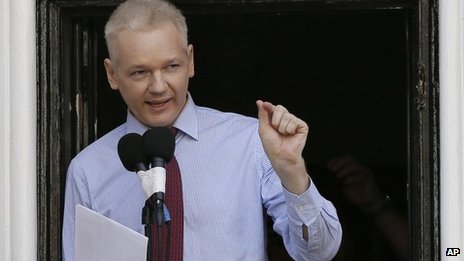
Julian Assange has predicted that eventually Sweden will drop its sexual assault case against him
Julian Assange has predicted that he will remain inside an embassy in London for "six to 12 months".
The Wikileaks founder is in Ecuador's embassy, fighting extradition to Sweden over sexual assault claims.
In a interview broadcast in Ecuador, Mr Assange said the Swedish authorities dropping the case against him is "the most likely scenario".
But Foreign Secretary William Hague has said there is "no solution in sight" to resolving Mr Assange's extradition row.
Ex-computer hacker Mr Assange's Wikileaks website has published leaked sensitive diplomatic cables involving various countries, including the US.
He has been inside the embassy since June and says he fears being passed on to authorities in the US if extradited to Sweden. Ecuador has granted asylum to Mr Assange.
The FCO says the UK has a legal obligation to extradite him to Sweden, and he will be arrested if he leaves the embassy.
Sweden wants to question Mr Assange over claims he sexually assaulted two women, which he denies.
During the Telesur television interview, recorded earlier this week inside the embassy, Mr Assange said that he believes the situation "will be solved through diplomacy".
He added: "The Swedish government could drop the case. I think this is the most likely scenario. Maybe after a thorough investigation of what happened they could drop the case.
"I think this will be solved in between six and 12 months. That's what I estimate."
Sexual offences claims
The South American country says Britain threatened to storm its embassy but the UK denies making any such threat.
Ecuador claimed Britain made threats to seize Mr Assange after UK officials said a 1987 law allowed police to enter diplomatic premises.
But speaking to the BBC on Thursday, Mr Hague stressed that the UK was not threatening to storm the Ecuadorian embassy - he said he was looking for an "amicable solution".
He added: "Given Ecuador's position on what they call diplomatic asylum and our very clear legal position, such a solution is not in sight at the moment."
In 2010, two women accused Mr Assange of committing sexual offences against them while he was in Stockholm to give a lecture.
He says the sex was consensual and he regards the case as politically motivated.
In May, the UK Supreme Court dismissed Mr Assange's attempt to reopen his appeal against extradition and gave him a two-week grace period before extradition proceedings could start.
It was during that time that he entered Ecuador's embassy in London's Knightsbridge area.
The South American country announced it had granted Mr Assange asylum on 16 August, saying his human rights could be violated if he is sent to Sweden to be questioned.
Source: BBC