 |
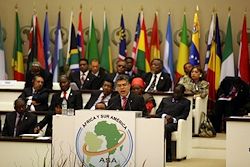
| The letter was read out yesterday (02/21/2013)by Venezuelan foreign minister Elias Jaua to the sixty-three countries at the III Africa – South America Summit (ASA), which is taking place in Equatorial Guinea. (MINCI) |
Mérida, 22nd February 2013 (Venezuelanalysis.com) –
Venezuelan president Hugo Chavez in an open letter has urged countries
of the South American and African continents to unite into a “true pole
of power”, while railing against recent Western interventions in Africa.
The letter was read out yesterday by Venezuelan foreign minister
Elias Jaua to the sixty-three countries at the III Africa – South
America Summit (ASA), which is taking place in Equatorial Guinea.
In the letter, Chavez called for “an authentic and permanent link of
joint work” between Africa and South America to search for strategies of
sustainable development that could benefit both continents.
“It’s in our continents, where enough natural, political and historic
resources are found…to save the planet from the chaos it’s been driven
towards [by the capitalist system],” he argued.
The Venezuelan president further urged countries of the two
continents “not to miss the opportunity…to unite the capacities of our
nations into a true pole of power”.
He also wrote that while “in no way do we deny our sovereign
relations with Western powers, we must remember that they are not the
source of the comprehensive and definitive solution to the problems that
our countries share”.
Venezuelan foreign policy during the Chavez presidency has held that
greater cooperation between Africa and Latin America is important to the
attainment of a “multipolar” world order, to counteract the dominance
of the United States and its allies.
Venezuela has been a key nation promoting the ASA Summit initiative,
hosting the II ASA Summit in 2009 and taking on the organisation’s
secretariat. The first summit was held in Nigeria in 2006.
In his letter Chavez urged that the pace of integration between the
two continents be picked up, and argued that priorities for cooperation
should be energy, education, agriculture, finance and communications.
He also suggested that Venezuela’s proposals for integration projects
be advanced, such as the University of the Peoples of the South,
Petrosur, and the Bank of the South. Trade between the two regions has
increased from US $7.2 billion in 2002 to $39.4 billion in 2011, Telesur
reports.
Representatives of other South American countries also argued for the
need to increase cooperation with Africa. Ecuador’s foreign minister,
Ricardo Patiño said that sometimes it had been difficult for the two
regions to reach agreements.
He said that this was because “we don’t know each other well, we
don’t have experience of joint work…there’s so much we can offer each
other, and not only in terms of commerce”. The minister argued that the
historic lack of cooperation between the two continents was rooted in
the legacy of colonialism by European powers.
Chavez claimed in his letter that modern-day intervention by Western
powers had interrupted the path of joint work between Africa and South
America set by the ASA summit in 2009.
Referring to Western interventions in Libya and Mali, among others,
Chavez wrote, “It’s not by luck or chance…[that] since the Summit in
Margarita (Venezuela) the African continent has been the victim of
multiple interventions and attacks by Western powers”.
The Venezuelan president argued that one of the objectives of these
interventions had been to put a brake on the consolidation of African
unity, in turn slowing cooperation between Africa and South America.
As such, Chavez repeated Venezuela’s “total rejection of all interventionist activity by NATO” in Africa and around the world.
The summit continues, with president of Bolivia Evo Morales and
summit host and president of Equatorial Guinea, Teodoro Obiang, making
speeches today.
Health update
The Venezuelan government released another update on Chavez’s health
yesterday as he is recovering from a cancer operation undergone last
December.
The official statement informed that “[Chavez’s] respiratory
insufficiency, emerging in the course of the post operatory phase,
persists and its tendency has not been favourable, due to which it
continues to be treated”.
“However, medical treatment for the base illness [cancer] continues,
without presenting any significant adverse effects up to now,” the
statement added.
Chavez returned to Venezuela on Monday after spending over two
months in Cuba recovering from his operation. He will continue to
receive treatment at the Dr. Carlos Arvelo military hospital in Caracas.
Source: venezuelanalysis.com
|