|
|
|
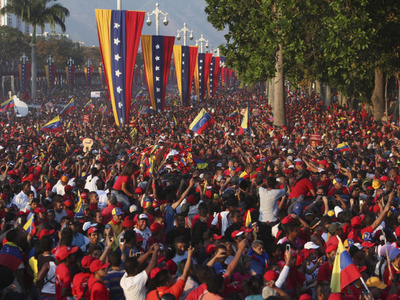
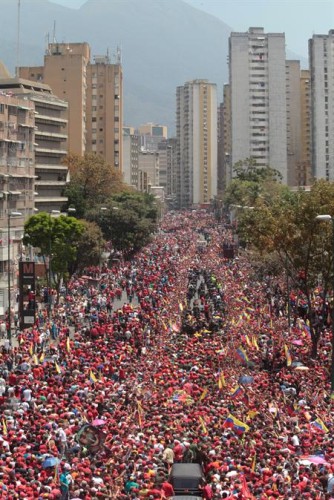
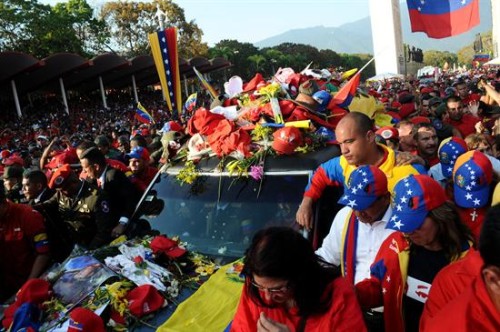
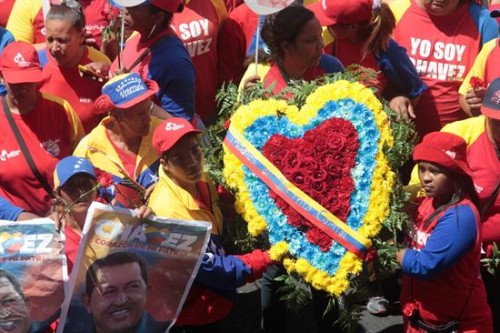
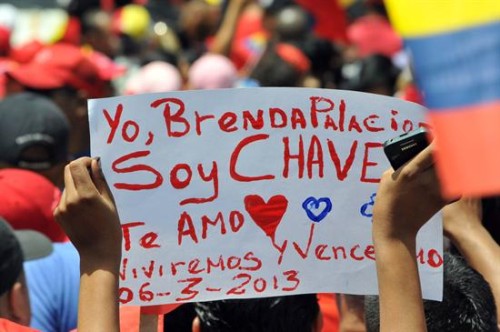
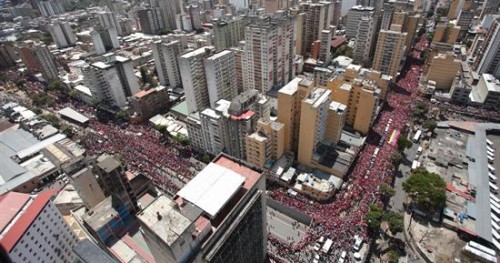
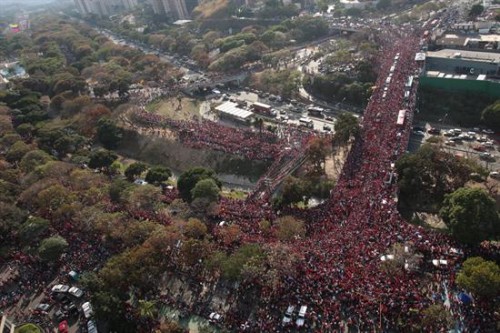
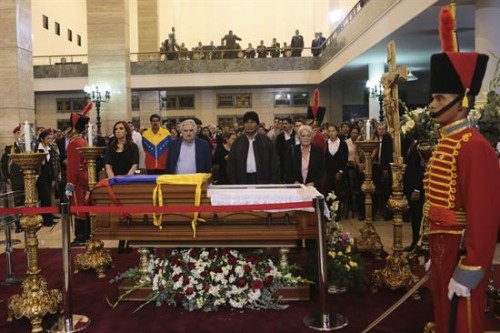
| Venezuelan people surround the coffin of President Chávez and place momentos on it as it passes through Los Proceres on way to the funeral at the Military Academy. Millions have waited in line for hours at the academy and passed by to pay their last respects to their beloved president 24 hours a day over the last seven days. |
Editor's Note: After reading Salim Lamrani's list of achievements by Hugo Chávez in Venezuela while serving 14 years as their democratically-elected president, can the reader have any wonder why he was so beloved by the people in Venezuela and around the world and why so reviled by the rich and the corporate governments of the world. We could add much more to this list including construction of a National Railroad System, still underway with the first line operational; the construction of cable car lines from the barrios to Central Caracas, reducing their travel to downtown from an hour or more to a few minutes; Mission Agro, bringing food-sovereignty to the nation and many more. All of these amount to the empowerment of the people. Lamrani's account of Chávez' victories for the people, in English and Spanish, is followed by photos.
- Les Blough in Venezuela
March 11, 2013
President Hugo Chávez, who died on March 5, 2013 of cancer at age 58, marked forever the history of Venezuela and Latin America.
- Never in the history of Latin America, has a political leader had such incontestable democratic legitimacy. Since coming to power in 1999, there were 16 elections in Venezuela. Hugo Chávez won 15, the last on October 7, 2012. He defeated his rivals with a margin of 10-20 percentage points..
- All international bodies, from the European Union to the Organization of American States, to the Union of South American Nations and the Carter Center, were unanimous in recognizing the transparency of the vote counts..
- James Carter, former U.S. President, declared that Venezuela’s electoral system was “the best in the world.”.
- Universal access to education introduced in 1998 had exceptional results. About 1.5 million Venezuelans learned to read and write thanks to the literacy campaign called Mission Robinson I.
- In December 2005, UNESCO said that Venezuela had eradicated illiteracy..
- The number of children attending school increased from 6 million in 1998 to 13 million in 2011 and the enrollment rate is now 93.2%..
- Mission Robinson II was launched to bring the entire populationon up to secondary level. Thus, the rate of secondary school enrollment rose from 53.6% in 2000 to 73.3% in 2011..
- Missions Ribas and Sucre allowed tens of thousands of young adults to undertake university studies. Thus, the number of tertiary students increased from 895,000 in 2000 to 2.3 million in 2011, assisted by the creation of new universities..
- With regard to health, they created the National Public System to ensure free access to health care for all Venezuelans. Between 2005 and 2012, 7873 new medical centers were created in Venezuela..
- The number of doctors increased from 20 per 100,000 population in 1999 to 80 per 100,000 in 2010, or an increase of 400%..
- Mission Barrio Adentro I provided 534 million medical consultations. About 17 million people were attended, while in 1998 less than 3 million people had regular access to health. 1.7 million lives were saved, between 2003 and 2011..
- The infant mortality rate fell from 19.1 per thousand in 1999 to 10 per thousand in 2012, a reduction of 49%..
- Average life expectancy increased from 72.2 years in 1999 to 74.3 years in 2011..
- Thanks to Operation Miracle, launched in 2004, 1.5 million Venezuelans who were victims of cataracts or other eye diseases, regained their sight..
- From 1999 to 2011, the poverty rate decreased from 42.8% to 26.5% and the rate of extreme poverty fell from 16.6% in 1999 to 7% in 2011..
- In the rankings of the Human Development Index (HDI) of the United Nations Program for Development (UNDP), Venezuela jumped from 83 in 2000 (0.656) at position 73 in 2011 (0.735), and entered into the category Nations with ‘High HDI’..
- The GINI coefficient, which allows calculation of inequality in a country, fell from 0.46 in 1999 to 0.39 in 2011..
- According to the UNDP, Venezuela holds the lowest recorded Gini coefficient in Latin America, that is, Venezuela is the country in the region with the least inequality..
- Child malnutrition was reduced by 40% since 1999..
- In 1999, 82% of the population had access to safe drinking water. Now it is 95%..
- Under President Chávez social expenditures increased by 60.6%..
- Before 1999, only 387,000 elderly people received a pension. Now the figure is 2.1 million..
- Since 1999, 700,000 homes have been built in Venezuela with many more under construction with the goal of 3,000,000 by 2015..
- Since 1999, the government provided / returned more than one million hectares of land to Aboriginal people..
- Land reform enabled tens of thousands of farmers to own their land. In total, Venezuela distributed more than 3 million hectares..
- In 1999, Venezuela was producing 51% of food consumed. In 2012, production was 71%, while food consumption increased by 81% since 1999. If consumption of 2012 was similar to that of 1999, Venezuela produced 140% of the food it consumed..
- Since 1999, the average calories consumed by Venezuelans increased by 50% thanks to the Food Mission that created a chain of 22,000 food stores (MERCAL, Houses Food, Red PDVAL), where products are subsidized up to 30%. Meat consumption increased by 75% since 1999..
- Five million children now receive free meals through the School Feeding Programme. The figure was 250,000 in 1999..
- The malnutrition rate fell from 21% in 1998 to less than 3% in 2012..
- According to the FAO, Venezuela is the most advanced country in Latin America and the Caribbean in the erradication of hunger..
- The nationalization of the oil company PDVSA in 2003 allowed Venezuela to regain its energy sovereignty..
- The nationalization of the electrical and telecommunications sectors (CANTV and Electricidad de Caracas) allowed the end of private monopolies and guaranteed universal access to these services..
- Since 1999, more than 50,000 cooperatives have been created in all sectors of the economy..
- The unemployment rate fell from 15.2% in 1998 to 6.4% in 2012, with the creation of more than 4 million jobs..
- The minimum wage increased from 100 bolivars ($ 16) in 1998 to 247.52 bolivars ($ 330) in 2012, ie an increase of over 2,000%. This is the highest minimum wage in Latin America..
- In 1999, 65% of the workforce earned the minimum wage. In 2012 only 21.1% of workers have only this level of pay..
- Adults at a certain age who have never worked still get an income equivalent to 60% of the minimum wage..
- Women without income and disabled people receive a pension equivalent to 80% of the minimum wage..
- Working hours were reduced to 6 hours a day and 36 hours per week, without loss of pay..
- Public debt fell from 45% of GDP in 1998 to 20% in 2011. Venezuela withdrew from the International Monetary Fund and World Bank, after early repayment of all its debts..
- In 2012, the growth rate was 5.5% in Venezuela, one of the highest in the world..
- GDP per capita rose from $ 4,100 in 1999 to $ 10,810 in 2011..
- According to the annual World Happiness 2012, Venezuela is the second happiest country in Latin America, behind Costa Rica, and the nineteenth worldwide, ahead of Germany and Spain..
- Venezuela offers more direct support to the American continent than the United States. In 2007, Chávez spent more than 8,800 million dollars in grants, loans and energy aid as against 3,000 million from the Bush administration..
- For the first time in its history, Venezuela has its own satellites (Bolivar and Miranda) and is now sovereign in the field of space technology. The entire country has internet and telecommunications coverage..
- The creation of Petrocaribe in 2005 allows 18 countries in Latin America and the Caribbean, or 90 million people, secure energy supply, by oil subsidies of between 40% to 60%..
- Venezuela also provides assistance to disadvantaged communities in the United States by providing fuel at subsidized rates..
- The creation of the Bolivarian Alliance for the Peoples of Our America (ALBA) in 2004 between Cuba and Venezuela laid the foundations of an inclusive alliance based on cooperation and reciprocity. It now comprises eight member countries which places the human being in the center of the social project, with the aim of combating poverty and social exclusion..
- Hugo Chávez was at the heart of the creation in 2011 of the Community of Latin American and Caribbean States (CELAC) which brings together for the first time the 33 nations of the region, emancipated from the tutelage of the United States and Canada.
- Hugo Chávez played a key role in the peace process in Colombia. According to President Juan Manuel Santos, “if we go into a solid peace project, with clear and concrete progress, progress achieved ever before with the FARC, is also due to the dedication and commitment of Chávez and the government of Venezuela.”.
Translation by Tim Anderson
Contacto: lamranisalim@yahoo.fr ; Salim.Lamrani@univ-reunion.fr
Página Facebook: https://www.facebook.com/SalimLamraniOfficiel
Source in Spanish Source in English.
Salim Lamrani is “*Doctor in Iberian and Latin American Studies at the Sorbonne in Paris, Salim Lamrani is a Senior Lecturer at the Reunion University and a journalist; he is a specialist in relations between Cuba and the United States. His last book (in French) is titled State of Siege. The Economic Sanctions imposed by the USA on Cuba, Paris, published by Ediciones Estrella 2011, with a prologue by Wayne S. Smith and a preface by Paul Estrade.
Ed. Note: Photos Follow the Spanish version of this article below. - lmb
El presidente Hugo Chávez, quien falleció el 5 de marzo de 2013 de un cáncer a los 58 años, marcó para siempre la historia de Venezuela y de América Latina.
- Jamás en la historia de América Latina, un líder político alcanzó una legitimidad democrática tan irrefutable. Desde su llegada al poder en 1999, hubo 16 elecciones en Venezuela. Hugo Chávez ganó 15, de las cuales la última fue el 7 de octubre de 2012. Siempre derrotó a sus rivales con una diferencia de 10 a 20 puntos..
- Todas las instancias internacionales, desde la Unión Europea hasta la Organización de Estados Americanos, pasando por la Unión de Naciones Suramericanas y el Centro Carter, se mostraron unánimes al reconocer la transparencia de los escrutinios..
- Jimmy Carter, antiguo presidente de Estados Unidos, incluso declaró que el sistema electoral de Venezuela era “el mejor de mundo”..
- La universalización del acceso a la educación instaurada en 1998 tuvo resultados excepcionales. Cerca de 1,5 millones de venezolanos aprendieron a leer y escribir gracias a la campaña de alfabetización denominada Misión Robinson I..
- En diciembre de 2005, la UNESCO decretó que se había erradicado el analfabetismo en Venezuela..
- El número de niños escolarizados pasó de 6 millones en 1998 a 13 millones en 2011 y la tasa de escolarización es ahora de 93,2%..
- La Misión Robinson II se lanzó para llevar al conjunto de la población a alcanzar el nivel secundario. Así, la tasa de escolarización en la enseñanza secundaria pasó de un 53,6% en 2000 a un 73,3% en 2011..
- Las Misiones Ribas y Sucre permitieron a decenas de miles de jóvenes adultos emprender estudios universitarios. Así, el número de estudiantes pasó de 895.000 en 2000 a 2,3 millones en 2011, con la creación de nuevas universidades..
- Con respecto a la salud, se creó el Sistema Nacional Público para garantizar el acceso gratuito a la atención médica a todos los venezolanos. Entre 2005 y 2012 se crearon 7.873 centros médicos en Venezuela..
- El número de médicos pasó de 20 por 100.000 habitantes en 1999 a 80 por 100.000 en 2010, o sea un aumento del 400%..
- La Misión Barrio Adentro I permitió realizar 534 millones de consultas médicas. Cerca de 17 millones de personas pudieron ser atendidas, mientras que en 1998, menos de 3 millones de vidas tenían acceso regular a la salud. Se salvaron 1,7 millones de vidas entre 2003 y 2011..
- La tasa de mortalidad infantil pasó de un 19,1 por mil en 1999 a un 10 por mil en 2012, o sea una reducción de un 49%..
- La esperanza de vida pasó de 72,2 años en 1999 a 74,3 años en 2011.
- Gracias a la Operación Milagro lanzada en 2004, 1,5 millones de venezolanos víctimas de cataratas u otras enfermedades oculares, recobraron la vista..
- De 1999 a 2011, la tasa de pobreza pasó de un 42,8% a un 26,5% y la tasa de extrema pobreza de un 16,6% en 1999 à un 7% en 2011..
- En la clasificación del Índice de Desarrollo Humano (IDH) del Programa de las Naciones Unidas para el Desarrollo (PNUD), Venezuela pasó del puesto 83 en el año 2000 (0,656) al puesto 73 en 2011 (0,735), y entró en la categoría de las naciones con el IDH elevado..
- El coeficiente GINI, que permite calcular la desigualdad en un país, pasó de 0,46 en 1999 a 0,39 en 2011..
- Según el PNUD, Venezuela ostenta el coeficiente GINI más bajo de América Latina, es el país de la región donde hay menos desigualdad..
- La tasa de desnutrición infantil se redujo en un 40% desde 1999..
- En 1999, el 82% de la población tenía acceso al agua potable. Ahora es un 95%..
- Durante la presidencia de Chávez, los gastos sociales aumentaron en un 60,6%..
- Antes de 1999, sólo 387.00 ancianos recibían una pensión. Ahora son 2,1 millones..
- Desde 1999, se construyeron 700.000 viviendas en Venezuela..
- Desde 1999, el gobierno entregó más de un millón de hectáreas de tierras a los pueblos aborígenes del país..
- La reforma agraria permitió a decenas de miles de agricultores ser dueños de sus tierras. En total, se distribuyeron más de 3 millones de hectáreas..
- En 1999, Venezuela producía el 51% de los alimentos que consumía. En 2012, la producción es de un 71%, mientras que el consumo de alimentos aumentó en un 81% desde 1999. Si el consumo de 2012 fuera similar al de 1999, Venezuela producirían el 140% de los alimentos consumidos a nivel nacional..
- Desde 1999, la tasa de calorías que consumen los venezolanos aumentó en un 50% gracias a la Misión Alimentación que creó una cadena de distribución de 22.000 almacenes de alimentos (MERCAL, Casas de Alimentación, Red PDVAL), donde se subvencionan los productos a la altura de un 30%. El consumo de carne aumentó en un 75% desde 1999..
- Cinco millones de niños reciben ahora alimentación gratuita a través del Programa de Alimentación Escolar. Eran 250.000 en 1999..
- La tasa de desnutrición pasó de un 21% en 1998 a menos del 3% en 2012..
- Según la FAO, Venezuela es el país de América Latina y del Caribe más avanzado en la erradicación del hambre..
- La nacionalización de la empresa petrolera PDVSA en 2003 permitió a Venezuela recuperar su soberanía energética..
- La nacionalización de los sectores eléctricos y de telecomunicación (CANTV y Electricidad de Caracas) permitió poner término a situaciones de monopolio y universalizar el acceso a estos servicios..
- Desde 1999, se crearon más de 50.000 cooperativas en todos los sectores de la economía..
- La tasa de desempleo pasó de un 15,2% en 1998 a un 6,4% en 2012, con la creación de más de 4 millones de empleos..
- El salario mínimo pasó de 100 bolívares (16 dólares) en 1998 a 247,52 bolívares (330 dólares) en 2012, o sea, un aumento de más del 2.000%. Se trata del salario mínimo más elevado de América Latina..
- En 1999, el 65% de la población activa cobraba el salario mínimo. En 2012 sólo el 21,1% de los trabajadores disponen de este nivel salarial..
- Los adultos de cierta edad que nunca trabajaron disponen de un ingreso de protección equivalente al 60% del salario mínimo..
- Las mujeres desprotegidas así como las personas discapacitadas reciben una ayuda equivalente al 80% del salario mínimo..
- El horario laboral se redujo a 6 horas diarias y a 36 horas semanales sin disminución del salario..
- La deuda pública pasó de un 45% del PIB en 1998 al 20% en 2011. Venezuela se retiró del Fondo Monetario Internacional y del Banco Mundial rembolsando con anticipación todas sus deudas..
- En 2012, la tasa de crecimiento de Venezuela fue del 5,5%, una de las más elevadas del mundo..
- El PIB por habitante pasó de 4.100 dólares en 1999 a 10.810 dólares en 2011..
- Según el informe anual World Happiness de 2012, Venezuela es el segundo país más feliz de América Latina, detrás de Costa Rica, y el decimonoveno a nivel mundial, delante de Alemania o España..
- Venezuela ofrece un apoyo directo al continente americano más importante que Estados Unidos. En 2007, Chávez dedicó más de 8.800 millones de dólares a donaciones, financiaciones y ayuda energética contra sólo 3.000 millones de la administración Bush..
- Por primera vez en su historia, Venezuela dispone de sus propios satélites (Bolívar y Miranda) y es ahora soberana en el campo de la tecnología espacial. Hay Internet y telecomunicaciones en todo el territorio..
- La creación de Petrocaribe en 2005 permite a 18 países de América Latina y del Caribe, o sea 90 millones de personas, adquirir petróleo subvencionado a la altura del 40% al 60%, y asegurar su abastecimiento energético..
- Venezuela brinda también ayuda a las comunidades desfavorecidas de Estados Unidos proporcionándoles combustible con tarifas subvencionadas..
- La creación de la Alianza Bolivariana para los Pueblos de nuestra América (ALBA) en 2004 entre Cuba y Venezuela asentó las bases de una alianza integradora basada en la cooperación y la reciprocidad, que agrupa a 8 países miembros, y que ubica al ser humano en el centro del proyecto de sociedad, con el objetivo de luchar contra la pobreza y la exclusión social..
- Hugo Chávez está en el origen de la creación en 2011 de la Comunidad de Estados Latinoamericanos y Caribeños (CELAC) que agrupa por primera vez las 33 naciones de la región, que se emancipan así de la tutela de Estados Unidos y de Canadá..
- Hugo Chávez desempeño un papel clave en el proceso de paz en Colombia. Según el presidente Juan Manuel Santos, “si avanzamos en un proyecto sólido de paz, con progresos claros y concretos, progresos jamás alcanzados antes con las FARC, es también gracias a la dedicación y al compromiso de Chávez y del gobierno de Venezuela”.
Doctor en Estudios Ibéricos y Latinoamericanos de la Universidad Paris IV-Sorbonne, Salim Lamrani es profesor titular de la Universidad de la Reunión y periodista, especialista de las relaciones entre Cuba y Estados Unidos. Su último libro se titula Etat de siège. Les sanctions économiques des Etats-Unis contre Cuba, París, Ediciones Estrella, 2011, con un prólogo de Wayne S. Smith y un prefacio de Paul Estrade.
Contacto: lamranisalim@yahoo.fr ; Salim.Lamrani@univ-reunion.fr
Página Facebook: https://www.facebook.com/SalimLamraniOfficiel
|