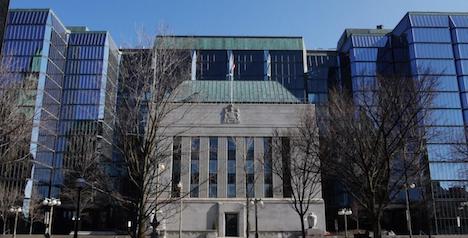
Governments that borrowed interest-free from Bank of Canada now incur massive debts borrowing from private banks Most Canadians are not aware that, prior to 1975, the construction of major public facilities, as well as the provision and improvement of social programs, were funded by interest-free loans from the Bank of Canada. Such loans helped Canada recover from the Great Depression of the 1930s and to achieve a prompt and prosperous economic boom after the Second World War. The construction of the Trans-Canada Highway, the St. Lawrence Seaway, modern airports and seaports, and other essential parts of Canada's infrastructure were all accomplished with Bank of Canada loans. And because they were essentially interest-free, they caused only a small increase in the government's debt. After 1975, however, when Ottawa abruptly started borrowing from private banks instead of "the people's bank" for large public projects, the steep interest rates it then had to pay built up steadily mounting debts. Most provincial and municipal governments, too, although the Bank of Canada could also have legally extended loans to them, have piled up massive debts from private bank loans over the past four decades. Our governments at all levels are now collectively paying some $60 billion in interest on these debts every year. "This enormous debt burden need never have been incurred," says George Crowell, a retired University of Windsor professor. "It deprives our governments of revenue that could be used instead for much-needed improvements to our social and economic services." Instead, both Liberal and Conservative governments not only flatly refuse to resume borrowing from the Bank of Canada, "but also use their deliberately incurred debts as an excuse for cutting public programs and services instead of preserving and expanding them. "At the same time," Crowell notes, "they keep reducing the tax rates on profitable corporations and wealthy individuals who don't need tax relief -- and many of whom evade the taxes they owe, anyway, by stashing their wealth in offshore tax havens." Ford and Edison favoured government funding Political and business leaders scoff at Crowell and other knowledgeable monetary critics, even dismissing them as impractical idealists or even "crackpots." I could continue to quote the irrefutable arguments that Crowell and other financial experts advance for going back to the pre-1975 Bank of Canada borrowing system, but instead will quote the salient views of two famous Americans: industrialist Henry Ford and inventor Thomas Edison. Ford and Edison were great friends. They often met to discuss current events and issues, including the construction of the huge Muscle Shoals water plant on the Tennessee River in 1928. They both claimed that this massive public edifice should be funded by the federal government rather than by borrowing from the private banks. They regarded the charging of high interest rates by the banks as a form of usury that caused social and economic inequities. Were Ford and Edison daydreamers or left-wing crackpots? Decide for yourself after reading the following excerpts from their interviews with the press. Henry Ford's interview FORD: "Army engineers say it will take $40 million to complete this big dam, but Congress is not in a mood just now to raise that amount through taxation. The customary alternative is to float 30-year bonds at 4 per cent. That means the United States government, to obtain $40 million to finance construction of a great public benefit, will have to go to the private money-sellers to buy its own money.Thomas Edison's interview Reporter: "What do you think of Henry Ford's proposal to finance Muscle Shoals by an issue of currency instead of bonds?" * * * Despite these compelling arguments by Ford and Edison for government funding of the Muscle Shoals dam construction, the U.S. Congress instead went ahead and borrowed the $40 billion from the private money-lenders at high interest rates, enriching them with $88 million of taxpayers' money. Ford and Edison, despite their fame and financial expertise, could not match the overwhelming political influence of the banks, Goldman Sachs, Citigroup, and other big investment firms. The same profligate private-borrowing system still prevails in the United States, and, since 1975, also in Canada. And the irrefutable case for government funding put forward by Crowell and other progressive financial analysts in this country are as rudely dismissed by our government as were the equally powerful arguments made back in 1928 by Ford and Edison. Such a horrific and needless mass transfer of billions of dollars from taxpayers to the banks and money-brokers is even more inexcusable in Canada than it is in the United States. We actually had an effective and virtually interest-free system of funding large public projects prior to 1975, before the Bank of Canada was callously stripped of that immensely beneficial public function. It's interesting that the provisions in the Bank of Canada Act that originally authorized the Bank to fund public projects have never been deleted from the Act. The Bank could therefore resume that advantageous operation any time a federal government directed or permitted it to do so. However, given the preference of our predominant neoliberal parties to coddle and subsidize the banks and big corporations rather than improve Canadians' standard of living, that's not likely to happen any time soon. Or at least not until a great many more Canadians become aware of the enormous and inexcusable waste of billions of their tax dollars that is incurred by needlessly borrowing from private banks instead of the People's Bank. Source URL |