By Translated for Axis of Logic by Agatha Haun*, revised by Yoo Hong; Axis of Logic and Solidarity for Peace and Reunification of Korea (SPARK)
Axis of Logic and Solidarity for Peace and Reunification of Korea (SPARK); translated by Tlaxcala*
Another translation for Axis of Logic by Tlaxcala!*
(Translator’s note: “Strategic flexibility” is the official term used by military and political officials to refer to the concept of altering the mission of the United States Forces in Korea (USFK) so that they will be able to use the ROK as a staging area for offensive military ventures elsewhere in the Asia-Pacific area. Under the original terms of the MDT, the USFK were restricted to a defensive role, helping to protect the ROK in case of an attack by North Korea. The implementation of strategic flexibility is part of the present restructuring of the US military forces, realignment of bases, and other measures intended to make it easier for the US to project military power anywhere in the world and to maintain military superiority on a permanent basis. - Agatha Haun
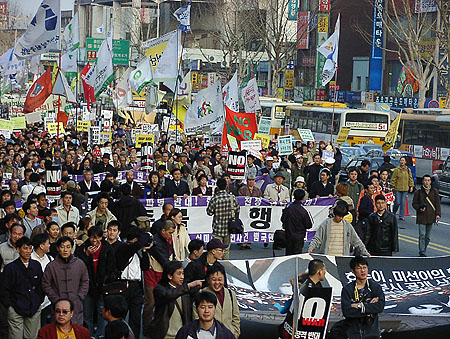
We resolutely condemn the agreement on strategic flexibility for the United States Forces in Korea.
It was announced on 20 January that the Republic of Korea (ROK) and the United States have agreed on the policy of strategic flexibility for the United States Forces in Korea (USFK), at the cabinet-level “strategic consultation” held in Washington.
We have already pointed out that when the USFK’s strategic flexibility is confirmed, it will be a serious threat to peace not only on the Korean peninsula, but also in Northeast Asia and the whole world. Therefore we strongly denounce this agreement and demand that it be revoked.
We oppose the USFK’s strategic flexibility, which will aggravate or provoke hostilities and discord instead of preventing or peacefully resolving conflicts.
Obtaining strategic flexibility for the USFK is a core strategy, which the US is pushing forward in order to consolidate its military hegemonism.
Similar to the invasion of Iraq, this makes it easier for the US – in the name of the so-called “war on terror” – to rapidly deploy the USFK in illegal wars, to contain China using military force, to launch a preemptive strike against North Korea, and so on.
The purpose of such strategic flexibility for the USFK is not to prevent conflicts or peacefully resolve conflicts.
On the contrary, there is the danger that by making it easier for the USFK to intervene militarily, it will bring about new conflicts and disputes and lead to disaster.
That is exactly why we oppose strategic flexibility for the USFK.
Under no circumstances can we allow the USFK’s strategic flexibility to turn the Korean peninsula into a forward base for the US’s military operations.
It means that authorization of the USFK’s strategic flexibility makes it more probable that the Korean peninsula will be dragged into a conflict because of the USFK’s military intervention in the region beyond the Korean peninsula.
At the same time, as a consequence of having provided large bases to the USFK, various agreements and laws, and the institutional support system, Korea will find itself in the position of supporting the US’s military operations.
The government claims that the US accepts Korea’s non-intervention policy with reference to Northeast Asian disputes, but at a time when the USFK is using the land, air space, and territorial waters of the Korean peninsula for military purposes, this glosses over the fact that Korea can’t avoid becoming involved in some kind of conflict.
Instead, this agreement by the government means that Korea promises to serve as a forward base which gives full backing to US military operations.
This agreement is in complete violation of both our constitution, which explicitly ordains pacifism, and the Korean-US Mutual Defence Treaty, which stipulates that the USFK’s role in Korea is solely defensive.
Moreover, the peace and prosperity policy, and the ROK’s role in creating a balance of power in Northeast Asia, which the No Mu Hyeon government has advocated, are also inconsistent.
If Korea is a state that aspires to peace, we believe that we must firmly resist the US’s military domination and must not give any military support to that.
We are opposed to the USFK’s strategic flexibility, which nullifies the efforts to secure peace on the Korean peninsula and in Northeast Asia.
We cannot help but be concerned that, in view of the fact that the USFK’s strategic flexibility is designed to increase military pressure on North Korea and China, this agreement can also have an adverse effect on the Six-Party Talks, which are now deadlocked.
This is because the USFK’s strategic flexibility makes it possible to put into effect the US’s military strategy, which includes the Bush administration’s doctrine of preemptive strike – even though the 19 September joint statement promised to exclude the use of military force against North Korea.
Furthermore, accepting the USFK’s coming and going on the Korean peninsula, while they maintain a large-scale military force and bases on the peninsula, can only be interpreted as an indication that Korea will be enrolled in the regional alliance led by the United States.
That means that in the process of containing mainland China and strengthening the US-Japan alliance, it is increasingly probable that Korea will be mixed up in the re-establishment of the wholly unwanted new Cold-War-like order in Northeast Asia.
This agreement must be rescinded in view of the fact that in this way, the USFK’s strategic flexibility can become a major obstacle to the effort to de-nuclearize the Korean peninsula and to establish a multilateral peace and security structure in Northeast Asia.
The government must cancel the agreement on the USFK’s strategic flexibility and first conduct a national debate about the realignment of the alliance and consult public opinion concerning this.
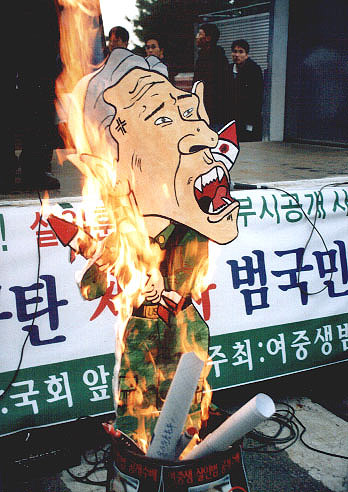 We cannot refrain from also expressing our outrage at the government’s way of negotiating with the US.
The government has consistently conducted in secret all the negotiations concerning the realignment of the alliance, controlled information, and issued one-sided reports.
This case was no exception.
As we also saw in the case of the Yongsan garrison relocation, while the government completely cuts off the public’s access to information, it exaggerates the miserable outcome of the negotiations, portraying it as a great success.
Such an attitude on the part of the government makes it difficult for the people to sincerely believe what the government says regarding negotiations with the US.
While the USFK’s strategic flexibility -- which is equivalent to the “software” of the realignment of the alliance – has been confirmed, now that the negotiations on the US base relocation have been completed – which can be called the “hardware” – the alliance’s future is going in the direction of confirming the US’s military supremacy.
However, the USFK’s strategic flexibility and the USFK’s changed status directly affect peace on the Korean peninsula and since this will impose a massive financial burden on the people, the government should first go through the process of a national discussion and consult public opinion.
That is because the stationing of large numbers of US troops – although there have been many controversies and conflicts about the USFK over the last several decades – has been tolerated since they were here to defend the Korean peninsula.
The government has to explain clearly to the public the changed rationale for stationing the USFK and must consult the Korean people about their attitude toward strategic flexibility and where the alliance is going.
If the realignment of the Korean-US alliance goes on in this one-sided way, the government must clearly understand that it can’t avoid strong public resistance.
- Cancel the agreement on the USFK’s strategic flexibility, which ignores public opinion.
- We firmly condemn the government’s secret negotiations and its one-sided manipulation of information.
- We demand that the people in charge of the negotiations, beginning with Foreign Minister Ban Ki Mun, be investigated and held accountable.
- The National Assembly must open hearings about all negotiations concerning the agreement on the USFK’s strategic flexibility, the negotiations about the US bases, and the realignment of the alliance.
2006-1-23
Green Korea United
National Association of Professors for Democratic Society
Korean People’s Solidarity
People’s Solidarity for Participatory Democracy
Solidarity for Unification
Women Making Peace
Centre for Peace Museum
Peacemaking
Solidarity for Peace and Reunification of Korea
Citizens’ Solidarity for Peace and Unification
Korean Federation for Environmental Movement
© Copyright 2006 by AxisofLogic.com (translation copyright)
 Translated from Korean into English for Axis of Logic by Agatha Haun, a member of Tlaxcala. Tlaxcala is the network of translators for linguistic diversity (Contact Tlaxcala). This translation is on Copyleft.
Photos from Koreans Against War




 Print This
  Print This