|
|
|
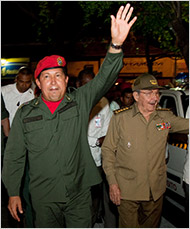
President Hugo Chavez of Venezuela and President Raúl Castro of Cuba on Thursday at a meeting of leftist governments in Venezuela on Thursday. (Carlos Garcia Rawlins/Reuters) |
Other leaders here said that in watching Mr. Obama extend his hand to Cuba, they felt they were witnessing a historic shift.
Cuba is not on the official agenda here; indeed, Cuba, which has been barred from the Organization of American States since 1962, is not even on the guest list. But leaders in the hemisphere have spent months planning to make Cuba an issue here.
The White House was well aware that if Mr. Obama did not address it head on, the issue would overwhelm the rest of the summit gathering. Earlier this week, the president opened the door to the discussions by abandoning longstanding restrictions on the ability of Cuban-Americans to travel freely to the island and send money to relatives there.
“I know there is a longer journey that must be traveled in overcoming decades of mistrust, but there are critical steps we can take toward a new day,” Mr. Obama said, adding that he was “prepared to have my administration engage with the Cuban government on a wide range of issues — from human rights, free speech, and democratic reform to drugs, migration, and economic issues.”
Mr. Obama’s message was not entirely new; he has said in the past that he was willing to engage with Cuba. But making a public pledge before leaders of 33 other nations, many of whom he had not yet met, gave his words added heft.
He came here with the aim of reaching out to leaders in a region that felt ignored by the United States during the Bush years. Just as he campaigned on the theme of change when running for the White House, he made change a theme of his speech here, saying: “I didn’t come here to debate the past. I came here to deal with the future.”
On Cuba, the president’s words were as notable for what he said as for what he did not say. He did not scold or berate the Cuban government for holding political prisoners, as his predecessor, former President George W. Bush, often did.
But he also did not say that he was willing to support Cuba’s membership in the Organization of American States, or lifting the 47-year-old trade embargo against Cuba, as some hemisphere leaders here want him to do.
“Let me be clear,” Mr. Obama said. “I am not interested in talking for the sake of talking. But I do believe we can move U.S.-Cuban relations in a new direction.”
Those sentiments drew warm praise from leaders like President Cristina Fernandez de Kirchner of Argentina and President Daniel Ortega of Nicaragua. Mr. Ortega, who said he felt ashamed that he was participating in the summit without the presence of Cuba, evoked images of the collapse of the Berlin wall, saying, “I am convinced that wall will collapse, will come down.”
Ms. Kirchner praised Mr. Obama for “what you did to stabilize the relationship from the absurd restrictions imposed by the Bush administration,” adding: “We sincerely believe that we in the Americas have a second opportunity to construct a new relationship. Don’t let it slip away.”
Mr. Obama’s speech on Friday night was only the latest in a string of overtures between the two countries. On Thursday, Raúl Castro, Cuba’s president, used unusually conciliatory language in describing the Obama administration’s decision to lift restrictions on family travel and remittances.
“We are willing to discuss everything, human rights, freedom of press, political prisoners, everything, everything, everything they want to talk about, but as equals, without the smallest shadow cast on our sovereignty, and without the slightest violation of the Cuban people’s right to self-determination,” Mr. Castro said in Venezuela during a meeting of leftist governments meant as a counterpoint to this weekend’s summit meeting in Trinidad.
On Friday, Mrs. Rodham Clinton responded, saying, “We welcome his comments, the overture that they represent, and we’re taking a very serious look at how we intend to respond.”
Earlier this week Brazilian officials signaled in Rio de Janeiro that President Luiz Inacio Lula da Silva, potentially flanked by Colombian President Alvaro Uribe, would raise the issue of accepting Cuba into the O.A.S. at the summit. Cuba’s “absence is an anomaly and he is waiting for this situation to be corrected,” Marco Aurelio Garcia, Mr. da Silva’s foreign policy adviser, told reporters.
Perhaps Cuba’s greatest ally at the gathering is President Hugo Chávez of Venezuela, who frequently referred to former President Bush as “the devil.” Mr. Chávez recently said he would refuse to sign the official declaration produced at the summit because Cuba was not admitted.
There are no plans for Mr. Chávez and Mr. Obama to meet privately, but White House officials said the two would participate in at least one small group leaders’ meeting.
But in a sign of how times have changed, Mr. Obama was photographed sharing a hand clasp and a seemingly warm smile with Mr. Chávez here.
Alexei Barrionuevo contributed reporting.
New York Times
RELATED ANALYSIS
Obama begins with a gambit in the US-Cuba chess match
¡La Cuba cambiante!
Julia Terreu, Radio Adelaide, interviews Les Blough on US and Cuba Relations
U.S. wants to "come in from the cold" to warmer environs in Cuba
The Rory Story of how the US is going to save Cuba





 Print This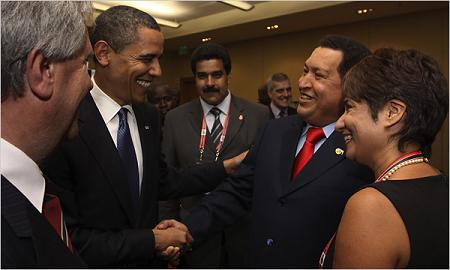
 Print This