|

|
|
By Luke Salkeld
The Daily Mail.uk
Monday, Jun 8, 2009
Meteorologists campaign to classify unique 'Asperatus' clouds seen across the world
Whipped into fantastical shapes, these clouds hang over the darkening landscape like the harbingers of a mighty storm.
But despite their stunning and frequent appearances, the formations have yet to be officially recognised with a name.
They have been seen all over Britain in different forms - from Snowdonia to the Scottish Highlands - and in other parts of the world such as New Zealand, but usually break up without producing a storm.
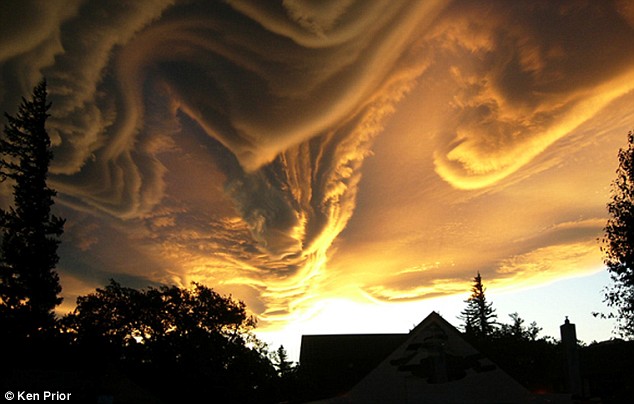 |
| Stunning but undefined: The clouds loom over the skies of New Zealand - but unfortunately words can't describe this dramatic vision from the heavens. |
And some experts believe the stormy weather phenomenon deserves its very own classification.
Experts at the Royal Meteorological Society are now attempting to make it official by naming it 'Asperatus' after the Latin word for 'rough'.
If they are successful, it would be the first variety of cloud formation to be given a new label in over half a century.
'It is a bit like looking at the surface of a choppy sea from below,' said Gavin Pretor-Pinney, founder of the Cloud Appreciation Society, who identified the cloud from photographs sent in by members.
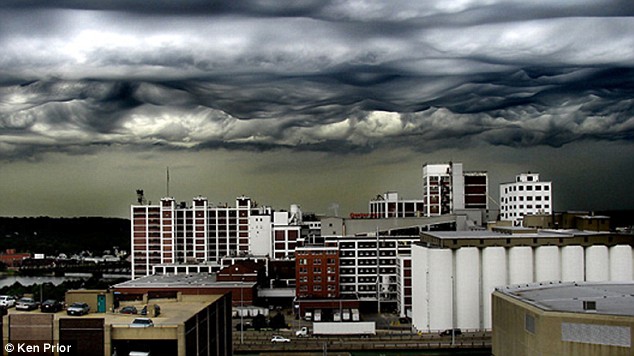 |
| Dramatic: The ribbons across the sky look like a 'choppy sea viewed from below'. |
'We try to identify and classify all of the images of clouds we get in, but there were some that just didn't seem to fit in any of the other categories, so I began to think it might be a unique type of cloud.'
He added: 'The underside of the clouds are quite rough and choppy. It looks very stormy, but some of the reports we have been getting suggest that they tend to break up without actually turning into a storm.'
The Royal Meteorological Society is now gathering detailed information for the days and locations where the asperatus clouds have been seen in an attempt to understand exactly what is causing them.
|
| Dramatic: The ribbons across the sky look like a 'choppy sea viewed from below'. |
Officials will then apply to the UN's World Meteorological Organisation in Geneva to have the new cloud type considered for addition into the International Cloud Atlas, the system used by meteorologists across the globe.
Professor Paul Hardaker, Chief Executive of the RMS, said: 'There would probably need to be quite a lot of heat around to produce the energy needed to generate such dramatic cloud formations.
'They are quite dark structures so there must be a lot of water vapour condensing in the cloud.'
Daily Mail.uk
 Print This Print This
|
If you appreciated this article, please consider making a donation to Axis of Logic.
We do not use commercial advertising or corporate funding. We depend solely upon you,
the reader, to continue providing quality news and opinion on world affairs. Donate here
|
|
World News

|




 Print This