Gladson Dungdung, a Human Rights Activist and Writer from
Jharkhand, examines the origins of India’s modern class struggle and
the hypocrisy surrounding its architect, Jawaharlal Nerhu.
The India’s first Prime Minister, Jawaharlal Nerhu, who is also
known as the architect of modern India, once said, “Dams are the
temples of modern India.” According to him, the big dams would address
the issues of hunger and poverty of India. Unfortunately, the big dams
only created pains, sufferings and sorrows to the owners (mostly the
Adivasis; the indigenous people of India) of the lands, which were
submerged by the temples of modern India. Similarly, the big steel
companies like Heavy Engineering Corporation, Bokaro Steel Limited, and
the mining industry created only misery for the Adivasis. Consequently,
the Adivasis became landless, daily wage labourers and servants of the
bigwigs after losing their land, forest, water and other livelihood
resources.
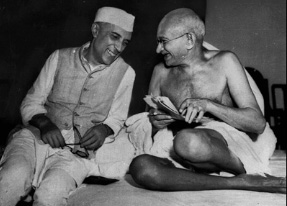 |
| India’s first Prime Minister, Jawaharlal Nerhu, pictured here sitting with Mohandas K. Gandhi. |
|
Ironically, the architect of modern India did not create space for
the Adivasis in their own modern country. He only inspired them to add
more sufferings to their lives for the sake of national interest,
saying, “If you are to suffer, you must suffer in the interest of the
country.” Perhaps, the Adivasis never knew what that meant, because
they have always suffered for the national interest but never enjoyed
the fruits, or given place in history or remembered in the holy land of
martyrs in the Nation’s capital. Needless to say, the architect of
modern India did not even bother to count the people who have suffered.
Nearly 50 million have sacrificed everything for the national interest:
Among them 40 percent are Adivasis, 20 percent are Dalits and rest 40
percent are the people of other backward classes. Indeed, the elites
have never suffered for the national interest as they are born only to
enjoy the fruit. And of course the country protects them in every
manner possible.
However, when the issues of the Adivasis are discussed, Nehru is
always remembered for his ‘Panchsheel for tribal development’, which is
also called the five pillars of the tribal development. But does his
panchsheel work for the Adivasis? Of course, it does not. In fact,
Nehru himself went against the principles of Panchsheel and so did the
Congress party and other Indian rulers. The history suggests that some
policies were made only to close the Adivasi mouths. According to
Vincent Ekka of the Indian Social Institute, whenever the Adivasis
protest against unjust policies of the state, they are given a taste of
the fruit, like some rights on paper, to keep them muzzled like dogs.
Obviously, Nehru’s Panchsheel is the best in principle but the worst in
practice as it was made for keeping Adivasis silent.
1. Non-imposition: The first pillar of Panchsheel
says that the Adivasis should be allowed to progress according to their
own pace and understanding of the situation. In principle, it seems to
be very good but practically, the Indian government went against it.
The most important question is, how can you ask the Adivasis to go with
their pace and understanding if you snatch their livelihood resources
in the name of the national interest and then do not provide them with
support? The idea of Nehru was just like a day dream. The fact is the
Adivasis’ indigenous method of development was never counted by people
of the mainstream society. The corporate development model was imposed
on them instead. The Indian rulers never walk their talk for the
Adivasis. In the last 6 decades, many policies have been made, which
displaced, dispossessed and deprived the Adivasis from their livelihood
resources and rehabilitation was never a concern for the government.
They were much too concerned about the corporate houses.
2. Respect of tribal customs: The second pillar of
Panchsheel also did not work because the Adivasi tradition, culture and
customs were never accepted by the Aryan invaders. Only the folk songs
and dances of the Adivasis were romanticized to some extent – but the
tradition, culture and ethos, which are based on community living,
equality for all and a need-based economy were always neglected,
depicted as vulgar and destroyed in many ways. Similarly, the Adivasis
religion was never recognized by the Indian constitution—though, many
other religions emerging much later in India, were. As a result,
thousands of the Adivasis accepted other religions, and religious
enmity was created among them and thousands of their sacred groves were
destroyed in the name of ‘development’. Where is the principle of
Panchsheel buried?
3. Development of tribal youth: The third pillar
speaks about the leadership of the Adivasis. But the fact of the matter
is the Adivasi leadership is not acceptable to the so-called people of
the mainstream Indian society. For example, history proves that the
Adivasis legend Baba Tilka Manjhi was the first man to fight against
the Britishers in 1780 and subsequently hanged, but he was not
recognized by historians of the mainstream. Similarly, other Adivasis
leaders: Sidho-Kanhu, Birsa Munda, Fulo-Jhano, Nilambar-Pitambar and
many others fought against the British government but they, too, were
not given their deserved space in India’s history. Therefore, the
Nehru’s third pillar doesn’t make any sense to the Adivasis. As far as
the Adivasis are concerned, they have always groomed, inspired and
promoted youth leadership in their community.
4. Simplicity of Administration: The fourth Pillar
of Panchsheel seems to be very good idea as the Adivasis’ strong
traditional system of self-governance (TSG) exists even today. The
Britishers were not able to destroy it, so they accepted it and made
laws for its protection and promotion. Ironically, the rulers of modern
India, including Nehru, did not accept the Adivasis’ TSG. Instead, he
preferred the voluntary agencies for carrying out development work in
the Adivasi regions. The Adivasis’ traditional self governance was not
accepted precisely because it was a biggest threat to the authorities
of Indian rulers. Though the Indian constitution has some provisions
for the Adivasis regions as 5th and 6th schedules, there was never any
attempts to strengthen their traditional self-governance. In fact, the
Indian rulers wanted the Adivasis regions under their control – so they
imposed legislation – Forest Acts, Laws to protect wildlife,
land-related Laws, mining Acts and various civil as well as criminal
laws. Finally, they captured the natural resources of these regions and
exploited it as much as they could.
5. Emphasis on human growth: The fifth pillar of
Panchsheel emphasizes human growth in terms of living standards, which
is appreciable. But as far as the Adivasis are concerned, they are not
even accepted today as human. They are always portrayed as uncivilized,
sub-human, demons, forest-dwellers and mindless people. The Aryans
invaders never treated the Adivasis as equal human beings. The Adivasis
are always racially discriminated, exploited and dispossessed. The
question is, if you take away the livelihood resources of Adivasis
without providing them alternatives, discriminate against them and
treat them like sub-humans then how can you expect their human growth?
The Adivasis regions lack education, health facilities, drinking water,
sanitation and shelter—even today, due to the deliberate inhuman
treatment of Adivasis by the Indian rulers.
Undoubtedly, Nehru is the architect of modern India, but it is also
the fact that his modern temples of India, industrialization process
and corporate model of development are the main reasons for the
Adivasis’ pains, sufferings and sorrows. Indeed, he is the architect of
the Adivasis’ misery. Today, millions of the Adivasis are struggling
for their survival, as a result of Nehru and his Congress Party. Later
on, the right wing and the left wing also added salt on the wounds.
Therefore, now we (the Adivasis) must realize that no one can fight for
us but we have to fight for ourselves. If we protect our natural
resources today, we would be ensuring a better future for our children
tomorrow. Before, we go for another movement against displacement, we
must pray to our super natural God for not to forgive Nehru because he
knew what he did to us. He created misery for us, he ensured that we
must suffer and he turned our heaven into hell. His temples of modern
India dispossessed us, his temples of modern India exploited us and his
temples of modern India created graves for us.
Gladson Dungdung is a Human Rights Activist and Writer from Jharkhand. He can be reached at gladsonhractivist at gmail.com
Intercontinental Cry





 Print This
  Print This