Trying to make a living as a farmer in Gaza these
days is taking a toll on the family ties so integral to the Palestinian
culture. Traditionally, occupations are passed from father to son for
generations, and their tie to the land is particularly strong. Before
Israel imposed a suffocating blockade on the 14-kilometer-long Gaza
Strip in 2007 (as punishment for electing Hamas as its governing
party), farmers could make a good living growing carnations and
strawberries for export and vegetables for the local market.
But now, sons are watching their
fathers struggle just to make ends meet, and are either forced to get
second jobs or are looking for different futures for themselves and
their families – at the same time that their fathers need them on the
farm more than ever, because they can no longer afford to hire
additional help.
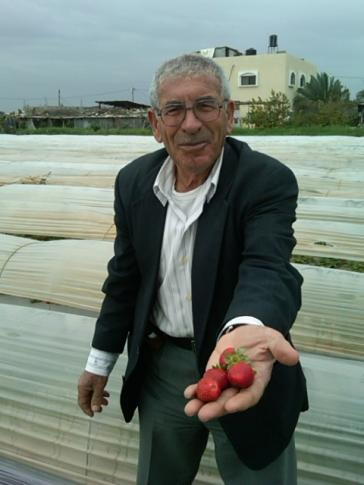 |
| Ahmad Shafi shows off Gaza’s strawberries, once considered the reddest and sweetest in the world. (Pam Bailey) |
|
“Our young people are no longer optimistic about the future; farming seems like a dead end to them,”
says Ahmad Shafi, chair of the Gaza Cooperative Association for Produce
and Marketing of Vegetables, through an interpreter. Shafi was born to
a farmer and has six sons himself – two are now engineers in the United
States, three teach as well as farm their family’s 50 dunums (12 acres)
and one is still a student. He adds that with 85 percent of Gazans now
below the poverty line – including farmers – making it impossible for
traditional men to support their families, tension in the home
increases. According to the United Nations Development Fund for Women
(UNIFEM), reports of domestic violence cases significantly increased
both during and after the 2008-9 Israeli invasion – in part due to a
loss of dignity and self-sufficiency.
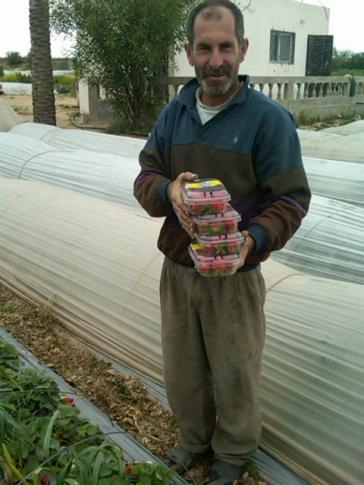 |
| Ahmed Shafi’s brother still farms, but also works as an accountant.
(Pam Bailey) |
|
Prior to the closing of the Israeli “noose,” as many as
35 trucks of produce were exported every working day of the
agricultural export season (November-March) — mainly cherry tomatoes,
flowers (carnations and roses) and strawberries. In addition, Gazans
exported another 35 trucks of goods such as furniture, clothing,
processed food, metal products and handicrafts. Gaza exports accounted
for 10.8% of the total Palestinian gross domestic product (including
the West Bank), valued at $330 million.
All that changed, however, in 2007, when the Israelis
imposed its blockade. Estimated annual losses from the inability to
export agricultural products alone stand at approximately $32 million,
and tens of thousands of people have lost their livelihoods. Flowers
and strawberries are the only small bright spot, thanks to a program
sponsored by the Dutch government. (Meanwhile, the United States Agency
for International Development stopped all funding of projects in Gaza,
sending its aid only to the West Bank.)
The Dutch government now insists that Israel permit
Gaza’s flowers and strawberries to reach European markets as an
exception to the ban on all other kinds of export — a ban that has
forced other donors to convert development programs into humanitarian
handouts.
However, Israel has kept a lid on even that program.
For example, the strawberry season begins in November, but Israel did
not let any of the fruit leave the Strip until early January, missing
much of the holiday season. By that time, product from Egypt and Spain
had flooded the market and the price had dropped. According to Shafi,
only 55 tons of strawberries have been exported this growing season,
compared to an average of 1,800 tons before the siege. As a result,
only 300 Palestinians in Gaza still grow strawberries for export,
compared to more than 500 before 2007.
“Israel knows exactly what it is doing,” observes Shafi. “It is very political and seems intent on allowing us to do just enough business to survive, but that’s all.”
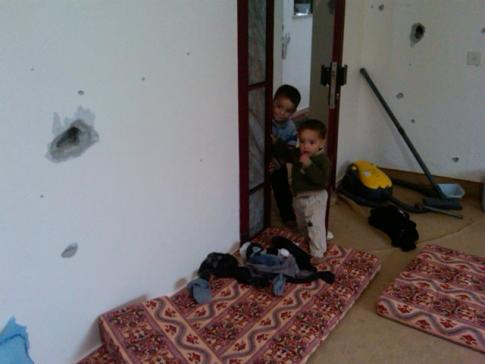 |
| Ahmed Shafi’s home was in the line of israeli fire during 2008/9 invasion. Note the walls damaged by gunshot. (Pam Bailey) |
|
In addition to limiting exports, Israel prevents
materials such as insecticides and “starter” strawberry plants from
entering Gaza, making it difficult for farmers to continue to grow.
Another Israeli tactic, says Shafi, is to publicize the rare openings
of the border in such a way that if the farmers don’t export whatever
they have – whether the fruit is ready or not – they are blamed for not
taking advantage of their neighbor’s “generosity.” Poor-quality fruit
is exported as a result.
What’s ironic is that Israel originally encouraged
Gazans to grow strawberries. Shafi explains that before the Six-Day
(1967) War, northern Gaza was especially famous for its citrus
plantations. But then in 1968, Israel — itself a major citrus producer
and now in control of Gaza — pushed Gazan farmers to grow strawberries
and flowers instead, to stifle any competition. With the two intifadas
– and particularly the second, which started in September 2000 –
Israeli forces began to bulldoze the groves, saying they gave cover to
militants. Fortunately, the sandy soil and “sweet water” from the local
wells in the Beit Lahiya neighborhood were perfect for the two crops.
Likewise, until 2007, the Gazans’ reliance on Israeli wholesalers made
the sector a rare beacon of co-existence.
The siege has darkened that one bright spot. However,
the people have farming in their blood and are still fighting, with the
help of a few European countries, primarily the governments of the
Netherlands and Spain. Mohammad El-Bahry, executive director of the
Union of Agricultural Work Committees in Gaza, describes through an
interpreter how his organization is working to empower rural women, who
are disproportionately represented among the poor, through three
centers it has set up in the north, south and central regions. The
centers train the women in leadership, teamwork, human rights and
vocational skills. Over the last three years, almost 1,000 women have
participated.
“To be truly free, both women and men must be able to generate income,”
El-Bahry explains. His union represents 29 general agricultural
committees, as well as 19 specifically for women. For example, the
women at the union’s centers are being equipped to contribute to the
family food and income by raising rabbits and chickens. The meat can be
sold as well as put on their own tables, helping to reduce the anemia
that is increasingly common among women in the south (42 percent) and
north (39 percent) of Gaza. El-Bahry adds that there also is a worrying
increase in cancers and birth defects among women in those regions, and
the UN has promised to investigate. In addition to poor healthcare,
El-Bahry suspects that soil contaminated during repeated Israeli
invasions is at fault. Google Earth photos of the Beit Lahiya area over
the past 10 years show a dramatic “browning” of the once-lush terrain.
The union has also helped its fellow farmers by
consulting on how to cope with the increasing saltiness of the ground
water. The poor quality of groundwater is due in part to
over-extraction from the aquifer, which has allowed salty seawater to
seep in.
“Israel steals much of the good water we have,” he explains, “and then tries to sell it back to us at very high prices.”
Much of the groundwater that is left in Gaza is unfit for human use,
and toxic to agriculture. Desalination is extremely expensive (about
half the cost of land, says El-Bahry), so farmers have had to switch
from crops like eggplants and cucumbers that require sweet water to
tomatoes, palm trees and some fruits that can tolerate salt. However,
tomatoes, he says, command a much lower price than other crops.
El-Bahry’s union also has worked with the Palestinian
Authority to enforce a law exempting them from paying a 14.5 percent
sales tax, and set up committees to talk about their rights and
increase their role in political and social decision-making. A UN
survey conducted among 1,100 households last year found that 85 percent
of men and 88 percent of women reported they had not been involved in
any consultation on the planning or design of humanitarian assistance
in their community. The union wants to change that.
“Farming is a long tradition in Gaza,” says Jameel El-Zaaneen, chairman of the union’s board of directors. “Our entire mission is to preserve that for future generations.”
The photo on the homepage was taken by Abib Katibb for LIFE.
Palestine Monitor





 Print This
  Print This