 |
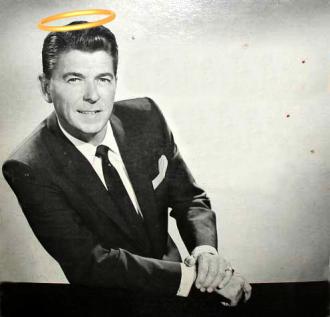
| New education standards in Texas present a glowing view of conservatism, Christianity, capitalism and U.S. military might. |
|
POP QUIZ: What do you get when you allow Texas right-wingers to rewrite social studies textbooks?
A) A defense of McCarthyism
B) Excision of important Latino and African American cultural figures like Cesar Chavez, Thurgood Marshall and Harriet Tubman
C) Removal of key events in the fight for women's suffrage and African American history
D) Poorly educated kids and a bigoted view of history
E) All of the above
If you guessed E, give yourself a gold star.
Last month, the Texas Board of Education approved a host of
curriculum changes to history and economics textbooks that are the
stuff conservative dreams are made of.
By a 10-to-5 vote, the board voted for curriculum changes "stressing
the superiority of American capitalism, questioning the Founding
Fathers' commitment to a purely secular government and presenting
Republican political philosophies in a more positive light," according
to the New York Times.
And, surprise surprise, the 10 board members who voted in favor of the changes are all Republicans.
"We are adding balance," Dr. Don McLeroy, the leader of the conservative faction on the board, told the Times after the vote. "History has already been skewed. Academia is skewed too far to the left."
McLeroy's day job? He's not an educator or an historian--he's a dentist.
Despite the fact that people like McLeroy might consider themselves experts, the Times noted that, "There were no historians, sociologists or economists consulted at the meetings."
So, exactly what are some of the changes that these self-styled
experts made to "correct" the curriculum--which will remain in place
for the next 10 years? Among other things, they are making sure
students learn more about the heyday of U.S. conservatism by adding a
plank about the importance of "the conservative resurgence of the 1980s
and 1990s, including Phyllis Schlafly, the Contract With America, the
Heritage Foundation, the Moral Majority and the National Rifle
Association."
As historian Eric Foner noted in The Nation, there's nothing
wrong with students learning about the conservative movement. But the
new historical "standards" are a thinly veiled excuse to expose
students to right-wing propaganda--and a worldview that glorifies
capitalism, social conservatism, American military might, nationalism
and any number of other pet causes of the right.
As Foner wrote:
Judging from the updated social studies curriculum, conservatives want
students to come away from a Texas education with a favorable
impression of: women who adhere to traditional gender roles, the
Confederacy, some parts of the Constitution, capitalism, the military
and religion. They do not think students should learn about women who
demanded greater equality; other parts of the Constitution; slavery,
Reconstruction and the unequal treatment of nonwhites generally;
environmentalists; labor unions; federal economic regulation; or
foreigners...
The changes seek to reduce or elide discussion of slavery, mentioned
mainly for its "impact" on different regions and the coming of the
Civil War. A reference to the Atlantic slave trade is dropped in favor
of "triangular trade." Jefferson Davis's inaugural address as president
of the Confederacy will now be studied alongside Abraham Lincoln's
speeches.
- - - - - - - - - - - - - - - -
YET THE Republicans on the board are not only attempting to
indoctrinate students with an interpretation of historical events that
are in many cases patently false. They're also out to polish the image
of social conservatism by taking credit where credit is most certainly
not due.
This effort includes new standards on teaching the civil rights
movement. Under the new rules, "textbooks would mention the votes in
Congress on civil rights legislation, which Republicans supported."
"Republicans need a little credit for that," McLeroy commented to the Times. "I think it's going to surprise some students."
Sure, the Republicans can be proud of their party's history on civil
rights--back when it was the party of Abe Lincoln. But that's not what
the board members had in mind. And it's a good bet that Republican
"achievements" in civil rights won't include discussion of prominent
civil rights opponents like Barry Goldwater or, whoops, George H.W.
Bush, who campaigned against the 1964 Civil Rights Act when he was
running for the Senate. They likely won't be mentioning that, while
running for governor in 1966, Ronald Reagan encouraged the repeal of
the Fair Housing Act. He explained why: "If an individual wants to
discriminate against Negroes or others in selling or renting his house,
it is his right to do so."
In addition, Texas school kids will now be learning history that's even whiter than before.
According to the Dallas Morning News,
Peter Marshall--an evangelical minister who was one of six handpicked
"experts" who advised the board on the changes--spoke out last year
against inclusion of both United Farm Workers organizer Cesar Chavez
and Supreme Court Justice Thurgood Marshall, the first African American
justice on the Court.
Hispanic board members were largely defeated on proposals to include more Latino role models. According to the New York Times,
one member of the board, Mary Helen Berlanga, left the meeting in
protest, saying of her fellow board members: "They can just pretend
this is a white America and Hispanics don't exist...They are going
overboard, they are not experts, they are not historians. They are
rewriting history, not only of Texas but of the United States and the
world."
Another change--this one personally pushed by McLeroy would, in the words of the New York Times,
"ensure that students study the violent philosophy of the Black
Panthers in addition to the nonviolent approach of the Rev. Dr. Martin
Luther King Jr."
Abolitionist Harriet Tubman has been removed as an example of "good
citizenship" for third graders in favor of Red Cross founder Clara
Barton. (Although the board did include Helen Keller--presumably only
because they were unaware that Keller was a dedicated socialist and
anti-imperialist.)
Progressives are, naturally, targets for the new standards. One of
the newly approved changes mandates that students study "the unintended
consequences" (presumably negative) of the Great Society legislation,
affirmative action and Title IX legislation.
And socialists and communists are particularly vilified in an
amendment that requires that the history of McCarthyism now include
"how the later release of the Venona papers confirmed suspicions of
communist infiltration in U.S. government."
There you go...the Red Scare and McCarthysm were entirely justified.
Why? Because a dentist and other members of the Texas Board of
Education say so.
The benefits of capitalism as an economic system are also to be
reinforced. The revisions add Milton Friedman and Friedrich von Hayek
to the usual list of economists to be studied. And, because of its
"negative connotation," the term "capitalism" is being replaced with
"free-enterprise system." (One imagines that a few too many members of
the board might have been called "capitalist pigs" in their time.)
Even poor Thomas Jefferson didn't pass muster for the Texas board.
He was cut from a list of people whose writings inspired 18th and 19th
century revolutions--and replaced with St. Thomas Aquinas, John Calvin
and William Blackstone.
The reason? Conservatives didn't want to emphasize Jefferson's pesky
belief in the necessity of a wall of separation between church and
state.
In another of the more ridiculous amendments, Republican board
member Cynthia Dunbar unsuccessfully tried to strike from the standards
any reference to the Scopes "monkey trial" that put teaching about
evolution on trial. Dunbar also sought to eliminate the famed defense
attorney Clarence Darrow as well as the Black nationalist leader Marcus
Garvey.
- - - - - - - - - - - - - - - -
AS MAVIS Knight, a Democrat on the Texas Board of Education, told the New York Times, "The social conservatives have perverted accurate history to fulfill their own agenda."
But the new conservative history "standards" on Texas are hardly an
anomaly. Witness Virginia, for example, where Republican Gov. Bob
McDonnell recently declared April to be "Confederate history month." In
his proclamation "honoring" soldiers who fought on the side of the
South, however, McDonnell made one small omission: he neglected to say
a word the institution of slavery or about the millions of slaves who
lives and labor built the South. According to the Washington Post,
McDonnell justified his omission by claiming that "there were any
number of aspects to that conflict between the states. Obviously, it
involved slavery. It involved other issues. But I focused on the ones I
thought were most significant for Virginia."
Funny that McDonnell didn't realize that slavery might be
significant to the African Americans who can trace their roots to human
chattel brought to plantations in Virginia.
Unfortunately, it's not just Texas kids who may suffer the
consequences of their new curriculum. Texas is one of the largest
buyers of textbooks in the country--which means that the curriculum
changes could be forced into other states' textbooks, since
larger-selling books are generally cheaper, an attractive feature to
cash-strapped school districts.
"The books that are altered to fit the standards become the
bestselling books, and therefore within the next two years they'll end
up in other classrooms," Fritz Fischer, chairman of the National
Council for History Education, told the Washington Post. "It's not a partisan issue, it's a good history issue."
The irony, of course, is that while the right wing harps endlessly
about how leftists "indoctrinate" children with left-wing ideas through
liberal education "biases," the revisions to the Texas curriculum are a
blatant ideological attack designed to reach the minds of kids and
teens. With right-wing social conservatism largely discredited, and
poll after poll showing young people to be more liberal than previous
generations on a host of social issues, it's not surprising why
conservatives might be desperate to push back in whatever way they can.
But just because conservative ideas are enshrined in textbooks
doesn't guarantee that their ideas will gain more currency. As Howard
Zinn put it in a 2005 essay "Changing minds, one at a time,"
presenting a people's history requires breaking down the barriers that
keep ordinary people from feeling as though we can not only study
history, but make it:
It is a challenge not just for the teachers of the young to give them
information they will not get in the standard textbooks, but for
everyone else who has an opportunity to speak to friends and neighbors
and work associates, to write letters to newspapers, to call in on talk
shows.
The history is powerful: the story of the lies and massacres that
accompanied our national expansion, first across the continent
victimizing Native Americans, then overseas as we left death and
destruction in our wake in Cuba, Puerto Rico, Hawaii, and especially
the Philippines. The long occupations of Haiti and the Dominican
Republic, the repeated dispatch of Marines into Central America, the
deaths of millions of Koreans and Vietnamese, none of them resulting in
democracy and liberty for those people.
Add to all that the toll of the American young, especially the poor,
Black and white, a toll measured not only by the corpses and the
amputated limbs, but the damaged minds and corrupted sensibilities that
result from war.
Those truths make their way, against all obstacles, and break down
the credibility of the warmakers, juxtaposing what reality teaches
against the rhetoric of inaugural addresses and White House briefings.
The work of a movement is to enhance that learning, make clear the
disconnect between the rhetoric of "liberty" and the photo of a
bloodied little girl, weeping.
And also to go beyond the depiction of past and present, and suggest
an alternative to the paths of greed and violence. All through history,
people working for change have been inspired by visions of a different
world. It is possible, here in the United States, to point to our
enormous wealth and suggest how, once not wasted on war or siphoned off
to the super-rich, that wealth can make possible a truly just society.
The juxtapositions wait to be made...The false promises of the rich
and powerful about "spreading liberty" can be fulfilled, not by them,
but by the concerted effort of us all, as the truth comes out, and our
numbers grow.
And that's a fact that even the Texas Board of Education can't write out of history.
Socialist Worker





 Print This
  Print This