 |
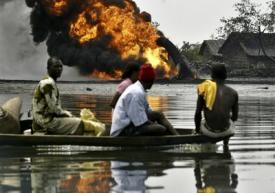
| In this Dec. 22, 2005 file photo, people evacuate their homes by boat, as they pass smoke and flames billowing from a burning oil pipeline belonging to the Shell Petroleum Development Company, across the Opobo Channel in Asagba Okwan Asarama, Nigeria. |
|
Oil gushing from an undersea well in the Gulf of Mexico has damaged
BP's reputation and share price but accidents involving other companies
in less scrutinized parts of the world have avoided the media glare.
Investors have knocked around $30 billion off BP's value since an
explosion at a drilling rig killed 11 people and began an oil spill the
London-based major is struggling to plug nearly a month after the
accident happened.
The U.S. media and political machine has
turned its full force on BP and U.S. President Barack Obama has set up
a commission into the leak which is sending an estimated 5,000 barrels
per day (bpd) into Gulf of Mexico waters.
In contrast, the
international media has largely ignored the latest incidents of
pipeline damage in Nigeria, where the public can only guess how much
oil might have been leaked.
The most recent damage in Nigeria,
which has not been attributed to militant attacks that have preyed on
Nigerian oil infrastructure for years, forced U.S. operator ExxonMobil
to relieve itself of contractual obligations by declaring force majeure
on its exports of Nigerian benchmark crude.
The light sweet crude
is particularly well-suited for refining into gasoline and is regularly
supplied to the United States, the world's biggest oil burner.
Exxon declined the opportunity to give details of the damage, clean-up or repair work.
An
industry source, who declined to be named, said 100,000 bpd of oil had
leaked for a week from a pipeline that has since been mended.
"If
this (the BP spill) were in the Niger Delta, no one would be batting an
eyelid," said Holly Pattenden, African oil analyst at consultants
Business Monitor International. "They have these kind of oil spills in
Nigeria all the time."
SHARE PRICE IMPACT
BP's share price
has fallen around 18 percent since news of the fire at the drilling
station on April 20, while Exxon shares were largely unchanged after
the force majeure announcement.
The largest operator in Nigeria,
Royal Dutch Shell has clashed with the Nigerian government for decades
following numerous spills in Africa's largest energy producer.
Shell
said in a statement on its website that its Nigerian joint venture
cleans up oil spills as quickly as possible, no matter what their
cause, but is sometimes delayed by security concerns or because some
communities deny access.
The Anglo-Dutch major said the volume of
oil spills in Nigeria for its joint venture was almost 14,000 tonnes
last year, the equivalent of around 280 bpd, mainly because of militant
attacks on facilities.
"It (the U.S.) is without doubt the worse
place for BP to lose their political capital," said James Marriott, oil
and gas analyst at environmental organization Platform.
"If the
U.S. administration gets aggressive against BP, then it's a problem for
them offshore, onshore in terms of shale gas, for conventional gas,
refining, some cross-border projects with Canada and further afield."
In
the United States, BP's massive spill and the risk of an environmental
catastrophe could have implications throughout the industry as it has
reopened the debate about deepwater drilling.
Analysts say, however, the world is hugely dependent on deepwater drilling to secure oil supplies.
The
ExxonMobil force majeure relates to shallow offshore oil, but much of
West Africa's crude production, like that in the U.S. Gulf of Mexico,
is deepwater.
Analysts say it is unrealistic to veto deepwater drilling if the world's oil needs are to be met.
"Perhaps
in terms of health and safety regulation (things will change), but not
in terms of drilling," said Angus McPhail of Wood Mackenzie consultants.
"It
is not really feasible to stop drilling altogether as long as there is
good demand for the product.... It would be total economic madness."
(Additional reporting by Barbara Lewis in London and Randy Fabi in Abuja; editing by Anthony Barker)
Reuters





 Print This
  Print This