Turkey’s awakening: Its gradual exit from the Western camp
 Print This Print This
By Excerpt GEAB N°39
GEAB
Friday, Oct 8, 2010
Taking advantage of the ongoing systemic crisis, and of the weakening of
the US and of the Western superstructure over which the latter’s might
is based, Turkey has entered a process of fundamental redefinition of
its key geopolitical interests. The new priorities ready to break out by
2012 will account for Ankara’s most profound reappraisal since the
country joined NATO in 1952. This process illustrates a return to the
Kemalist vision of Turkey’s vital interests (1) i.e., different from the
agenda set for the country by big powers. It is quite ironical that
this evolution is initiated by leaders of religious-oriented party, the AKP.
There will be substantial geopolitical, economic and commercial
consequences to this strategic shift which challenges the traditional
vision of a pro-Western Turkey waiting to join the EU.
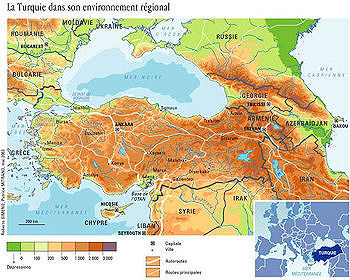 |
| Turkey and its regional environment - Source: Comité Valmy |
In the Eastern Mediterranean region, the relation with Israel is often a
reliable indicator of a country’s relation with the Western camp
altogether. Indeed, for more than a decade, the West has been defining
itself along the Washington/Tel Aviv guiding line. But, in this regard,
in the past few months, Turkey seems to have undertaken to move away
from this line which, for many years, it used to follow as closely as
possible. The attack on Gaza by the Israeli army in December 2008 is the
marking event of this change of tone first, of orientation then. Since
then, Ankara has gradually undertaken to move all the way backward along
the road to its diplomatic and military cooperation with Tel Aviv. Two
recent examples: Ankara’s decision to ban Israeli air force drills from
Turkey; and its barring Israel from participating in a NATO exercise in
October 2009 (2), soon followed by the announcement that Turkey would
hold military exercises with Syria (3). We are far from the military and
strategic behavior expected from a faithful ally of the United States
and a prominent member of NATO.
However, changes in strategic priorities in the region have been
brewing ever since the USSR collapsed, turning Turkey’s decade long and
cold war-related dead-end position into a wide open space with huge
cultural, economic and commercial potentialities. Since then, under the
compliant Turkey, it was possible to catch glimpses of a country
growingly reluctant to put the uniform lent by a Western world with
regional aims more and more alien to Turkish interests (4). As long as
the Cold War went on and the Soviet threat was on the borders, Turkey
agreed to be a “Western tower” on the Middle-East chessboard. But since
1989, interests between the Tower and the King or Queen have
increasingly diverged, a bad omen for the rest of the game on two
aspects:
. on the one hand, Turkey will get increasingly reluctant to
comply with Washington’s exhortations, as already suggested by a series
of negative reactions (5) which provoked an upsurge of hostility towards
Turkey within NATO. Something new is happening: the legitimacy of
Turkey’s NATO membership is being questioned by leaders from other NATO
member states.
. on the other hand, Washington’s and/or the Alliance’s policy in
the region will be growingly hampered by a reluctant Turkey developing
its own specific regional strategic approach, possibly opposed to
NATO’s. Ankara’s good relations with Tehran (6), far from the ideas of
sanction or embargo vigorously advocated by Washington, provide another
glowing warning signal.
In short, the Turkey/NATO relationship is about to reach a point
of no-return. The Turkish case is another striking example of the
general process of disintegration currently affecting the Alliance (a
theme already developed in previous GEABs) whose leader no longer has
neither the vision nor the means required to control all its members.
Ironically, it appears to LEAP/E2020 that the other component of
Turkey’s « anchoring » to the West, i.e. the promise of EU accession,
will be the decisive factor in Turkey’s exit from the Western camp.
Indeed this unkeepable promise, result of EU leaders’ lack of courage
and imagination which led to official entry talks in 2005, will create
two important conditions of the new orientation of Turkish foreign
policy:
. first, the democratic requirements linked to EU accession have
gradually compelled the Turkish military to go back to their barracks
and stay there. For decades, they were used to run the country in the
shadow of political puppets, dismissing them if necessary when some
electoral outcome annoyed them. Thinking of themselves as protectors of
Ataturk’s legacy, in fact they were mostly concerned about controlling
the country and making the most of the NATO, EU and US manna rewarding
their loyalty to the Western camp (7). As they grew weaker, they
deprived the West from its most faithful ally in Turkish society.
Another example of the irony of History.
. secondly, EU’s obvious reluctance (among the general public in
particular (8)) to the perspective, even far in the future, of Turkey’s
accession became clear for Turkish citizens in the past four years.
Meanwhile, the discovery that the so-called « accession negotiations »
(9) were no negotiations at all but on the contrary an obligation for
Turkey to comply with the 90,000 pages of EU’s legal, moral, commercial
and cultural corpus (the timing of the « acquis communautaire
From Russia (whose nationals flock Turkish beaches) to Central
Asia (where Ankara is conducting a proactive trade and cultural policy
towards Turkish speaking countries), Iran and Syria, Turkey is quick in
building a new diplomacy intended as a synthesis between the political
and historical territories of the Ottoman legacy, Muslim religious
proximity and its own specific interests as a regional power and
crossroads. The combination is played by means of pendulum effects in
which NATO and the EU are becoming mere components of Ankara’s
diplomatic game, and no longer a basic data (which NATO used to be) or
main objective (which the EU used to be).
Americans and Europeans shouldn’t be mistaken! According to
LEAP/E2020, there will be no turning back. Since NATO is in a process of
disintegration, there is no reason why Ankara should stop going it
alone to this intermediary position at the centre of a geopolitical
equilibrium involving Russia, the EU, Iran and any influential power
between its Southern border and Egypt (Washington, for the time being).
NATO’s last loyal allies are the generals of the Turkish army. In ten
years from now, around 2020, they will be replaced by younger
generations (11) who will agree on seeing their country in the future as
a “bridge between East and West”, knowing that a bridge doesn’t belong
to any of the banks it connects, otherwise it is no longer a bridge but a
dead-end (12).
» is the only negotiable thing), has triggered a feeling of rejection
among Turkish population of what suddenly appeared as a “colonialism by
law”. Little by little, the under-forty Turkish generations began to
think that the Europeans didn’t want them and that their country was
therefore engaged in a dead-end. This process of awareness is a key
phenomenon because it has put an end to forty years of an unchallenged
official stance according to which EU entry was the sole desirable
future for the country. Simultaneously, the Muslim party in power (who
supported the project of EU accession under duress only (10)) gained the
support of a non-religious stream of opinion opposed (or at least
reluctant) to EU entry.
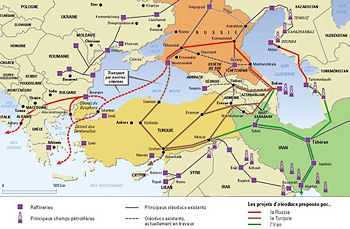 |
| Turkey at the centre of the energy supply network - Source: JapanFocus, 12/2007 |
This goes for the European Union too. Even if the political will
is now missing, Brussels’ and Ankara’s bureaucracies will certainly go
on with the accession negotiations. But they will never be finalized,
sinking year after year into the quagmire of general indifference.
Indeed an enlargement is only the result of some political will. But the
main supporter of this enlargement, i.e. Washington, now has other fish
to fry and lacks the necessary influence to overcome the strong
opposition of the European general public (they can’t even convince
European troops to stay in Afghanistan). As to the EU, no political
leader will take Turkey’s entry as a workhorse by fear of losing the
election. From Ankara’s point of view, an alternative future to a
European Turkey has appeared. If the EU understands that and soon
proposes a state-of-the-art strategic partnership to Turkey, this dream
will be one of a Turkish Turkey at crossroads between the various
surrounding powers. But if Brussels sticks to its accession project,
leaving no alternative, it runs the risk to push Turkey in the opposite
direction, that of a Muslim Turkey. Ironically, one often gets the
opposite of what he strove to get if he fails to take into consideration
the dreams and expectations of the concerned people.
In conclusion, according to our team, Turkey’s shift out of the
Western camp, itself in decay, far from being a problem for Europe, is
only another facet of the global systemic crisis and of the gradual
obliteration of structures inherited from the post-1945 world, thanks to
which, by 2015, the Europeans could have a Turkish partner, with an
appeased identity, able to be a useful intermediary in their relation
with the Middle-East and Central Asia.
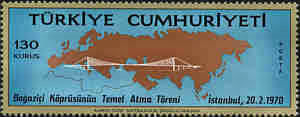 |
| Turkey: a « Pont Neuf » (13) between East and West |
Notes:
(1) Kemal Atatürk,
founder of modern Turkey, has indeed imagined and wished for his
country to diverge both from its Ottoman past and from decisions set by
the big powers of the beginning of the 20th century (UK and France in
particular). The fact that he rejected the Treaty of Sèvres and the
consequences it had on Turkish territory is meaningful in this regard.
In his political will, he also clearly expressed what kind of a thread
could link him to any future heirs: “I leave behind no verse, dogma, or
arcane doctrine as my moral heritage. Rationality and science are to be
regarded as my legacy. (…) Time flows quickly; subject also to flux is
the perception or interpretation of happiness and misery by nations,
societies, and individuals. In this world, claiming to spell out certain
fixed, unchangeable ideas denies both the existence of rationality and
science. (…) Thus, those who desire to follow in my footsteps can only
assume the role of my moral inheritors if they affirm the primacy of
rationality and science.” They could be for instance those who would
have the courage to dismiss obsolete recipes.
(2) Source: Reuters, 10/14/2009
(3) We remember Turkish Prime Minister Recep Erdogan’s
scene in Davos in January 2009 when he suddenly left the floor because
he couldn’t speak the same amount of time as Israeli President Shimon
Peres. Source: Tribune de Genève, 01/30/2009
(4) As already suggested by the difficulties met by Washington in
persuading Ankara to let them use their Turkish bases for attacking Iraq
in 2002/2003.
(5) Like in April 2009, when Turkey opposed to Fogh Rasmussen’s
NATO bid as new Secretary General because of his support to Danish media
over the caricature crisis. Source: France 24, 04/03/2009
(6) Turkish Prime Minister Recep Erdogan insists on calling
Iranian President Mahmoud Ahmadinejad a friend of Turkey and declares
that he won’t accept double standards towards Iran on nuclear issues.
Source: The Guardian, 10/26/2009
(7) The IMF also played an important role in this regard, as
Turkey has been one of its biggest clients for decades, thus enabling
the West to run the country by proxy. The country’s exit from IMF’s
adjustment programme in 2008 is also the moment when this strategic
shift in Turkish diplomacy became visible. As a matter of fact, Ankara
is now extremely reluctant to sign any new loan agreement with the IMF.
Sources: EurAsiaNet, 07/02/2009; BrettonWoodsProject, 06/17/2009
(8) An increasing proportion among the European elite no longer
wishes Turkey to join the EU. Turkey’s recent diplomatic shift has
persuaded them that Ankara’s vision of the future is less and less
compatible with the EU project. Source : EUObserver, 04/04/2009
(9) For decades, the Turkish elites, never denied by their EU
counterparts, made their citizens believe Turkey’s EU accession was a
process where each party covered half of the road. In 2005, this idea
started to be recognized as a lie.
(10) Traditionally, the pro-Muslim movement in Turkey was opposed to EU entry. But if Paris is well worth a mass, Ankara was well worth a hypothetical enlargement.
(11) In the coming five years, the risk remains that a bunch of
worn out generals backed by Washington tries some military coup. But
this risk is small and would probably end up like the Russian generals’
coup against Mikhail Gorbachev in 1991.
(12) In fact Turkey is a double-bridge: between East and West, but
also between Black Sea and Mediterranean. Moreover, in the 21st
century, a bridge will also (especially) be a pipeline (gas or oil), a
field where Turkey is also a central player thanks to the Nabucco project whose key is Iran.
(13) The « Pont Neuf » is, as its name doesn’t tell, Paris’ oldest bridge.
GEAB
 Print This Print This

|