GRAPH: Income Inequality In U.S. Worse Than Ivory Coast, Pakistan, Ethiopia
Print This
By Special Report
Think Progress
Friday, May 6, 2011
May 4, 2011
As ThinkProgress has repeatedly noted, crucial services and public investments for Main Street America are being guttedas taxes on the richest Americans are the lowest they’ve been in a generation. Yet many Americans may not know exactly how unfair this is, as the country has grown increasingly unequal at the same time. Using data from the CIA Factbook based on the Gini coefficient — a measure of income inequality within a society — ThinkProgress has assembled the following graph, which demonstrates that the United States is now about as economically unequal as Uganda and more unequal than countries like Pakistan or the Ivory Coast:
Income inequality in the United States is actually higher than at any other time in modern history since the Great Depression. There is also a tremendous amount of inequality even in life expectancy, with the American Human Development Index reporting in 2010 that there is now a 6 year gap in average life expectancy between Mississippi, in the Deep South, and Connecticut, in prosperous New England.” As ThinkProgress previously reported [see TP report below], one of the major factors in this hike in income inequality has been the decline of unionization in America.
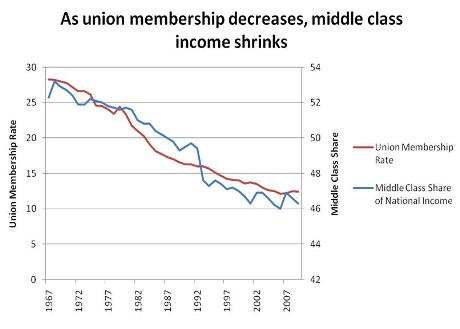
Across the country, right-wing legislators continue their attack on labor unions, claimingthat they are saving their states money. Yet in waging these anti-labor campaigns, these politicians are ignoring one very simple fact: unions were a major force in building and sustaining the great American middle class, and as they declined, so has the middle class. As CAP’s Karla Waters and David Madland showed in a report they first published this past January, as union membership has steadily declined since 1967, so too has the middle class’s share of national income, as the super-rich have taken a larger share of national income than any time since the 1920s:
This is not to say that declining union membership is the only factor that led to the growth of income inequality over the past 35 years. Yet, the correlation does show that the presence of strong labor unions tends to co-exist with a strong and vibrant middle class. That is why a Main Street Movementalloverthecountryis fighting to protect collective bargaining and the middle class wages, benefits, and protections it promotes.
Update
The Progressive Change Campaign Committee is currently running a campaign to run a TV spot where ordinary Wisconsinites explain the value of collective bargaining to their livelihoods. Watch it:
If you appreciated this article, please consider making a donation to Axis of Logic.
We do not use commercial advertising or corporate funding. We depend solely upon you,
the reader, to continue providing quality news and opinion on world affairs.Donate here





 Print This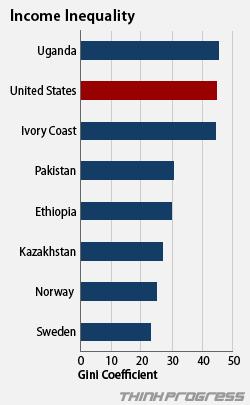
 Print This