 |
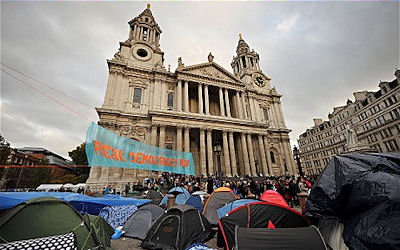
| The 'Occupy London Stock Exchange' demonstration on the steps of St. Paul's Cathedral Photo: AFP/GETTY
|
Protesters camped outside London's St Paul's Cathedral are to be allowed to
stay until next year, lawyers acting for the group have claimed.
Local authorities have offered protesters a deal "to stay on site until
the new year" in return for the group agreeing to abandon their
demonstration.
John Cooper, a lawyer for the protesters, said the loosely organised
demonstration against capitalist excess was "considering this offer".
The group, inspired by New York's Occupy Wall Street movement, has
wrong-footed both city and church officials since it began last month,
defying pleas to leave and the threat of legal action.
It came a day after authorities suspended legal bids to remove the tents.
It also followed comments from the Archbishop of Canterbury Dr Rowan Williams,
who backed a so-called Robin Hood tax on financial transactions as one way
to alleviate the global economic crisis.
On Wednesday protesters said the City of London authority had offered not to
take any legal action until 2012, but was asking demonstrators to remove
some of the scores of tents outside the building.
"We would have to make a slight reduction in tents in order to free up
space for the fire brigade," Tina Rothery said.
A spokesman for the local authority, the City of London Corporation, was
unavailable for comment.
While police and bailiffs have removed protest camps in some cities around the
world, the London demonstrators have endured, in part due to their location
in front of one of the city's most famous buildings.
Their proximity to Christopher Wren's 300-year-old icon has embroiled the
church in a conflict between bank-bashing protesters and the city's powerful
finance industry.
Dr Williams entered the debate Wednesday, saying "it was time we tried to
be more specific" in finding answers to the vague demands represented
by the protests.
"The protest at St. Paul's was seen by an unexpectedly large number of
people as the expression of a widespread and deep exasperation with the
financial establishment that shows no sign at all of diminishing," he
wrote in a commentary for the Financial Times.
"There is still a powerful sense around - fair or not - of a whole
society paying for the errors and irresponsibility of bankers; of messages
not getting through; of impatience with a return to 'business as usual'
represented by still soaring bonuses and little visible change in banking
practices."
The transaction tax - often called a "Tobin tax" - was proposed in
the 1970s by the late James Tobin, an American economist and Nobel Prize
winner. Williams said a low tax rate - 0.05 percent on each transaction -
could raise more than $400 billion globally each year.
The European Commission supports the tax, estimating that it could raise £30
billion ($41 billion) a year, but the British government has firmly opposed
it, preferring a direct tax on bank assets.
Dr Williams called for a "robust" public debate "to probe how
far the government's preferred option will guarantee the domestic and
international development goals central to the 'Robin Hood ' proposals."
He wrote approvingly of three proposals offered last week by the Pontifical
Council for Justice and Peace: separation of high-risk investment banking
from retail banking; recapitalising banks with public funds; and a tax on
financial transactions.
"If religious leaders and commentators in the UK and elsewhere could
agree on these three proposals, not as a fixed agenda but as a common ground
on which to start serious discussion, the struggles and questionings alike
of protesters and clergy at St. Paul's will not have been wasted," he
added.
The British Bankers Association opposes a transaction tax, arguing that unless
it was applied worldwide it would harm the financial industry in higher-tax
countries.
The Anglican church was caught by surprise when demonstrators against
corporate greed and banking excess pitched tents outside St. Paul's on
Octtober 15.
They had hoped to protest in front of the London Stock Exchange, but were
evicted from the private property and moved on to the nearby cathedral.
Since then cathedral officials have appeared uncertain how to respond. They at
first welcomed protesters before asking them to leave; closed the building
on health and safety grounds then reopened it a week later; and announced
legal action to remove the tent city before suspending it and promising
dialogue.
The cathedral's dean and a senior priest have both resigned over the
mishandled crisis.
The Corporation of London, the local authority for the cathedral and
surrounding area, also has suspended plans to evict the protesters, and the
campers say they are prepared for a long stay.
Stuart Fraser, the corporation's policy chairman, said officials were meeting
protesters for the first time Wednesday "and we will take things day by
day".
Source: The Telegraph
Also see: Archbishop of Canterbury Rowan Williams calls for new tax on bankers





 Print This
  Print This