Venezuela Nationalizes Gas Plant and Steel Companies, Pledges Worker Control
 Print This Print This
By James Suggett
Venezuelan Analysis
Saturday, May 23, 2009
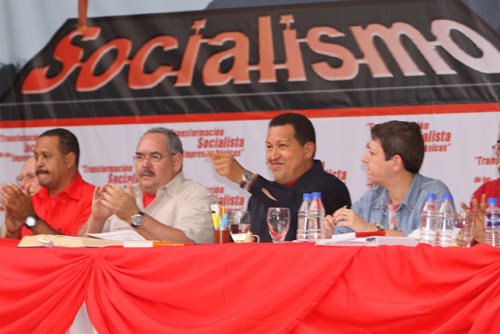 |
| President Hugo Chavez conducts a socialist workshop with steel workers yesterday. (ABN) |
This week the Venezuelan government nationalized a gas compression plant in the eastern state of Monagas and five prominent steel and iron briquette companies as part of its two year-old national development plan to integrate the country's strategic industries under state control. President Hugo Chávez said the nationalized companies should gradually be placed under worker control.
On Wednesday the government took control of the PIGAP II gas compression plant, invoking a law passed by the National Assembly earlier this month that re-establishes government control over a range of oil and gas related activities that were previously contracted out to foreign multinationals.
Venezuela's state oil company PDVSA had contracted the PIGAP II project to the U.S.-based multinational Wilpro Energy Services in 2001. The plant has the capacity to produce 1,400 billion cubic feet of gas per day.
Then, on Thursday evening President Chávez visited the mineral-rich Guayana region of southeastern Venezuela to declare the nationalization of the Guayana Steelmaking Complex (COMSIGUA), the steel tube maker Tavsa, the iron producers Orinoco Iron and Venprecar, the Matesi briquetted iron plant, and the ceramic tile producer Ceramicas Carabobo.
Orinoco Iron and Venprecar together produce 3 million tons of briquetted iron per year, and are jointly owned by BHP-Billiton and International Briquettes Holding (IBH), an affiliate of the Venezuelan steel company SIVENSA.
The Argentine company Techint owns both the Matesi plant and Luxembourg-based Tenaris steel tube company, of which Tavsa is a majority-owned subsidiary. Techint is also a stakeholder in COMSIGUA, which is partially owned by Japan's Kobe Steel. Techint owned Venezuela's largest steel plant, SIDOR, from 1997 until the government nationalized the plant last year.
After nationalization, workers previously employed by the private owners are transferred to the government payroll. The workers union at Ceramicas Carabobo, which had suffered an ongoing collective contract dispute with the company's owner, said the nationalization will "dignify our work."
"We are happy and joyous about the decision to nationalize Ceramicas Carabobo, which represents a long struggle," said Leandro Gonzalez, a union representative. "Previously, the owners kept us subjugated, and we even went seven months without pay," said Gonzalez.
Chávez also ratified the collective contract of the workers in the state-owned Ferrominera Orinoco. Starting in June, the company's 3,839 workers will receive a 30 bolivar ($14) per day raise, and Chávez also negotiated with the management to lower executive salaries by 10%-20%.
Since Chávez was re-elected to the presidency in 2006, his administration has purchased all or the majority share of joint venture oil production projects, the largest steel plant, the third largest bank, and the cement, telecommunications, and electricity industries.
Worker Control
President Chávez said the nationalizations will allow the government to advance on its plans to construct a state-owned "socialist industrial complex," in which he said the companies should gradually be passed over to some form of worker control.
"These companies must be under worker control. That's how it must be," he said.
The president suggested that eventually the management of state-owned companies could be elected by worker assemblies. "All this must be assumed with responsibility and a sense of integration of the government and the workers," he said.
While in Guayana, Chávez conducted a "Socialist Transformation Workshop" that was attended by 400 workers and Labor Minister Maria Cristina Iglesias.
"Every factory must be a school to educate, like [Argentine-Cuban revolutionary leader Ernesto] Che [Guevara] said, to produce not only briquettes, steel, and aluminum, but also, above all, the new man and woman, the new society, the socialist society," Chávez remarked during the workshop.
Shortly after nationalizing the SIDOR steel plant last year, the government resolved the collective contract of nearly 5,000 workers, but did not augment worker control of the plant. Also, more than 70% of the workforce had been pushed into non-unionized contract jobs by the previous owners, and only a small portion of these workers were incorporated into the collective contract.
The Classist, United, Revolutionary, Autonomous Current (C-CURA), a leftist current of the National Workers Union (Unete), says the Chávez government has fallen short when it comes to workers rights.
C-CURA leader Orlando Chirino said the recent nationalizations should not be seen as good deeds by the government, but hard fought victories won through "the struggle, persistence, and altruistic self-sacrifice of the working class of Guayana." Chirino also criticized the government for compensating at market rates for nationalized companies, which he said favors the private owners.
"To avoid that these companies... continue being capitalist companies in the hands of the state, it is urgent that we continue the battle so that they are controlled directly by the workers," said Chirino. "Worker control is not limited to the workers participating in the election of managers."
Venezuelan Analysis
 Print This Print This

|