'It Wasn't Suicide' Korean Mourners Say
 Print This Print This
By Peter Schurmann
South American Media
Wednesday, May 27, 2009
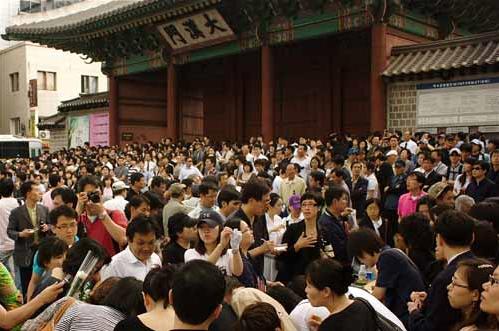
SEOUL, South Korea -- A line of mourners wound its way Sunday from Cheongye Stream in central Seoul to the entrance of Deoksu Palace and an altar commemorating former South Korean President Roh Moo-hyun, whose suicide a day earlier has stunned the nation.
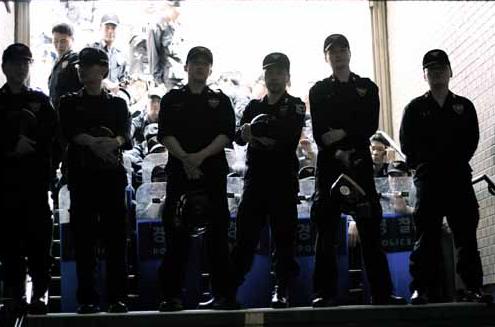 |
Riot police in the hundreds were out in force to contain the crowds, men and women, young and old. Many blamed the incumbent President Lee Myung-bak’s government for Roh’s death early on the morning of the 23rd. Roh, who had been embroiled in a bribery case implicating the former head of state as well as his family and close confidantes, leapt from a cliff above his home in the rural town of Bongha, some 450 kilometers southeast Seoul.
A teary eyed Catholic priest who, like most gathered, carried a white chrysanthemum in his hands, a traditional symbol of mourning for the dead, said he had waited nearly three hours in line to pay his respects to the former leader and liberal icon.
“If we look at the political factors behind his death, it becomes clear he was driven to do this,” the forty something clergyman said, declining to give his name. Suicide in the church is considered a grave sin. “It was not suicide,” he said pointedly.
Another young man several feet away shook his head in agreement. Dressed in black and wearing a ribbon on his lapel bearing two Chinese characters representing the deceased, he said at first he did not believe the news. “I thought it was a joke.”
Pointing to the riot cops surrounding the mostly peaceful demonstrators, he said the reason they’d been blocked from gathering in front of city hall across the street was because the government did not want photographers to be able to capture the true size of the crowd. “Instead, they blocked the subway exit (to City Hall) and herded us here, where we have to file in this long line” stretching back a kilometer or more.
 |
Indeed, popular sentiment among supporters of the self-taught human rights lawyer turned president lays the blame for his death squarely on the shoulders of the current administration. A probe into allegations that Roh had received US$6 million in bribes from a local tycoon is widely seen as being politically motivated, part of a cycle of vengeance by leaders looking to bolster their standing by going after the previous administration.
Roh himself denied knowledge of the payments that he said his wife, Kwon Yang-sook, had received from Park Yeon-cha. In April, he appeared before prosecutors in Seoul, travelling by bus from his rural residence and flanked by national media, for what turned into a ten-hour interrogation. It was deeply humiliating for Roh, who prided his tenure on being spotless, once earning him the moniker “Mr. Clean.”
A colleague, an editor with a local news wire, says South Korean law would have prevented Roh’s wife from being prosecuted as only sitting officials or business executives can be indicted on charges involving bribery. “Which is why he may have repeatedly denied knowledge of the payments made to his wife,” she says.
But, she adds, declining to be identified, “If we went after every politician here for taking money, there would be no one left to govern.” Gift giving, she says, is an inherent part of political culture here, where campaign finance laws are “primitive.”
In a piece for the Asia Times published days before Roh’s death, long time Korea hand Donald Kirk writes that the allegations surrounding Roh Moo-hyun … are “really small change compared with the hundreds of millions that former president Chun Doo-hwan purloined after seizing power in December 1979.” Or the $4 billion pocketed by his successor Roh Tae-woo. The list goes on.
One comment on a popular English language blog reads, "In the end, his corruption will be noted for its hypocrisy, not its severity."
Still, not all are inclined towards sympathy for the man whose tenure many say enriched a tyrannical regime in the North and damaged long-standing ties with Washington. During his presidency, which lasted from 2003-2008, Roh pushed hard for reconciliation with North Korea, continuing with the policy of his Nobel laureate predecessor Kim Dae-jung. He was also outspoken about Seoul’s relationship to Washington, having once quipped, “What’s wrong with being anti-American?”
Whatever the reasons behind Roh’s decision to end his life, there is no doubt the probe which had already landed his older brother and several close confidantes behind bars, had affected him deeply. On April 24, in an apology to his supporters, he wrote that he was no longer fit to represent the values he once stood for. “You should now discard me,” he said.
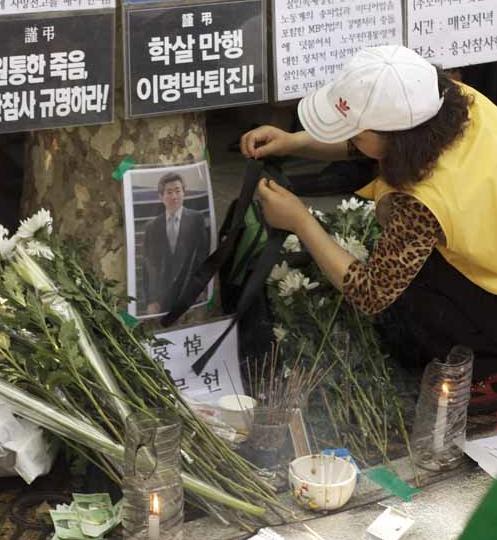
Far from it. Late into the evening people lined up outside the Buddhist Joggye Temple in downtown Seoul to honor Roh’s memory. Under a canopy of lanterns a monk’s prayers echoed across the grounds as hundreds stood to pay their last respects to the country’s 16th president.
 |
New American Media
 Print This Print This

|




