By Les Blough. Axis of Logic
|
|
|
|
Javier Solana Foreign Policy
Chief of the European Union |
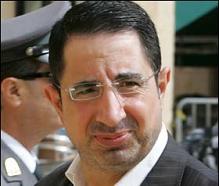
Hajj Hassan, Hezbollah
Minister of Parliament |
Javier Solana's meeting with Hajj Hassan today was pregnant with significance. Solana, EU's Foreign Policy Chief, was not only meeting with a Lebanese MP, he was also meeting with a "terrorist", by definition of the Obama regime in Washington. Hassan is one of 11 Hezbollah MPs who won seats in Lebanon's parliament on June 7, 2009. Hezbollah also controls Lebanon's most powerful military force while being listed by Washington as a terrorist organisation. This was hardly a casual or chance meeting and had to be approved at the highest levels of the European Union. It is the first European official to recognize and meet publically with Hezbollah - ever.
In order to understand the significance of this European turnabout, it's important to return to July 12, 2006 when Hezbollah killed 3 Israeli soldiers and captured 2 others after an Israeli cross-border raid into Southern Lebanon. Rejecting Hezbollah's proposal for a prisoner exchange, Israel reacted to their loss with a massive bombing of civilians and Lebanon's infrastructure and a 34 day war ensued.
As a result, Amnesty International charged Israel with war crimes. They reported on the destruction of "up to 90% of some towns and villages in southern Lebanon". Aerial photographs released by Amnesty, "showed Beirut's southern Dahiya district had been transformed from a bustling suburb into a grey wasteland". Amnesty's damage report was damning for Israel:
"In village after village the pattern was similar - the streets, especially main streets, were scarred with artillery craters along their length," the report said.
"In some cases, cluster bomb impacts were identified. Houses were singled out for precision-guided missile attack and were destroyed, totally or partially, as a result.
"Business premises such as supermarkets or food stores and auto service stations and petrol stations were targeted, often with precision-guided munitions and artillery that started fires and destroyed their contents."
The Guardian (UK) reported that Israel launched more than 7,000 air strikes against Lebanon in 34-days and their ships sent 2,500 shells into Lebanon's civilian areas. Over 1,000 civilians were killed, one third of them children, over 4,000 injured and about a million were displaced. Israel's rogue attack destroyed 30,000 houses, 120 bridges, 94 highways, 25 fuel stations, 900 businesss, 2 hospitals, 31 airports, ports, water & sewage treatment plants and electrical facilities. The overall cost of the damage was $3.5bn (£1.8bn).
Hezbollah's heroic defense of southern Lebanon and ultimate military victory over Israel in August, 2006, under the leadership of Sheikh Hassan Nasrallah, established Hezbollah as a formidable fighting force with whom to be reckoned. In September 2006, immediately after the ceasefire, Hezbollah began a massive rebuilding campaign of the infrastructure and about 30,000 homes destroyed or damaged by Israel's carpet bombing. Their impressive defense and tactical military savvy, combined with their restoration of Beirut and southern Lebanon brought them long-overdue respect from European governments who had been swayed by U.S./Zionist propaganda for decades.
When a news reporter asked Javier Solana how his meeting with Hajj Hassan squares with the U.S. listing of Hezbollah as a terrorist organization, Solana replied:
"Lists of terrorist groups are not the same in every country ... Hezbollah is a member of the Lebanese society and it is represented in the Lebanese parliament and it will bear responsibilities."
The two corporate news reports below continue to play with the truth (e.g. claiming Hezbollah was defeated in the June 7 election when the opposite is true), but Javier Solana's auspicious meeting with Hajj Hassan on Saturday is a benchmark in Euro-Hezbollah relations that portends a positive future for both.
- Les Blough, Editor
EU's Solana meets Hezbollah in Beirut
Javier Solana recognised Hezbollah's political role in Lebanon
 |
| Javier Solana (left) recognised Hezbollah's political role in Lebanon |
A senior EU official has for the first time held talks with a politician from the Lebanese Hezbollah movement.
European Union foreign policy chief Javier Solana met Hezbollah official Hussein Hajj Hassan at the Lebanese parliament building in Beirut.
Mr Hajj Hassan is one of Hezbollah's 11 members of parliament, following recent elections which were won by a rival Western-backed alliance.
Hezbollah is regarded by the United States as a terrorist group.
The EU has previously rejected public contacts with Hezbollah, which also controls Lebanon's most powerful military force.
But Mr Solana said: "Hezbollah is part of political life in Lebanon and is represented in the Lebanese parliament."
Mr Hajj Hassan described the meeting with Mr Solana as a "goodwill gesture from the European Union towards Hezbollah."
He said it was an attempt by the EU to "get to know" Hezbollah.
Britain said earlier this year it favoured re-establishing links with Hezbollah's political wing. BBC
Solana holds first ever meeting with Hezbollah MP
By Rita Daou
BEIRUT (AFP) — EU foreign policy chief Javier Solana held unprecedented talks with a Hezbollah official on Saturday, during a Beirut visit to reaffirm Europe's support for Lebanon after last week's polls.
He met in parliament with MP Hussein Hajj Hassan, whose Shiite movement is considered a terrorist organisation by the United States and which was defeated in the June 7 general election.
"Lists of terrorist groups are not the same in every country," Solana told a news conference when asked about the US blacklist of the Shiite militant group.
"Hezbollah is a member of the Lebanese society and it is represented in the Lebanese parliament and it will bear responsibilities," he said before leaving for Egypt at the end of a two-day visit.
For his part Hajj Hassan told AFP that the meeting "means more EU overture towards Hezbollah, and one at a higher level."
"This also means better communication for the European Union with the region and its parties," he said after the talks, adding that the move will "move the EU towards more realism."
Hajj Hassan is among 11 Hezbollah candidates who won seats in the 128-seat parliament.
Solana said Lebanon's rival political leaders "realise the responsibility they face" and he expected them to "find a way to push the country forward and form a cabinet" as soon as possible.
The Hezbollah-led opposition wants to have veto power on key issues in any new government, as they did in the outgoing cabinet, but majority leaders are opposed to this.
Solana, who also met with Lebanese President Michel Sleiman, officials and party leaders, earlier said that the EU "is pleased with the 2009 parliamentary election results.
"They reflected the maturity of the country," he said. Lebanon was at risk of civil war last year after political differences between the rival camps boiled over.
"This (election) will help very much open a new page for the future of the country, prosperity, democracy and peace," Solana said.
"The EU will continue to support Lebanon, and the EU will continue its efforts, in regard to pursuing peace in the Middle East, in cooperation with the international community and the United States."
Solana's trip coincided with a visit by US envoy George Mitchell who vowed on Friday that Washington would not sacrifice Lebanon as it seeks comprehensive peace in the Middle East.
Before Mitchell headed on to Syria, the two diplomats met briefly to discuss cooperation between the EU and the United States, whose President Barack Obama has vowed to help kick-start stalled Arab-Israeli peace negotiations.
The European Union does not blacklist Hezbollah as a terrorist organisation and Britain said earlier this year it plans to authorise low-level contact with the group.
"The military wing of Hezbollah is proscribed in the UK," but the political wing is now represented in the government, Foreign Secretary David Miliband said in March.
AFP





 Print This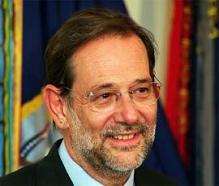
 Print This