Quinoa Plants a Seed for Food Revolution in Colombia
 Print This Print This
By Elyssa Pachico
Upside Down World
Friday, Jun 19, 2009
They were tiny white seeds, as rough and grainy as a handful of sand, and Esmeralda Solarte knew that she had seen them before. It was June 2000, just outside of Quito, Ecuador, and the Colombian farmer was attending an international seminar on agricultural innovations introduced by farmers like herself, rather than technocrats from the World Bank.
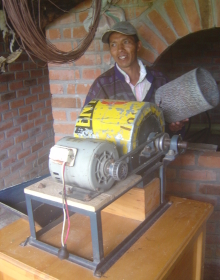 |
| Angel Maria Hurtado with quinoa threshing machine. |
|
At first, she said, the seeds reminded her of amaranth, a staple crop of the Incas. Back in Las Cruces, a small Colombian village nestled between the green slopes of the Andes, she and other indigenous farmers used to cultivate the grain themselves, toasting the kernels like popcorn before drizzling them with honey. But for whatever vague reason – the convenience of buying white bread from the nearest major city, guerillas stalking the countryside, a bad strain of seed that didn’t survive the rainy season – amaranth had disappeared from Las Cruces completely in 1994.
Ms. Solarte was told that the familiar-looking white grain was not the amaranth that she remembered so well. It was another altitude-hardy, protein-loaded grain typical of the Incas: quinoa. Then the idea came to her.
“I don’t know how long quinoa has been lost to our community,” she said. “Our grandparents would talk about their grandparents growing it.” Upon returning to Las Cruces from Quito, Ms. Solarte met with Colombian agronomist Jose Ignacio Roa, who’d been working with local farmers on experimenting with maize and bean varieties. What would happen, she asked him, if they were to bring quinoa seeds back to the indigenous reservation?
The push to reintroduce long-lost native crops is not exclusive to Ms. Solarte’s village, but rather is one expression of Latin America’s burgeoning food sovereignty movement. Governments across Latin America are increasingly concerned with promoting the rural poor’s ability to live self-sufficiently on locally produced goods instead of dumped products often exported from monoculture farms.
In Mexico, lack of self-sufficiency in food – the country imported half of its wheat supplies and three-quarters of its rice last year – has fueled rural unrest for years. (1) In Argentina, Bolivia and Venezuela, small-scale farmers have long protested against large agribusinesses that invest in transgenic agriculture, arguing that by forcing farmers to cultivate only the company seed, this prevents farmers from innovating with their own ancestral crops, and eventually causes dependency on company product. At the forefront of the movement is Ecuador. In September 2008, President Correa’s government passed a constitutional amendment that promised to cut back dependency on food imports. (2)
A law passed last February declared the country “free of transgenic crops and seeds,"3 although Correa has since proposed modifying the legislation, inspiring the outrage of campesinos and environmentalists alike.
In Las Cruces, located in one of the six indigenous reservations found in Colombia’s Cauca department, introducing quinoa was widely seen as a rallying cry for a modest food revolution. “We want to depend less on foreign products that are filled with preservatives and rely more on what’s local, what’s organic,” said Ms. Solarte. “We want to recuperate our traditions and improve the health of our community at the same time.”
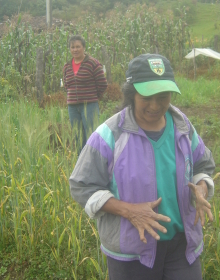 |
| Esmeralda Solarte and Mercedes Hurtado. Upside Down World |
|
Beginning in 2000, Ms. Solarte and a small group of mostly female farmers began experimenting with six different varieties of quinoa on their tiny garden plots, alongside towering rows of maize and squat, green strawberry bushes. Ten years later, the crop is spreading steadily throughout the Quisgo reservation, population approximately 5,000. Esmeralda estimates that 40% of farmers in the region now grow quinoa, and the other 60% are at least familiar with it.
“It’s been a very useful crop for me,” said Merecedes Hurtado, a farmer who helped popularize the crop alongside Ms. Solarte. They hope to continue protecting their food sovereignty by not initially selling quinoa to supermarkets or factories outside the region, she explained. Instead, “it must first be eaten in the reservation.”
A family’s typical diet on the reservation previously relied heavily upon white bread purchased in either Silvia or Popayan, the closest major cities. Wheat flour handouts from a family welfare program, known as bienestarina, were another staple. Mixed with soya extracts and other preservatives, the bienestarina is generally viewed with suspicion: in the region’s poorest indigenous reservation, Guambia, the welfare flour has long been subject to a popular (yet unfounded) rumor that it is spiked with sterilizing chemicals.
According to Ms. Solarte, due to the community’s lobbying, the welfare program has since begun mixing the bienestarina with quinoa instead of soya, as well distributing individual packages of quinoa to families. A previously unknown crop is now commonly sold among farmers at $2,500 pesos (about $1) per kilo, or else traded for, say, half a pound of seed for 20 maize cobs. Community members have observed less malnutrition among children, Ms. Solarte says, while families often visit her home, asking to borrow her quinoa threshing machine.
The crop is used for cakes, drinks, trout food, making purses and even medicinal purposes, by taking the ash from burned quinoa greens and applying them to wounds.
“There is a real desire, especially within the indigenous community, to recuperate their genetic heritage [in crops],” said agronomist Roa, who has been working with small-scale farmers in Colombia for the past two decades. “And there is real suspicion of transgenic seeds, a real fear that they are going to lose their own varieties of seeds to other varieties imposed on them from the outside.”
Increasingly in villages like Ms. Solarte’s, farmers are rescuing ancestral crops from the “inside” rather than waiting to react to “outside” species. In Santa Maria, another predominantly indigenous community in Colombia’s lush, green Cauca department, farmers successfully reintroduced granadilla to the region after years of careful experimentation. A type of passion fruit with a thick orange peel and gooey translucent insides, it went virtually extinct after farmers deforested the area to make way for coffee plantations. Now, it is once again a kitchen staple for local families, and is also commonly sold along with pineapple in rickety wooden stands by the roadside.
San Bosco, another Colombian village in Cauca, also launched a campaign to reintroduce yunga, a brightly colored, local maize variety that had been steadily disappearing over the past 70 years. Similar recuperation efforts are also underway in some regions of Bolivia for papa lisa varieties, a corkscrew-shaped potato that ranges from bright pink to deep purple. In Ecuador, farmers are experimenting with rescuing ancestral habas (broad bean) varieties, while in the Mixteca indigenous region in southern Mexico, farmers are reviving a traditional style of agriculture known as milpa that better promotes soil fertility.4
While Ms. Solarte hopes that someday all families on the indigenous reservations will be cultivating, eating and selling quinoa to outside markets, she says their impact on the region is already unmistakable. For farmers like herself, successful innovations like quinoa follow the kind of sustainable production model that allow communities to feed themselves, safeguarding seed diversity and reviving long lost traditions – the likes of which do not have to be irreconcilable with modernity.
“A decade ago, I had a friend – about 70 years old – who called me over to his farm and showed me a handful of black, wild quinoa seeds that he’d found on his land,” said Angel Maria Hurtado, another quinoa-grower on the Quisgo reservation. “ ‘What are these for?’ he asked me. An old man, and he had no idea that this was a crop our community used to grow. Now everybody knows of the nutritional benefits.”
“White rice isn’t native to here, but there’s no shortage of white rice in people’s homes,” he added. “What we need is people sprinkling quinoa on top of their white rice.”
Notes:
1. “The Basic Food Position: 2008,” Rosen, Fred, NACLA Report On The Americas, July 2008, pg. 4 Vol. 41 No. 4.
2. Food First
3. Upside Down World
4. Inter Press Service
Upside Down World
 Print This Print This

|