 |
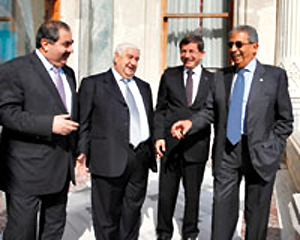
| Left to right: Foreign ministers Hoshiyar Zebari of Iraq and Walid al-Moualem of Syria met with Turkish Foreign Minister Ahmet Davutoğlu and Arab League Secretary-General Amr Moussa in İstanbul's Ottoman-era Çırağan Palace last week. |
|
The Turkish government has sealed two
contracts in the past year with Syria and Iraq to establish a greater
economic zone similar to that of the European Union to tackle political
and ethnic conflicts through economic development.
Turkish Foreign Minister Ahmet Davutoğlu
has had talks with respect to the EU, Armenia, the South Caucasus, the
Middle East, Iran and the Balkans in the past 12 days. Developments in
these regions directly concern Turkey, and Davutoğlu's sustained
efforts both in Iraq and Syria have opened a new phase as Turkey will
likely spearhead economic and political developments in the Middle
East. Some say involvement in Middle Eastern affairs symbolizes
Turkey's slow drift away from the West, but these policies in no way
undermine the feasi-bility of Turkey's EU membership bid.
Speaking
on CNN Turk on Friday, Foreign Minister Davutoğlu said during the EU
foreign ministers' meeting in Sweden last week the agenda was the Black
Sea, Mediterranean cooperation, the South Caucasus and the Balkans, and
in all of these regions Turkey is indispensable. Davutoğlu also added
that Turkey's EU negotiations should not concern only technical issues
but that Turkey also has to have a strategic vision.
Western
observers have often attributed Turkey's foreign policy success to
Foreign Minister Davutoğlu's mastery of foreign policy. Thanks to
Davutoğlu's tireless efforts, numerous problems blocking Turkey's
expanding foreign policy have been resolved effectively. The foreign
minister's repeated visits to the region have brought about major
transformations. Not even 10 years ago, Turkey and Syria were on the
verge of war as Syria allegedly hosted Kurdish Workers' Party (PKK)
terrorists within its territory. More open dialogue in the Middle East
has started since the Justice and Development Party (AK Party)
appointed Davutoğlu as chief advisor to the prime minister on foreign
affairs in 2003.
On Thursday
Turkey hosted several Iraqi ministers as part of a High-Level Strategic
Cooperation Agreement signed in July 2008 with Iraq. Before the
meeting, Davutoğlu said Turkey wanted to transform the Middle East into
an economic zone free of problems and crises. Speaking to Sunday's
Zaman, Hüsnü Mahalli, Middle East expert and a writer at the Yeni Şafak
daily, said Turkey has proved that its sole goal is to establish peace
and stability in the region. “Then Foreign Minister Abdullah Gül had a
tour in the Middle East to stop the outbreak of the Iraq war. However,
due to the existing conditions in the region, he failed to address the
problems of the Middle East and the wrong policies of Middle Eastern
countries,” Mahalli said.
Having
a strong belief that Turkey sincerely seeks peace in the region,
Mahalli said: “Turkey has no aim to pursue its national interest while
doing all these activities. Turkey stands equal to every country and
wants them to live in peace.”
Turkey
also has a similar framework with Gulf countries. Following the
High-Level Strategic Cooperation Agreement with Iraq in 2008, Turkey
was swift at signing a similar agreement with Gulf countries. However,
Davutoğlu's recent initiative was only limited to Iran, Iraq and Syria.
“Iran, Turkey, Iraq and Syria are the four major countries in the
region,” said Mahalli. “A similar agreement, I am sure, will also be
signed with Iran, and naturally this will expand to other countries,
too. Why should the Middle East not have a union like the European
Union?” Mahalli asked. He specified that a similar structure is also
possible in this region.
Middle
East Strategic Research Center expert Serhat Erkmen said Turkey's
normalization of relations with the Middle East has topped the agenda
for five years, and relations with neighbors have gotten better in
recent years. Turkey failed to build relations with its neighbors due
to several problems including terrorism. Syria was allegedly hosting
PKK terrorists and Iraq was slow to eradicate its PKK camps in northern
Iraq. This facts worsened relations with Turkey. “Turkey has evaluated
the terms and conditions in the region and has taken the first step.
The most critical step was a decision to have better relations with
Iraq,” Erkmen noted.
Speculating
about the economic dimension of the relations, Erkmen said: “If Turkey
transforms its relations with Iraq into a healthy economy, this may
spill over to other countries, too. Both Iraq and Syria feel the
necessity to get foreign direct investment (FDI). Turkey, in this
sense, may supervise their economic development.”
The
“Middle East Union” still remains a blur and a dark picture for many.
This region has recently experienced full-fledged wars, failures of
economic models and terrorist attacks. Countries in the region also
have also many problems among each other. “Turkey has taken very
important and serious steps; however, there are potential problems in
the region. These include instability in Iraq, problems between Iraq
and Syria, water crises and other problems,” Erkmen stated.
To
establish such an economic zone for the welfare of regional countries,
this model should also include other countries. “If these problems
remain unresolved, its expansion seems difficult for now. Iran-Arab
tension needs not to rise. Iran is a very important country for Turkey,
and Turkey in no way should ignore its significance,” Erkmen concluded.
Today's Zaman





 Print This
  Print This