 |
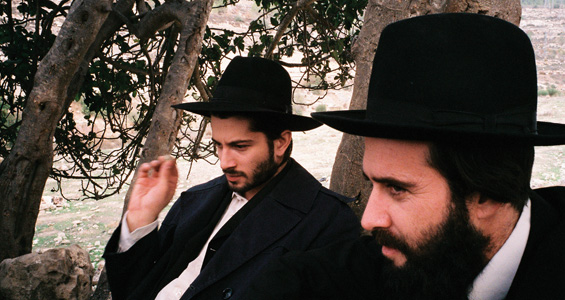
| Eyes Wide Open, a love story between two Orthodox Jewish men, provoked anger at its screening. |
|
A series of controversial Israeli films are provoking outrage and plaudits in equal measure at the London Film Festival.
The best documentary award has gone to one of the year's most controversial films.
Defamation is a polemic by Israeli filmmaker Yoav Shamir. In his
expose of America's Anti-Defamation League (ADL), he claims
anti-Semitism is being exaggerated for political purposes. He argues
that American Jewish leaders travel around the world exploiting the
memory of the Holocaust to silence criticism of Israel.
He gets inside the ADL, which claims to be the most powerful lobby
group of its type anywhere in the world. With unprecedented access, he
travels with them as they meet foreign leaders, and use the memory of
the Holocaust to further their pro-Israeli agenda.
At one point, an ADL leader admits to Shamir that "we need to play on that guilt".
Shamir says his film, Defamation, started out as a study of "the political games being played behind the term anti-Semitism".
"It became more a film about perceptions and the way Jews and
Israelis choose to see themselves and define themselves - a lot of the
time unfortunately choosing the role of eternal victims as a way of
life."
Israel's national psyche
 |
| Israeli filmmaker Yoav Shamir, says his film started out as a study of "the political games being played behind the term anti-Semitism". |
|
He wanted to find out how this mentality has become part of Israel's national psyche.
The
film suggests that the attitude is thrust upon children from an early
age. School trips to concentration camps in Poland run year-round.
From just 500 children in the 1980s, he claims around 30,000 are now flown to Europe every year.
He
discovers that the trips are not designed to educate, but to provoke an
emotional reaction. They fly out of Israel euphoric, and end their
journey in tears, talking about their shared hatred.
They are accompanied by secret service agents who prevent them from
talking to any locals - they are led to believe that most Poles are
anti-Semites.
The end result is disturbing. The victim mentality is being used to
justify Israel's occupation and colonisation of the West Bank and siege
of Gaza.
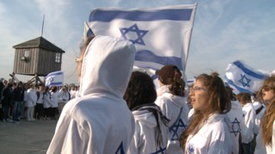 |
| One dramatic finding of Shamir’s film is the systematic indoctrination of young people in Israel, who are taught on a mass scale that the whole world hates Jews and that the only way to define oneself as an Israeli is on the basis of this worldwide animosity. |
|
In the film, one Israeli Jew tells Shamir that she
refuses to get upset by Israeli aggression against the Palestinians
because "we" faced worse. To her, the Holocaust justifies anything the
Israeli army does.
And for Shamir, that is the real danger. "We are experiencing the
most right-wing government we've ever had, and there is very little
room for discussion. Putting so much focus on hate and the negative, I
don't see it as a healthy thing."
In Israel, the film has received a mixed response. "It's kind of a
love or hate type of response to the film," Shamir says. "It's very
hard to get people to come and watch documentaries in the cinemas in
Israel."
Touchy subject
In the UK, too, there is anger towards Defamation.
Mark
Gardiner from one of Britain's biggest anti-Semitism campaign groups,
the Community Security Trust, believes the film could put Jews at risk.
"All of a sudden some bloke appears out of nowhere, oh he's an Israeli,
oh he's a Jew, therefore what he says must have more credence than what
organisations like my own and the ADL have said for years - I think
that shows a deep-seated bias."
And he is furious at the suggestion that anti-Semitism is being used for political purposes.
"This
assumption that people are saying it because they're being malicious,
because they know that it's not anti-Semitic, but hey lets use
anti-Semitism in order to win the Israel case, that's what I find
really really offensive," Gardiner says.
Shamir is not surprised by reactions like that.
"Anti-Semitism
is a very touchy subject and making a film about anti-Semitism is
almost like walking on thin ice, you're going to hurt people's
feelings."
Martial Kurtz from the Palestine Solidarity Campaign (PSC) believes the film can make a difference to activists like him.
He says all too often Israel's supporters label groups like the PSC as anti-Semitic.
"There
are many Jewish organisations which campaign [with us] against the
occupation, campaign against the siege in Gaza," he says. "So the whole
argument falls flat."
'Rocking the boat'
 |
| Despite trying to keep their affair secret, the pair are threatened with violence by the community's "Modesty Guards", leading to tragedy. |
For more info on the film, see "Eyes Wide Open"
|
Defamation is not the only controversial movie at this year's London Film Festival.
Eyes Wide Open provoked anger and walkouts when it was screened.
It
is a love story between two Orthodox Jewish men set in Jerusalem.
Despite trying to keep their affair secret, the pair are threatened
with violence by the community's elders, leading to tragedy.
Director Haim Tabakman knew the film would not be easy for some Jews
to watch. "This film has a provocative pitch," he says. "Every good
film is political."
But he just wants people to face reality. "If you talk about it, it
exists, so it's not in their interests to talk about it," he told Al
Jazeera.
"It's like the flood with Noah and his ark - the water
came to destroy everything but something new came out of it. Sometimes
it's good to shake the boat."
'Victims of war'
Another director causing waves is Samuel Maoz, whose war film Lebanon is sparking debate inside Israel.
"You can't change anything without first of all talking about it,"
he says. "The film moves people to talk, even to argue with each other."
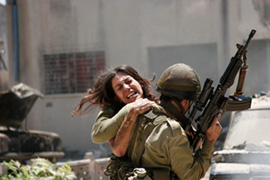 |
| Scene from the film Samuel Moaz film, "Lebanon", which won the Leone d'Oro (Golden Lion) at the 66th Venice International Film Festival, becoming the first Israeli-produced film to have won that honour. |
|
Maoz's film, which won the top prize at the Venice Film Festival in
September, is based on his own experiences as his army invaded Lebanon
in 1982. He says he made the film because of the guilt which still
haunts him to this day.
"I'm not comparing between the suffering of a Lebanese woman who
lost her family to the suffering of a soldier who fell into a no way
out situation and needs to kill. If I can make some kind of scale, she
is in level 10 and he is in the bottom, he is in level two. But both of
them are victims of war."
He knows words like that will cause controversy in Israel, but he is ready for the backlash.
"The
army is not something holy, especially after the 2006 Lebanon war. In
war itself there are no good guys and bad guys. The war is the bad guy."
Maoz believes that Israel will only become less belligerent when civilians are shown the realities of war.
"First
of all it was a need to unload and expose the war as it is, naked,
without all the heroic stuff and the rest of the cliches."
But Maoz has a bigger aim - to stop Israel launching attacks on Palestinians and Lebanese.
"Every film has its ambition to change something ... the film is attacking war itself," he says.
"Peace
will come but it's just a question of time and time is blood. If we can
find a short cut we can save a lot of blood for both sides."
Al Jazeera





 Print This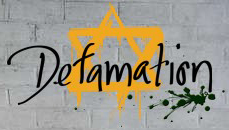
 Print This