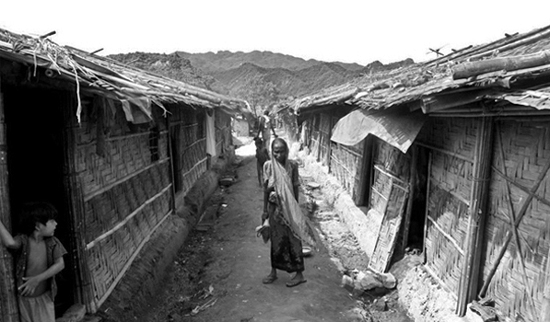
 |
| A woman in Leda camp. (Alex Ellgee) |
|
TEKNAF, BANGLADESH — “I’ve lost everything in my life and now I can
only pray that I don’t get sent back to Burma,” Haziqah, a 27-year-old
female Rohingya refugee, told The Irrawaddy from her half-built mud hut in the unofficial Kutupalong refugee camp in Bangladesh.
Before
coming to the camp, Haziqah lived in the Bandarban Hill Tract, about
150 km to the north, where many Rohingya refugees fleeing persecution
in Burma have settled. She had just given birth at the time, and so was
unable to work, but she and her husband managed to survive on the
meager wages he earned from odd jobs in the area.
However, their hopes of leading a quasi-normal existence were crushed
when one morning soldiers from Bangladeshi border force, the BDR,
stormed their village, rounded up all the Rohingyas living there, and
marched them towards the border.
En route, she said, the soldiers
beat her husband severely and pushed her along, ignoring the
one-week-old baby in her arms. When they reached the top of a hill
bordering Burma, the soldiers simply gave them a shove to send them
back to the country from which they had fled.
In the chaos, she
was separated from her husband; she later received reports that he had
been captured by the Nasaka, the Burmese border force operating in
Arakan State. She and some other women hired a boat to take them back
to Bangladesh. When they arrived, Haziqah realized that her baby had
died along the way.
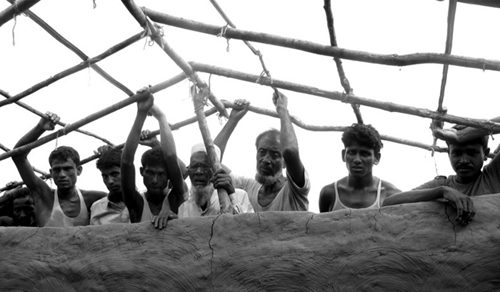 |
| Rohingya men gather round to listen to Haziqah tell the story of her husband being arrested and losing her child. (Alex Ellgee) |
|
Similar stories of brutality at the hands of
the Bangladesh Rifles, as the paramilitary border force is known, are
common among new arrivals at the makeshift camp. Like Haziqah, many of
the women have been separated from their husbands and must struggle to
find food and look after their children by themselves.
Since
tensions broke out in August between Bangladesh and Burma’s ruling
State Peace and Development Council (SPDC) over the latter’s
construction of a border fence, arrests and forced repatriation of
Rohingya refugees has dramatically increased.
In Cox’s Bazar, a
district in southern Bangladesh where many Rohingya live in both
unofficial camps and in camps supported by the UN’s refugee agency,
UNHCR, different opinions are circulating as to why arrests have
increased, but one NGO worker stated the most prominent one.
“The
construction of the border fence means that the BDR will no longer be
able to push back the Rohingya without the SPDC knowing; instead, they
will have to pass through the gates,” he explained.
“The
Bangladeshi government is afraid. In a way it’s a race against time to
send back as many Rohingya refugees as they can, before construction is
completed,” he added.
In order to escape arrest, many have fled
to the unofficial camp, which unlike the UNHCR camp next door, receives
no food rations. The Bangladeshi government refuses to accept Rohingya
who arrived in the country after 1991 as refugees and instead labels
them illegal migrants, leaving them to fend for themselves.
As
a result of the influx of Rohingya refugees from the “push back” areas,
the little food available to the refugees must be shared among more
mouths, creating problems in the camps.
Unrecognized by the
Bangladeshi government, NGOs are unable to provide food for the
refugees, leaving them to find work in the nearby area. However, recent
arrests at checkpoints, to and from the workplace, have led to many
being too afraid to leave the camp to find work.
Zawpe, a Rohingya leader in Kutupalong camp, told The Irrawaddy that more than 500 people were arrested last month and another 100 so far this month.
“Because
of the arrests, conditions in the camp are very bad. People are too
afraid to go outside to find food. The food crisis is alarming,” he
explained, standing at the top of a hill overlooking the maze of mud
huts that make up the camp.
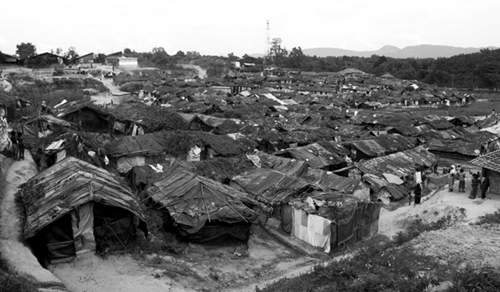 |
| A view of the Kutupalong unofficial refugee camp. (Alex Ellgee) |
|
“The government doesn’t let NGOs
give us food and we are not allowed to work for food, so we are
starving. It’s 1 pm and most the camp hasn’t eaten yet. If the situation continues like this, then all the people will die.”
Desperate
for food, some of the men walk great distances to work and travel back
to the camp at night in order to avoid arrest. According to Zawpe, some
local villagers have learned about the refugees’ nighttime routes and
wait for the men to return so they can steal their money.
“Soon we might have no way to find food,” he said.
With winter around the corner, many of the residents expressed concern about the cold months that lie ahead.
“I
don’t know how we will survive in the winter months without my
husband,” shrieked one woman as she fell to the floor of her hut in a
flood of tears.
Earlier that morning, the BDR arrested her
husband and 11 other Rohingya men when the bus they were on was stopped
at a checkpoint. They were put into a police van and driven off.
There
have been many reports of what fate awaits those who are “pushed back”
to Burma. Although the BDR doesn’t hand the refugees over to the
Nasaka, many are caught by patrol units and held in their camps.
One
man sitting in the refugee camp’s makeshift teashop described how he
was caught by the Nasaka after the BDR pushed him down the hill into
Burmese territory. Having been severely beaten by the BDR, he was then
beaten by the Nasaka and forced to prepare wires for the border fence
to stop cross-border smuggling and Rohingya repatriation.
Some
refugees who are pushed back manage to escape and return to Bangladesh,
bringing with them stories of brutality that fuel fears of arrest. This
has led to many of them being confined to the camps.
“From what
we’ve seen, the number of men confined to the camps is increasing,”
said Paul Reynolds, the country director for Medecins Sans Frontieres
(MSF). “This is putting an added strain on a population of 24,000
outside the camps which is increasing and receiving very little
humanitarian aid.”
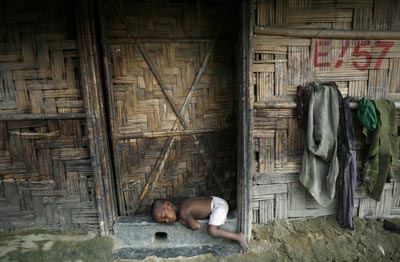 |
| A Rohingya boy sleeps in front of his makeshift home in a refugee camp in Cox's Bazaar. (Reuters) |
|
Another concern that the food crisis brings
is the number of children working in the towns away from their
families. Many Rohingya parents, desperate to find a way to feed their
children, send them to stay with local Bangladeshi families as domestic
helpers in exchange for food and a little pay.
One mother who had
already made this decision said that she had found a family in Cox’s
Bazar that hired her two daughters, aged five and nine, to help around
the house for 200 taka ($3) a month.
“I really didn’t want to
send them away,” she explained quietly under the shadow of the black
plastic garbage bag that served as the roof of her hut. “But we had no
choice. My husband is missing and I can’t find enough food for their
survival. I feel so upset inside, though, and just keep telling them
one day it will be ok and we can go back.”
In Leda, the other
unofficial camp, two hour’s drive south of Kutupalong, refugees are
equally concerned about their survival in the coming months as a result
of travel restrictions which have been imposed by the BDR arrests.
The
infrastructure here is marginally better and much work has been done by
Islamic Relief, a UK-based aid agency. Previously, the residents were
settled 10 minutes down the road on the bank of the river Naf. The
conditions were so bad that MSF fought to have them moved away from the
floods and the highway to the new site, and with government permission,
they were able to build a durable infrastructure.
However,
residents said that being next to the river had one advantage—the
abundance of opportunities to make a livelihood. This wasn’t a problem
until very recently, when travel restrictions began, and now the
residents are finding it increasingly difficult to find food.
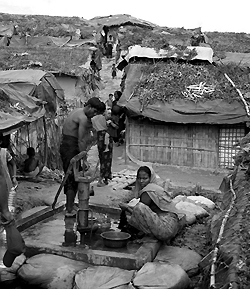 |
| People collect water from wells provided by Action Contre la Faim in Kutupalong camp. (Alex Ellgee) |
|
“We
have good shelter here, but we’re finding it so hard to go outside to
get food,” said one English teacher from the Leda camp. “Before one of
the biggest differences between our lives in Burma and here was that we
could travel freely. Now we are facing the same travel restrictions
that we did in Burma.”
To make matters worse, Islamic Relief,
which runs a clinic in the camp, has reported a malaria epidemic. There
were 404 new infections last month and 30 more have been reported in
November. This has sent alarm bells ringing in an environment where
malaria could be fatal and people are already weak because of the lack
of food.
Sitting in his two-room hut with his wife and three
children, Faisal Islam shivered as his malaria-induced fever took its
effect. He told The Irrawaddy how his family’s main source of
income was fishing on the nearby tourist island of St. Martins.
However, this was cut off when a BDR boat found them and warned them
they would be arrested and repatriated if they were caught there again.
“Now
I have no chance to work because of this sickness, so I can’t provide
food for my family,” he said. “For lunch, we had rice and sugar. We
have none left, so I don’t know what we will eat for dinner. Even if I
get better, I don’t know what I’ll do for work.
I don’t dare go back to my fishing place.”
The situation for the
Rohingya refugees is rapidly deteriorating and many NGO workers around
Cox’s Bazar voiced concerns at the fast approaching food crisis. The
UNHCR has begun talks with the Bangladeshi government to try to improve
the conditions of the unregistered refugees, but people remain
pessimistic that it will bring about any change.
Already facing
severe problems, with overpopulation and growing tensions between the
Rohingya and the local population, the likelihood of the government
taking on more refugees is slim. The main concern is that this would
create another influx into an already resource-stretched Bangladesh.
With no food assistance or legal recognition, the unregistered refugees
in Bangladesh could face a serious threat to their existence in the
coming months.
As one NGO worker put it: “The only thing the refugees can do now legally is starve.”
The Irrawaddy





 Print This
  Print This