 |
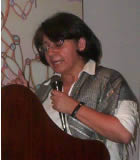
| COFADEH was founded in 1982 by Bertha Oliva de Nativí. She started the organisation in 1982 after her husband, Professor Tomás Nativí, was kidnapped and disappeared. (COFADEH) |
|
"I
call myself a veteran Defender of Human Rights- it sounds better than
old- and as I sit down to write this I feel ill at ease, perhaps
because I have the idea that over the long process of the last few
decades, we had achieved some small and relative advances in the area
of Human Rights. Perhaps its because I always look towards the past in
order to spy into the future and, of course, to check on the present…" –Bertha Oliva de Nativi
The
history of Bertha Oliva de Nativi is the history of Honduras. If the
storyline of the past one hundred years of this continent has been ‘so
few with so much, and so many with so little’, then Bertha has been the
fearless protagonist racing to rewrite the chapters that will hence
come. In 1982 Berta’s husband, Professor Tomas Nativi disappeared.
One of hundreds of Hondurans and tens of thousands of Central Americans
to lose their lives to state sanctioned violence, Tomas and all of
those who have disappeared remain the most terrifying and silencing
bootprint of the military regimes of the 1980’s. The stories are all
too common: "they came to our door in the middle of the night" or "he just never came home ever again."
Their families must find ways to grieve, to cope, and to say goodbye
to their loved ones without the benefit of closure or resolution.
Some, however, began to demand answers. Shortly after Tomas'
disappearance Bertha and twelve other families also in search of their
missing loved ones founded what would become the most well respected
human rights organizations in the country, the Committee of Relatives
of the Disappeared in Honduras (COFADEH). Throughout the military
repression of the last century, the banana strike of 1954 and the cold
war proxy wars, Honduras has born infinite other protagonists as well,
many of whom history will never remember their names or their faces.
However, their collective effort to forge a better quality of life for
themselves and their communities lives on in the heroes of today’s
social movements. We can lend our ears to the testimonies of a
handful of the tireless warriors that work day in and day out to lead
their country towards a more just and peaceful place. Dina Mesa. Rutilia Calderon. Carmen Alvarado. Luis Mendez. Raul. Juliana. Edgardo.
Anonymous, 51 years old. Anonymous, 28 years old. Anonymous, 23 years
old. Among countless others, they work as journalists, doctors,
educators, trade unionists, community organizers, mothers, fathers,
grandparents. Here they trace for us the context of the current state
of affairs in Honduras and speak to the most pressing issues at hand.
We the People of Central America
The
history of repression in Central America has flown for centuries like a
river into the sea of the impoverished masses. If we follow this flow
upstream we see that it runs directly through the handful of local
elite families to the source - the economic and military might of the
United States. Luis Mendez, an organizer with the National Front of
Resistance against the Coup D’etat, puts the June 28 military takeover
of Honduras in historical context:
"We the people of Central America have tread through sad and painful
processes. In Nicaragua, just as in Guatemala, and of course in El
Salvador. Honduras, meanwhile, has been a strategic platform for the
United States to install military bases, originally to support the
counter-revolution in Nicaragua. This threw our country on it’s side.
We have the most powerful people in the country lacerating the economy
and abusing the people. In the context of all of the violence that we
witnessed in Central America in the 80’s, the people of Honduras
accepted it, paralyzed and silent. We tolerated the military and
political powers, but the coup d’etat means that we have reached our
limit of tolerance, a limit to the abuse that we have been subjected to
for decades. We say enough is enough."
As
the third poorest country in the Western Hemisphere, limited access to
land, healthcare, education and basic nutrition have created an
incredible gap between the few who hold economic and political power
and everybody else. Two-thirds of the country live under-employed in
the fragile informal economy, highly vulnerable to the current
recession. These conditions are prime for the infectious growth of
gangs, crime, violence and discrimination against minorities. The
'cure' for Honduran poverty has taken the form of World Bank and
Inter-American Development Bank loans, mega mining, dam and tourism
development projects, and a heavy reliance on the U.S. to buy it’s
principal exports of textiles, minerals, coffee and bananas.
Unfortunately, these trends which date back to the first days of the
original Banana Republic and the United Fruit Company's early monopoly
of the region continue to hammer the country into imperial submission.
This begs the question - what can be done?
Constitutional Reform
"We
wanted the constituyente so that the poor would finally have a voice
with which to speak. In the past we were left on the fringe, not
allowed to enter into society because if we ever tried they would break
our nose with the door." -Juliana. Grandmother, Protestor. 80 years old.
"What
does the 'consituyente' mean for the Honduran people? The country needs
to recast itself. It needs to revise the constitution because it does
not correspond to the needs of the Honduran citizenry. If elections
continue with all of the blood and fire of this country, without the
president who was forcibly removed, then these elections are illegal." -Dina
Mesa, investigative journalist and recipient of Amnesty International's
'Special Award for Human Rights Journalists Under Threat' (www.defensoresenlinea.org)
On
June 28, the citizens of Honduras were slated for a non-binding vote
to begin the process of Constitutional Reform. The 'Constituyente' (a
Constituent Assembly) would allow for the creation of a body to rewrite
the Honduran set of rules for government, written originally in 1982,
after decades of military dictatorships. According to the United
States Department of State's human rights report for 1992, "although
basic human rights are protected in the 1982 constitution, in practice
the government has been unable to assure that many violations are fully
investigated, or that most of the perpetrators, either military or
civilian, are brought to justice."
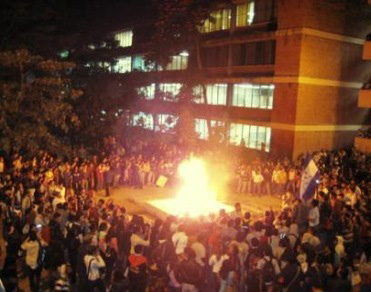 |
| Students from the Revolutionary University Force celebrate resistance to the military dictatorship that has taken hold of their country. Their protests remain peaceful and dancing and cheering rock the evening on campus at the National Autonomous University. However the desperation for change is apparent as an effigy of de facto President Roberto Micheletti is burned and the symbols of fascism are sent 'al carajo' (to hell). |
|
"The
constitution should be an expression of a pact between the
different social sectors of a country. The Constitution, since it’s
inception in 1982, has simply been a formality that is only invoked
when a certain group or person is at risk. From 1982 until now, it has
never been invoked for the common good, for the good of the excluded
sectors of this country," explains Dr. Rutilia Calderon, epidemiologist, professor and veteran on the edge of social change for the last 35 years.
"If we are therefore to give the Constitutional Reform process
the characteristics of a social pact that will permit an inclusive
society, real access to conditions of equality, in the eyes of the law
and the justice system, then the Constituyente makes sense. But if it
is only to become once again a measure for the powerful groups of the
country to continue protecting their interests, under the delusion that
the demands of the people will be attended to through elected
representatives, then it will not be for the better. The construction
of a reform process is not to produce a formal document that is called
'The Constitution,' it is to create new forms of relating between
different sectors of society- to close the gap of inequality and to
attain a just distribution of the wealth that this country has."
Culture of Fear
The
'Constituyente' referendum was interrupted by and became the commonly
accepted motive of the kidnapping of the country’s currently elected
President Manuel Zelaya, known as "Mel," on the very day it was
scheduled for, over four months ago. In the interest of the most
economically powerful families of the country, President of the
National Congress Roberto Micheletti seized power. Thus faded hopes of
constitutional reform began a stream of dictatorial repression. The
atmosphere of human rights has been tenuous at best and deadly at worst.
"You
don't walk around alone. We walk in groups of three or four. I used to
participate a couple times a week in the protests but I was let go from
my job so now I am here everyday. You have to understand, the economy
is terrible since the coup d'etat. Look, you see them (soldiers) over
there taking photos. They take your photo and then they compare it to
those in the Electoral Registry. They can find your identification
number, and then for the love of god- your age, your address... do you
know how many of us have disappeared? Yesterday another was found dead
in San Pedro Sula." -Anonymous Protestor, 51 years old.
"Right
now we have a National Congress that depends directly on the Executive
branch. We have a Supreme Court that responds directly to the
interests of the Executive branch. We have a Commision of Human Rights
and a Public Ministry that respond directly to the Executive Branch.
Now, for example, the Public Ministry denounces certain individuals who
participate in peaceful demonstrations and accuses them of sedition.
They become political prisoners. They are using our own judicial
system to plant seeds of terror." –Dina Mesa, journalist.
"The
spinal column of the repression is based in the criminalization of
protest, the control, censorship and closure of dissenting media
outlets, and the illegal suspension of constitutional rights," states
COFADEH's report "Statistics and Faces of the Repression - Violations
of Human Rights in the Context of the Coup D'etat," presented at a
Press Conference in the capital city, Tegucigalpa, on Oct. 22. The
statement references the closing of television station Channel 36 and
radio station Radio Globo. COFADEH, the leading human rights
organization in Honduras, reports that in relation to the political
violence ensuing after the date of the Coup, June 28, until Oct. 10,
they have registered 21 assassinations, 685 injuries to person, 3,033
illegal detentions and 108 death threats on official record.
The Resistance: Diversity and Democracy
"My
name is -anonymous-. I come here today to represent the Barrio de
Kennedy...." "My name is -anonymous-. I was sent here by the people of
the Valley of Amarateca...." "My name is -anonymous-. I come from
Cerro Grande...."
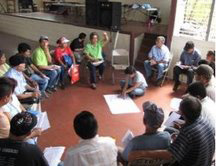
Democracy
begins at the ground level and is best carried out in circles. That’s
exactly how the National Front of Resistance Against the Coup D’etat
gathered this past Saturday morning in order to discuss the upcoming
elections. Over 100 representatives from each of the neighborhoods
surrounding the capital city sat in five separate discussion circles,
each huddled around a giant white sheet of paper on the ground. An
elected scribe perched over this drawing board in each of the circles,
as each person took turns speaking to the demands and to the ideas of
their home communities. Throughout the discussions a common thread
prevailed that highlighted the necessity to abstain from the elections
- to search out a deeper sense of democracy for this country. How to
accomplish this was naturally up for hot debate and over the span of
several hours each of the circles labored to work out the diversity of
ideas in order to present them to the rest of groups. It proved to be
an exemplary demonstration of democracy in action, putting the power to
make decisions in the hands of the common citizens, sitting in circles,
at the ground level.
With Mel or Without Mel
"Why
do I say the Resistance transcends Mel?," asks Carmen Alvarado, social
justice veteran and organizer with 'Visitacion Padilla: Women for
Peace' (www.laschonas.com).
"Because we believe in democracy as a way of life. Democracy is a
continual process in which many different people converge to share a
diversity of ideas and ideals, a process that embraces tolerance and
plurality, and that is open to change. Democracy should be a system
that guarantees the rights of men and women, indigenous peoples, whites
and blacks, homosexuals and lesbians, rich and poor, and in this manner
we can construct a democratic perspective of life that transcends what
the political parties are capable of thinking. Will the simple act of
voting will take care of our lives? No. This is not a movement of Mel
sympathizers, like the media outlets would have you believe. This is a
social movement."
Dr.
Rutilia Calderon further examines the situation of her country, "In a
simplified analysis of the crisis of this country, there is a conflict
between ousted President Zelaya and de facto President Micheletti, but
in fact the crisis is far beyond individuals. Perhaps Zelaya, through
his discourse of hope, came to represent for the excluded portions of
society seeking any type of social opportunity, a chance that things
could change. In this sense, the poor of this country, the people who
live on less than a dollar a day began to organize, began to recuperate
a sense of grassroots organization that was lost during the repression
of the ‘80’s."
Luis
Mendez elaborates, "The strengthening of real democracy in this country
has to do with the clear consciousness of the Honduran people that with
Mel or without Mel in the presidency the struggle will continue
forward. Farmers, laborers, young and old, a diversity of groups are
working together. With Mel or without Mel, we need to clean up the
politics, the administrative, justice and legislative systems, as well
as reconstruct the media and the cultural and social aspects that have
been invaded by the most powerful sectors and subsequently manipulated,
abused, controlled."
Where
do we go from here? The Resistance has marked 130 straight days of
their continued presence in the streets. Months of stalled
negotiations were superficially resolved last week with the
less-than-punctual intervention of the U.S. State Department. The
Guaymuras Accords signed between de facto president Micheletti and
ousted president Zelaya will allow the Honduran Congress to decide
whether Zelaya will be reinstated, although the amount of legitamite
power he would assume is completely unclear. Constitutional Reform was
officially wiped from the board and as the three short months left of
Zelaya's term dwindle, many are worried that after the elections at the
end of November, the world will forget about the injustice of the Coup.
Others suggest that if elections are not internationally recognized it
will give Michelletti an excuse to continue his military reign
indefinitly. Anonymous protestor, age 28, echoes the commentary heard
all around this week's demonstrations, "This agreement is a stalling
tactic. The State Department is trying to eat up time by deceiving with
false promises, right alongside the perpetrators of the Coup. If not
this week, then next week…"
COFADEH
warns the world, "With documented proof in our hands we are affirming
to the world that the country we live in is in a state of NATIONAL
EMERGENCY. " There are, however, rays of hope to be found. In the
context of the repression from the 1980's, the situation here rings
Deja Vu, but there are key differences between the two eras. Access
to technology has given many organizations and independent bloggers the
chance to have their voices heard. With high speed communication and
cell phones present at every demonstration, disappearances and cases of
violence are known about immediately. Moreover, the presence of
international witnesses and journalists since the very beginning of the
Coup has helped to increase accountability of human rights violators.
COFADEH's human rights report speaks to their ability to increase
accountability, "Although the military dictatorship that we live under
today has similar features to the situation that we suffered under in
the 1980's, one major difference is that the repressors of that age hid
their faces and their names. On the contrary, the repressors of today
have faces, they have names, they have uniforms."
The
Resistance itself, largely characterized in the media as pro-Chavez
Communists and demonized as extremists, does not go without critique
from it's own members. Carmen Avarado warns, "We are a heterogenous
group. It is still up to us to internally discuss and debate the
situation, decide where we go from here. The weakness of the
Resistance is that it lacks a clear political vision, there is no
common point, and this is why it has largely manifested in little more
than street protests."
"The
leaders of the Resistance," explains Dr. Rutilia Calderon, "who largely
come from union backgrounds, have an enormous responsibility with the
majority who do not pertain to unions or a particular patronage, but
simply spontaneously began toorganize themselves, of their own accord.
We can hope that these leaders steer the country beyond the
Zelaya-Micheletti polemic. There are many doubts about their real
commitments and we are going to have to be very attentive in the next
several months to see if the loudest voices of the Resistance give in
to personal interests, or truly assume leadership of this surging
grassroots movement."
Upside Down World




 Print This
 Print This