 |
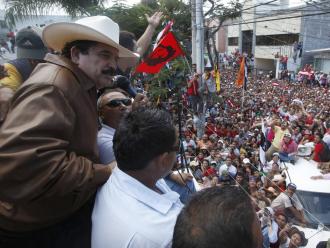
| Manuel Zelaya addressing supporters from the balcony of the Brazilian embassy in Tegucigalpa. |
|
The political crisis that began with the June 28 coup d'etat against
President Manuel Zelaya has reopened afresh after the collapse of a
U.S.-brokered deal apparently agreed to by coup leader Roberto
Micheletti that was supposed to return Zelaya to office.
The agreement, known as the Tegucigalpa/San José Accords, was struck
October 28 under the auspices of Thomas Shannon and Daniel
Restrepo--respectively the top Latin America hands for the U.S. State
Department and the Obama White House.
One week later, the deal was in tatters, with its first important
step--the installation of a "government of unity and national
reconciliation" by November 5--devolved into a typically absurd display
of Micheletti's chutzpah.
The accords didn't formally mandate the reinstatement of Zelaya, but
the ousted president clearly expected to return to office by November
5. Zelaya's confidence in this interpretation, also shared by other
governments, is strong evidence that the U.S. negotiators guaranteed
Zelaya's return.
Because this was for many--including the popular anti-coup
resistance--a precondition for recognition of upcoming elections,
scheduled for November 29, tolerating Zelaya until the end of his term
in January would have been the most intelligent option for Honduras'
elite.
Although the business class backed the coup, the relentless struggle
of the resistance has prevented Micheletti's regime from consolidating
and legitimating itself, opening up splits among the country's rulers
about whether to continue backing the coupmakers. The elections would
have given Honduras' business interests an opportunity to go back to
"business as usual," ending months of exhausting--and
expensive--political instability.
But the "golpistas" arrogance has often ruled the day during the coup, and it appears to have done so again.
- - - - - - - - - - - - - - - -
THE FIRST omens that the coup regime would back out of the agreement
came immediately after it was signed, with pro-coup legislators openly
predicted that Zelaya would not be restored--and this didn't draw any
objection from U.S. officials.
The appointment of Labor Secretary Hilda Solis to the agreement's
Verification Commission was a further sign of the Obama
administration's lack of seriousness, given the contrast between the
primarily domestic responsibilities of a labor secretary and the need
for international experience in a critical diplomatic mission.
On November 3, the golpista-controlled Executive Council of the
National Congress declared that it wouldn't convene to discuss the
restoration of Zelaya until after the November 29 elections.
At the same time, Micheletti let it be known that he would be
assembling a unity government under his own (illegal) authority.
Minutes before midnight on November 5, he announced the formation of
his unilateral "Government of Unity and National Reconciliation." Its
leader was that proven uniter and reconciler: Roberto Micheletti.
The National Resistance Front Against the Coup d'Etat had greeted
the expected reinstatement of Zelaya under the accords as a "popular
victory over...the pro-coup oligarchy." But the unfolding reality has
signaled the agreement's collapse. In its communiqué of November 5, the Front announced that if Zelaya were not reinstated by midnight, it would not recognize the elections. The next day, Zelaya declared the agreement a "failure" and also issued a statement calling for non-recognition of the election, saying, "Elections under dictatorship are a fraud for the people."
The collapse of the Tegucigalpa/San José Accords marks the third
breakdown of attempts to reconcile the legitimate government and the
coup regime through negotiations. Each time, the failure was due to the
intransigence of the golpistas--who seem incapable of making
concessions even when it's in their own greater interests to do so.
The coupmakers have exhausted the patience of even bourgeois
diplomats. Former Chilean President Ricardo Lagos, a member of the
Verification Commission, bluntly blamed Micheletti for breaking the
agreement. Costa Rican President Oscar Arias, a U.S. client who has
been trying to impose a basically pro-oligarchy "compromise" in
Honduras, complained that the golpistas "are looking, by means of
delaying tactics, to pass the time until the elections come, risking
that the future government will not be recognized by some countries."
For its part, the Obama administration has slouched from its
confident declaration of success on October 28 to a more typical
posture of self-contradiction.
In an alarming November 3 interview with CNN en Español, Thomas
Shannon indicated that the U.S. would recognize the Honduran elections
even without the restoration of Zelaya--apparently, a reversal of U.S.
policy.
Worse, two days later, Republican Sen. Jim DeMint issued a press release
claiming that he had "secured a commitment from the Obama
administration to recognize the Honduran elections on November 29th,
regardless of whether former President Manuel Zelaya is returned to
office and regardless of whether the vote on reinstatement takes place
before or after November 29th."
DeMint cited personal assurances from both Shannon and Secretary of
State Hillary Clinton. Yet the State Department refused to confirm or
deny DeMint's claims, leading to complete confusion about what official
U.S. policy actually is--or if it exists.
Over the weekend, Micheletti--apparently under pressure from U.S.
Ambassador Hugo Llorens--announced a "waiting period" before installing
his "unity government." However, a meeting between Llorens and
representatives of Zelaya and Micheletti got nowhere.
Furthermore, Llorens told Radio America, "The elections will be part
of the reality, and will return Honduras to a path to democracy." Even
if the U.S. had always intended to recognize the elections, it makes no
sense to say so now--this give ups any U.S. leverage with the golpistas
and exposes Washington politically. Obama's policy, simultaneously
cynical and stupid, arouses nothing but contempt.
If the Honduran coup is, as resistance leader Juan Barahona
characterized it, an "experiment in turning back the clock" to the days
before the advance of the populist trends in Latin America, then the
U.S. has let the experiment go awry. Its tacit backing of the coup is
on the verge of becoming explicit, bringing the Obama administration
down on the unpopular side of a deeply divisive issue across the
hemipshere.
Although few Latin American governments are eager to cross the U.S.,
most will find it difficult or impossible to support elections
conducted under a manifestly illegal dictatorship that is widely hated
by the Latin American public. This is the kind of "with us or against
us" policy that other governments hoped the Obama administration would
abandon.
The situation inside Honduras defies prediction. As Berta Cáceres of COPINH, the indigenous resistance organization, said in a November 1 speech,
"[I]f there is a scenario...where they don't reinstate the president,
then this country will approach a tremendous situation. Greater
repression and violence, maybe even a civil war, which the people don't
want, and then more isolation."
One should also add the possibility of international war, given the
golpistas' isolation, xenophobia and provocations--particularly against
the Brazilian Embassy where Zelaya has stayed since his secret return
to Tegucigalpa.
Yet as Cáceres insists, "In all of these scenarios, brothers and
sisters, we only have one option. In all of them--in whichever one that
happens--it is to struggle. It is to continue in the resistance. It is
to march towards the refounding of this country."
Socialist Worker




 Print This
  Print This