Election Report From Honduras: The People Say “We Didn’t Vote!”
Print This
By Jackie McVicar
Upside Down World
Friday, Dec 4, 2009
Both those in the caravan and people yelling support from the streets, "I didn't vote!" showed their ink-less fingers, to show they had not been registered at a polling station where a finger print as part of your id is normally taken.
After a long bus ride back from the north eastern part of the country and the department of Colon,
we arrived in the capital today just in time to join a massive caravan
organized by the Popular Resistance Front. Like the other
demonstrations held since the coup d'etat on June 28, the mobilization
winded through the "barrios", the neighborhoods in Tegucigalpa where supporters left their homes to show their support.
This
time, instead of walking, organizers decided to drive their cars in a
caravan, to avoid confrontation or repression that they feared by the
State security forces. Hundreds of cars and people drove through the
streets honking their horns, with flags, horns and music. Both those in
the caravan and people yelling support from the streets, "I didn't
vote!" showed their ink-less fingers, to show they had not been
registered at a polling station where a finger print as part of your id
is normally taken.
Though
the media is reporting record high turnouts for Sunday's election, no
one is buying it. One woman I interviewed who didn't want to be
identified because of fear ("if they see my picture, they [the
military] will come after me"), said, "I have over 150 people in my
[extended] family and not one went out to vote."
Another man, when asked what the streets of
Tegucigalpa
looked like yesterday, said with pride, "The streets were deserted.
That is the reality. Those who went to vote were just a few...I didn’t
go out to vote, precisely because we don't support the de facto regime.
And conscious people who didn’t vote in
Honduras,
is 65%. It’s the majority who didn’t go vote and the Tribunal [Supreme
Electoral Tribunal - TSE] wants to cheat us by saying the majority went
to vote. In
Honduras, people are conscious after the 28th of June. And it’s the majority who won, it’s the popular resistance."
On election day at
,
the TSE announced that they were having a large turnout and didn't have
enough paper and ink so were going to extend voting by an hour. Others
suggest that they extended the voting hour precisely because there
wasn't a large turnout and there are reports that police started going
into neighbors’ houses announcing that all citizens must vote. Despite
this, many didn't. One taxi driver I asked from Tocoa, in the
department of
Colon,
said, "I didn't leave my house yesterday. I shut the door and didn't
open it all day. Who knows what they [State forces] would've done."
This
driver had reason to be nervous. Five members of our delegation were in
Tocoa the day before the election and we saw at least five unmarked
trucks and SUVs with tinted windows driving through the small town,
reminding those on the streets they were being watched. Some didn't
even bother taking the National Party banner off the vehicles as they
drove past folks walking on the streets or pulling up in front of the
homes of resistance leaders homes.
When
our delegation met with the Sub-Chief at the National Police Station in
Tocoa on election day, after receiving a call that up to eight people
had been illegally detained, he said that the police were, "doing all
they could to ensure the safety of citizens." He noted that the police
register any unmarked cars they see to ensure they do not have
dangerous materials inside and that they are registered to the right
people driving the car. When I asked why the police hadn't stopped the
unmarked vehicles we saw, despite the fact that every other car was
being stopped and registered at the police check point, he simply
didn't answer. Later that night, a pipe bomb exploded in the Liberal
Party Headquarters in Tocoa and the eight missing still have not been
found or the story cleared about their whereabouts.
Outside
of Tocoa, in the municipality of Trujillo, we visited the community of
Guadalupe Carney (named after an Irish American Priest who worked there
and who was killed in the 1980s), who had heard the night before that
military were encircling the community from both directions.
Thankfully, they never raided the community, but they sent a message
loud and clear: be careful, we're not far away. We heard reports that
the military in part were camped out a Colonel's hacienda near by. The
police had Guadalupe on their radar and had been "prepared for the
worst" in that community, according to Officer Sauceda. When we
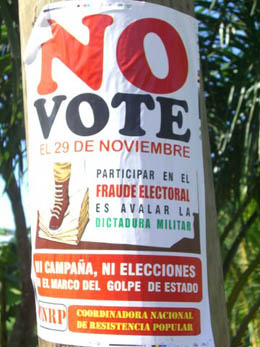
visited, we saw signs posted: Don't vote!
Of
the over 800 families living in the community, they suspect only a
handful went to vote. The campesinos in this community know this will
be a long battle, but one man, Augustin, age 75, said proudly, "I have
seen a lot in my life time. We continue the struggle because it is part
of who we are, we are conscious and we believe in the struggle."
In
other polling stations, we saw political hype but not too many voters.
In Corosito, Colon, we visited the polls with members of the
Coordination of Popular Organizations of Aguan (COPA) and saw many
empty rooms in the school where the poll had been set up. Military and
police guarded the door, the first time for this kind of security
during a civilian election. In other parts of the country, including
San Pedro Sula where people in resistance had planned a peaceful march
to show opposition to the election process, tear gas and water bombs
served to control the crowds.
Back
in Tegucigalpa, there are many unknowns: will Mel Zelaya leave the
Brazilian Embassy this week and fulfill his term as President before
Pepe Lobo of the opposing National Party takes power at the end of
January? What political alliances will be made now that the vote has
taken place? Will Canada, the US and other nations go ahead and accept
these unfair, unfree elections and accept a highly militarized state
and a President elected during a coup d'etat as trade partners and go
ahead with business as usual? Will the newly elected National Party be
able to convince the world that Honduras' "problems" are a thing of the
past, part of Liberal Party squabbling that have ended?
One
issue isn't in question: the strength and courage of the Honduran
people. As the caravan ended tonight in front of the Brazilian Embassy,
in an act of solidarity with President Zelaya held captive inside,
chanting, singing and dancing (there was even a Mariachi band!) could
be seen and heard while the police and military called in
reinforcements and pointed their 50 mm machine gun at the celebrating
crowd. So when it was time, people left - peacefully, just as the
caravan had started. They weren't about to enter a conflict with the
military, a physical fight is not what they want.
When
I asked a young woman in the crowd why she was there, what she wanted,
she didn't surprise me with her answer, "la constituyente" – the
constituent assembly that many believe could one day lead to real
change in Honduras. Until then the people keep singing, "The People,
United, Will Never Be Defeated!". Just as the graffiti says throughout
Honduras, "The Power Is In The Streets."
If you appreciated this article, please consider making a donation to Axis of Logic.
We do not use commercial advertising or corporate funding. We depend solely upon you,
the reader, to continue providing quality news and opinion on world affairs.Donate here





 Print This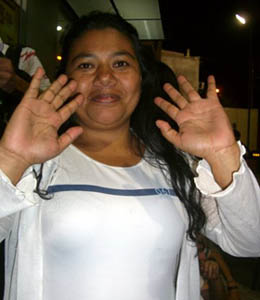
 Print This