Israeli Army Used to Deport Activists Against the Wall
 Print This Print This
By Jonathan Cook
The Palestine Chronicle
Friday, Feb 12, 2010
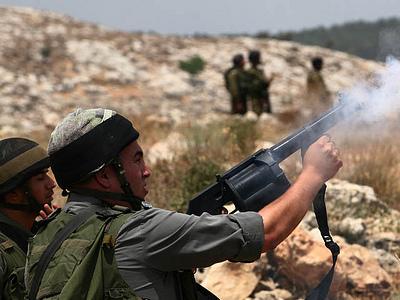 |
| 'Israel knows that the non-violence struggle is spreading.' |
|
The Israeli courts ordered the release this week of two foreign women
arrested by the army in the West Bank in what human-rights lawyers warn
has become a wide-ranging clampdown by Israel on non-violent protest
from international, Israeli and Palestinian activists.
The
arrest of the two women during a nighttime raid on the Palestinian city
of Ramallah has highlighted a new tactic by Israeli officials: using
immigration police to try to deport foreign supporters of the
Palestinian cause.
A Czech woman was deported last month after
she was seized from Ramallah by a special unit known as Oz, originally
established to arrest migrant labourers working illegally inside Israel.
Human
rights lawyers say Israel’s new offensive is intended to undermine a
joint non-violent struggle by international activists and Palestinian
villagers challenging a land grab by Israel as it builds the separation
wall on farmland in the West Bank.
In what Israel’s daily
Haaretz newspaper recently called a “war on protest”, Israeli security
forces have launched a series of raids in the West Bank over the past
two months to detain Palestinian community leaders organising protests
against the wall.
“Israel knows that the non-violence struggle
is spreading and that it’s a powerful weapon against the occupation,”
said Neta Golan, an Israeli activist based in Ramallah. “Israel has no
answer to it, which is why the security forces are panicking and have
started making lots of arrests.”
The detention this week of
Ariadna Marti, 25, of Spain, and Bridgette Chappell, 22, of Australia,
suggests a revival of a long-running cat-and-mouse struggle between
Israel and the International Solidarity Movement (ISM), a group of
activists who have joined Palestinians in non-violently opposing the
Israeli occupation.
The last major confrontation, a few years
into the second intifada, resulted in a brief surge of deaths and
injuries of international activists at the hands of the Israeli army.
Most controversially, Rachel Corrie, from the US, was run down and
killed by an army bulldozer in 2003 as she stood by a home in Gaza
threatened with demolition.
Ms Golan, a co-founder of the ISM,
said Israel had sought to demonise the group’s activists in the Israeli
and international media. “Instead of representing our struggle as one
of non-violence, we are portrayed as ‘accomplices to terror’.”
The
first entry of Israeli immigration police into a Palestinian-controlled
area of the West Bank, the so-called “Area A”, occurred last month when
a Czech woman was arrested in Ramallah. Eva Novakova, 28, who had
recently been appointed the ISM’s media co-ordinator, was accused of
overstaying her visa and was deported before she could appeal to the
courts.
Human rights lawyers say such actions are illegal.
Omer
Shatz, the lawyer representing Ms Marti and Ms Chappell, said a
military operation into an area like Ramallah could not be justified to
round up activists with expired visas. “The activists are not breaking
any laws in Ramallah,” he said. “The army and immigration police are
effectively criminalising them by bringing them into Israel, where they
need such a visa.”
Officials in the Palestinian Authority (PA)
have grown increasingly unhappy at Israeli abuses of security
arrangements dating from the Oslo era. The PA’s president, Mahmoud
Abbas, recently described the Israeli operations into Area A as
“incursions and provocations”.
Although the supreme court
released the two women on bail on Monday, while their deportation was
considered, it banned them from entering the West Bank and ordered each
pay a $800 bond.
The judges questioned the right of the army to
hand over the women to immigration police from a military prison in the
West Bank, but left open the issue of whether the operation would have
been legal had the transfer occurred in Israeli territory.
The Spanish government is reported to have asked the Israeli ambassador in Spain to promise that Ms Marti would not be deported.
Ms
Marti said they had been woken at 3am on Sunday by “15 to 20 soldiers
who aimed their guns at us”. The pair were asked for their passports
and then handcuffed. Later, she said, they had been offered the choice
that “either we agree to immediate expulsion or that we will be jailed
for six months”.
On Wednesday, shortly after the court ruling,
the army raided the ISM’s office in Ramallah again, seizing computers,
T-shirts and bracelets inscribed with “Palestine”.
“Israel has
managed to stop most international activists from getting here by
denying them entry at the borders,” said Ms Golan. “But those who do
get in then face deportation if they are arrested or try to renew their
visa.”
The ISM has been working closely with a number of local
Palestinian popular committees in organising weekly demonstrations
against Israel’s theft of Palestinian land under cover of the building
of the wall.
The protests have made headlines only
intermittently, usually when international or Israeli activists have
been hurt or killed by Israeli soldiers. Palestinian injuries have
mostly gone unnoticed.
In one incident that threatened to
embarrass Israel, Tristan Anderson, 38, an American ISM member, was
left brain-damaged last March after a soldier fired a tear-gas
cannister at his head during a demonstration against the wall in the
Palestinian village of Nilin.
In addition to regular arrests of
Palestinian protesters, Israel has recently adopted a new tactic of
rounding up community leaders and holding them in long-term
administrative detention. A Haaretz editorial has called these
practices “familiar from the darkest regimes”.
Abdallah Abu
Rahman, a schoolteacher and head of the popular committee in the
village of Bilin, has been in jail since December for arms possession.
The charge refers to a display he created at his home of used tear gas
cannisters fired by the Israeli army at demonstrators.
On
Monday, the offices of Stop the Wall, an umbrella organisation for the
popular committees, was raided, and its computers and documents taken.
Two co-ordinators of the group, Jamal Juma and Mohammed Othman, were
released from jail last month after mounting international pressure.
The
Israeli police also have been harshly criticised by the courts for
beating and jailing dozens of Israeli and Palestinian activists
protesting against the takeover of homes by settlers in the East
Jerusalem neighbourhood of Sheikh Jarrah.
Last month, Hagai
Elad, the head of Israel’s largest human rights law centre, the
Association for Civil Rights in Israel, was among 17 freed by a judge
after demonstrators were detained for two days by police, who accused
them of being “dangerous”.
The Palestine Chronicle
 Print This Print This

|