At 9 p.m., some four hours after polls closed in Kirkuk on March 7,
the sky outside my window starts to echo with fireworks and celebratory
gunfire. I am staying in a mixed neighborhood in the center of town,
and here both Kurds and some Turkomans have plenty of reason to
celebrate. Although results are preliminary, at least one local
Turkoman candidate appears assured of a seat in Baghdad's parliament.
The Kurds have their eyes on a much bigger prize: seven to eight seats
and the political heft these bring in shaping Kirkuk's future. While
the results are not yet known, whatever happens these elections are
unlikely to significantly advance the Kurds' chances to integrate
Kirkuk into the Kurdistan region.
In the public eye, every
election in Kirkuk turns into a census and quasi-referendum rolled into
one. This is because the ethnic communities here assume that Arabs,
Kurds and Turkomans vote for their own candidates; that this shows the
respective communities' sizes; that the vast majority of Kurds want
Kirkuk to be attached to the Kurdistan region; and that these factors
combined suggest the probable outcome of a future referendum on
Kirkuk's status.
If the Kurdish parties gain eight of Kirkuk's
twelve parliamentary seats, as many predict they will, they would cross
what they consider the magical threshold of a two-thirds super majority
that, in their view, psychologically at least, would clinch their claim
to Kirkuk as an inalienable part of Kurdistan. They would await a
formal census, now scheduled for October, and use their explicitly
acknowledged political weight in Kirkuk to press for a status
plebiscite.
Not so fast, Arabs and Turkomans say. They
challenge the legitimacy of the voter rolls that produced this Kurdish
majority by using a provision in the electoral law that mandates, if a
simple majority in parliament requests it, an investigation of the
voter registry in governorates such as Kirkuk that have seen an
unusually large annual population growth. As long as this scrutiny is
underway - the law says it should be completed within a year but Kirkuk
has a history of parliamentary investigations running on endlessly and
aimlessly - the contested registry cannot be used as the basis for
future elections or as a precedent for Kirkuk's political or
administrative status. In other words, the Kurds may have advanced only
ever-so-slightly in untying the Gordian knot that the Kirkuk question
has become since 2003.
Moreover, matters are complicated by
intra-Kurdish divisions. Some of the heaviest campaigning in Kirkuk was
not between Arabs and Kurds but intra-Kurdish: between the Kurdistani
Coalition which combines the two Kurdish principal parties - the
Kurdistan Democratic Party and Patriotic Union of Kurdistan - and the
upstart Goran, or Change, movement. Goran's strong showing in the
Kurdistan regional elections last July was a dire warning to the ruling
parties, especially the PUK, the party from which Goran's frustrated
would-be reformers sprang last year. Today, when no open campaigning
was allowed, the PUK and KDP went all-out in their bid to outpace their
rival. Cars bearing KDP and PUK flags and blaring their horns
crisscrossed Kurdish neighborhoods as if the campaign was still in full
swing. Men beat drums; in some areas, women - decked out in their most
colourful finery - danced to the beat.
Some Goran candidates
may not be following the main parties', and possibly their own
leadership's, line on Kirkuk. For five futile years, the KDP and PUK
have insisted that the only way to resolve Kirkuk's status is by a
referendum based on an ethnic vote. They have loaded the outcome
through their control of local government, which allowed them to change
the governorate's demography in their favor. That outcome, therefore,
is unlikely to be accepted by the losers, who have threatened violence
if they are inducted into the Kurdistan region against their will.
Some
Goran officials in Kirkuk, by contrast, seem to be saying something new
- that the only sensible way to proceed is to restore trust between the
ethnic communities and let Kirkukis decide for themselves, over time,
what the best solution is for Kirkuk, by referendum or otherwise. This
is music to the ears of Arabs and Turkomans, who have made no secret of
their hope that Goran will gain a couple of seats at the PUK's expense,
even if they themselves wouldn't vote for Goran, lest they increase the
overall Kurdish vote. As voting ended, however, Goran looked to have
done less well in Kirkuk than it had expected and may be lucky if it
gains a single seat.
For now, it is too early to determine each
party's true strength. Votes are still being counted and all sides have
made accusations of fraud that will have to be investigated and
adjudicated before the supreme court certifies the final tally. The
stakes are enormous, however, here in Kirkuk, and many worry that
gunfire directed at the sky tonight will find more serious targets once
the results are in and all sides draw their own conclusions, and act on
them.
Foreign Policy




 Print This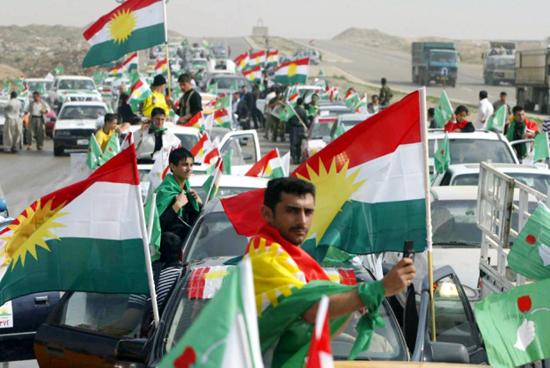
 Print This