Arabs Organize to Get Counted in U.S. Census
 Print This Print This
By Suzanne Manneh
New American Media
Friday, Mar 12, 2010
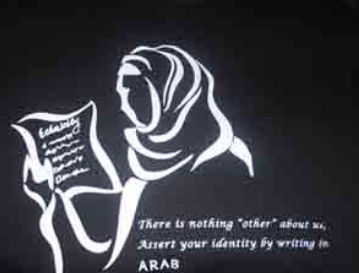 |
| A custom designed T-Shirt
to support the organizing campaign. |
|
A coalition of Arab-American cultural organizations in the San
Francisco Bay Area have launched a grassroots organizing campaign
designed to send a clear message to Washington: that they, along with
every other Arab in America, are in fact Arab, and not white.
At issue is the format of the 2010 Census form, which has boxes for
more than a dozen different racial categories but no racial or ethnic
category for people of Arab descent.
In response, community activists have launched a grassroots canvassing
campaign to encourage Arabs living throughout the San Francisco Bay
Area to complete the 2010 Census by checking the “other” box in Section
9 and write in “Arab.”
The drive was launched at an organizing meeting last Sunday that
brought together representatives and volunteers from local Arab social
service and cultural organizations.
Loubna Qutami, a coordinator with the Arab Cultural and Community
Center (ACCC), one of the organizations behind the campaign, said for
far too long, Arabs have been classified as “other,” “Caucasian,” or
“white.”
“We don’t want to be subsumed under the category of white,” Qutami
said. Arabs “don’t identify as white, and don’t identify as black
either,” she added. “We’re still so misunderstood.”
"There is this idea that Arabs are refugees or new immigrants because
we’re invisible," she added. "There’s a distortion in our identity,
that we’re camel riders, nomads, when in fact Yemenis were part of the
labor movement with Cesar Chavez.”
Qutami said that there is also a “hyper visibility - that we’re
terrorists, and that’s when people want to know we’re Arab,” she said.
“We need to have a voice.”
She argued that the time is now for Arabs to mobilize as a community,
and hopes that these efforts will lead to establishing an “Arab” box to
check-off for the 2020 Census.
Undercounting Arabs
According to the 2000 Census, the number of Arabs living in the United
States was 1.25 million, a figure that many involved in this initiative
believe is inaccurate, since Arabs traditionally have larger families
than other ethnic groups in the United States. The Arab American
Institute estimates the national population to be more than 3.5
million. Community activists say both numbers are too low.
One reason for the undercount, Qutami said, is that without a box to
check Arabs write in a variety of terms – for example, Middle-Eastern,
Arab-American or Palestinian -- on the Census questionnaire, and the
numbers get stratified.
Another organizer, Lily Haskell, who is of Moroccan descent and is with
the Arab Resource and Organizing Committee (AROC), echoed Qutami’s
views.
She said only by identifying as Arab on the Census will legislators
know how many Arabs are actually in their constituency. Also, in
certain parts of San Francisco and the greater Bay Area, where new
immigrant Arab communities have settled, having such Census data will
help ensure that those areas have translators in vital settings like in
hospitals to accommodate those in need.
That is exactly why community organizers must canvass neighborhoods on
foot to convey this to other Arabs, explained Rama Kased, a coordinator
with the Arab Youth Organization (AYO).
Canvassing on Foot
“Canvassing is the oldest way of doing outreach— it was done before
Facebook and texting," Kased said, “this is how you can build off of
what they are telling you, it’s really personal and the person feels
like their voice counts.” That, she added, was how community organizers
and volunteers can connect with and empower other Arabs.
Kased also said the canvassers are reassuring everyone by pointing out
that, “we’re doing this for our own community, to unify our community;
we’re not doing this for the government.”
That same afternoon, 20 volunteers in 7 groups of 2-3 reached out to 60
Arab-owned liquor stores, markets, delis, cafes, and restaurants in
various districts of San Francisco.
Organizers say that this is the first of several planned outreach and
awareness days, where they plan to cover other parts of the Bay Area
with Arab communities, such as the East Bay, Peninsula, and South Bay.
Similar efforts are also underway in Arab communities throughout the
United States like Los Angeles, Detroit, and Chicago. Town hall
meetings are being organized and Arab newspapers are writing short,
"news you can use" articles that explain how to fill out the Census
questionnaire.
Canvassers were wearing T-shirts depicting an Arab woman in a kuffiyeh
and the U.S. Census form. They brought large posters that student
artists designed, which outlined the need to complete the Census and
write-in Arab. They hung them in business windows with each owner’s
permission. They also supplied each business informational postcards in
Arabic and English about how to fill out the Census, to leave on their
counters, in addition to pamphlets outlining social and cultural
services available to Arabs in the Bay Area.
Unfamiliar with the Census
Several business owners they encountered were unfamiliar with the
Census or its importance, and said many Arabs have always felt left out
of the process and kept uninformed.
Arabs, like Samaan Azar, a mini-market owner on 16th and Mission, was
one of them. When Ramsey El-Qare and Homa Nader - campaign volunteers
representing the ACCC - explained the Census to him, Azar was
disappointed. Over the years, he said, he has always had to justify his
racial and ethnic identity because there was never a place for him.
Azar said he was eager to share the information with all of his other
Arab friends and family in the United States.
“We need to be recognized for who we are,” he told the group of canvassers before him.
A few blocks south, Maher Assad, another store owner shared Azar’s concerns.
“This is so frustrating, we are never counted in anything,” he said.
“But doing this, these are baby steps, it’s a great way to start,” he
said.
But the canvassers encountered some business owners who did not welcome their initiative.
Lubna Morrar, a campaign volunteer representing AROC, said that one
business owner she spoke to had been living in the United States for
twenty years. “He told me that he wasn’t going to fill out the Census,
he didn’t care and he didn’t see the relevance,” said Morrar.
But, she added that this canvassing experience helped several other
uninformed Arabs realize the importance of filling out the Census and
filling in Arab, anyway.
She said that one well-known restaurant owner who had been in the
United States for nearly 30 years was not responsive at first. "But
then I asked him if he would identify as 'white,' since we’re usually
lumped in with 'white,' or 'white-other,'” she said.
“‘No way, I am not white, we are not white, we are not anything except
Arab, and if this is what we have to do, then I support it,'" she
recounted.
New American Media
 Print This Print This

|