St. Petersburg Times
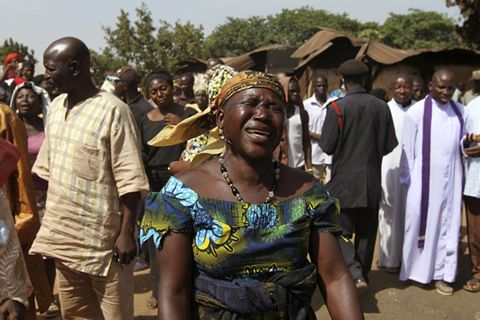 |
| A woman cries during a funeral for victims killed in religious attacks in Dogo Nahawa village, Nigeria, early this week. (Reuters) |
|
JOS,
Nigeria — Christians and Muslims once shared their lives together in
Nigeria’s fertile central belt, buying each other’s goods in mixed
neighborhoods and cultivating each other’s farms across a sun-baked
plateau.
But
growing religious hatred, political and ethnic rivalries and increasing
poverty have led to two outbursts of savage violence this year in which
men, women, children and even babies were butchered, and that harmony
seems lost forever. Now, many people carry weapons and man impromptu
road blocks, fearful of the military, the police and each other.
Various
factors have been weaving a tapestry of violence here but the most
recent bloodshed on Sunday was mostly about revenge. Christian villages
near the city of Jos were attacked before dawn, less than two months
after Muslims were targeted and a mosque torched, with hundreds killed,
their corpses stuffed into wells and sewage pits.
Witnesses
say Sunday’s pre-dawn silence was broken by gunfire. Simple, one-room
houses were set ablaze, the flames illuminating villages that have no
electricity. People ran from their burning homes. Assailants with
machetes were waiting. Many of those who were cut down were children.
At least 200 people died.
One
20-year-old man arrested for allegedly taking part in Sunday’s attacks
said his family members died at the hands of rioters in January. Of
those who were attacked on Sunday, he said: “There are some people that
kill all our parents. We went to avenge what they did to us.”
Nigeria,
a nation of 150 million people, is almost evenly split between Muslims
in the north and the predominantly Christian south. The recent
bloodshed has been happening in central Nigeria, where dozens of ethnic
groups vie for control of the nation’s fertile “middle belt.”
“Jos is a mini-Nigeria. All segments of Nigeria are here,” said state police commissioner Ikechukwu Aduba.
National
leaders appear to have little control over this region in Africa’s most
populous nation. The police and army failed to prevent these horrific
massacres. Acting President Goodluck Jonathan promised security forces
will bring peace to the city and outlying areas where 1 million people
live under control, but many Christians fear the Muslim-dominated
police force and military. Local youths armed with kitchen knives and
machetes have formed self-protection gangs in neighborhoods and
scrutinize each passing vehicle.
Sixty
kilometers (38 miles) from Jos, in the village of Ku-Got, men armed
with machetes, homemade swords, slingshots and bows and arrows stand
guard amid arid cornfields. Barricades made of boulders and cacti
manned by frightened locals block many roads. Nigerian security forces
rarely, if ever, patrol these areas. They’re usually beyond cellphone
range and there’s no electricity.
“It’s
clear these people are unprotected here. If you have to carry a bow and
arrows in your own town, you are unprotected,” said Mark Lipdo, who
leads a Christian foundation in Jos.
Despite
once working on farms belonging to the Muslim Fulani ethnic group, the
people of Ku-Got now look out over the silhouetted mountains and worry
that armed Fulani herders will be coming down the ridge. Villagers say
they buried two old women killed by Fulani raiders Sunday. The
attackers razed their homes, broke a glass pulpit at the Christian
church and destroyed the community’s only satellite television receiver.
“They
want to inherit the land,” said the Rev. Joshua T. Dafom, who preaches
at the church. “They want to wipe us out to inherit the land to graze
their animals.”
For
their part, the Fulanis now watch over their herds of cattle in groups
of armed men numbering into the dozens, instead of going alone,
unarmed, to watch over the animals as they once did, Fulani community
leader Sale Bayari said. The men now fear a “guerrilla war” against the
ethnic group that left many of them dead during the January rioting but
are prepared, Bayari said.
“My people have an instinct for survival,” he said.
Plateau
state, of which Jos is the capital, has long been known as “The Home of
Peace and Tourism.” It has unspoiled savannas, wild animals like
leopards and hippos, waterfalls and curious rock outcroppings. But this
monicker is now a sad irony.
“Plateau
state has become a jungle,” said Bayari, who is being sought by police
for the Sunday attacks. He spoke by mobile telephone from a neighboring
state.
St. Petersburg Times





 Print This
  Print This