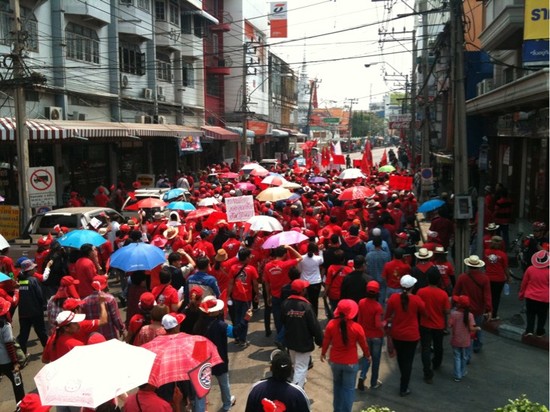
 |
| Cannot see end of parade in Paknam. (Richard Barrow) |
|
Anti-government Redshirt supporters say that the Thai government
must choose between suppression of its proposed “million-man” peaceful
protest on March 14, or dissolution of the current Democrat-led
government.
“Our aim is to bring down the administration,” said
Sean Boonpracong, a spokesman for the Redhshirt United Front for
Democracy Against Dictatorship (UDD).
“We will use only peaceful means,” he said, acknowledging that
Redshirt violence at the disbanded Asian summit in Pattaya and in
Bangkok during the Songkran 2009 protests damaged the anti-government
cause.
How a peaceful protest will force the government to choose
between suppression of the protest on the one hand, and dissolution of
the parliament on the other, was not clarified.
However, senior
UDD member Jaran Ditthapichai told media at a Bangkok press conference
on Thursday that if the protest is met with violence, then a civil war
in Thailand could be possible.
“If the government suppresses
us, then they will have declared civil war.” he said. "If this happens,
you will not see elections of democracy in Thailand for five, maybe ten
years."
The Redshirts have pledged a peaceful march, with
estimates between 500,000 and 1.3 million given as a possible turnout.
UDD leaders believe that substantial portions of the army and police
support their cause, which they feel will help bring down a government
that was “established in the army barracks,” according to Sean
Boonpracong.
The current prime minister assumed his position
after anti-Thaksin Yellowshirt protestors occupied Government House and
the country's international airports, in protest at what they decried
as corruption during the Thaksin era, and under the elected pro-Thaksin
administrations that followed the restoration of civilian rule after
the 2006 coup that removed Thaksin from office.
Redshirts saw
these protests as stemming from an elitist aversion to Thaksin's
“pro-poor” policies. Yellowshirts depicted Thaksin as a threat to the
country's monarchy, which the UDD today again countered by saying that
loyalty to the head of state is a prerequisite for membership.
Amid
concerns that the Redshirts could seek to provoke a confrontation with
the security forces, Boonpracong backtracked on a prior “call to arms”
issued by other UDD members, but cautioned that “there may be certain
elements that we cannot control.” He blamed the government for trying
to portray the Redshirts as violence-prone.
The UDD has said it will not form a political party even if the government is dissolved and new elections called.
The
pro-Thaksin Peua Thai party said on Thursday that it backs the UDD
March, despite recent ranncour between the UDD and Peua Thai groups,
with the latter saying that the one million turnout for the March 14
protest was not feasible. However, on Wednesday the Puea Thai MP for
Chiang Mai, Surapong Towijakchaikul, said that between 40,000 and
50,000 people from the North are expected to travel to Bangkok to
participate.
The protest comes after last Friday's Supreme Court
decision to seize THB 46.37 billion of assets formerly belonging to
Thaksin Shinawatra, who was Prime Minister of Thailand prior to being
ousted by a September 2006 military coup.
Prime Minister
Abhisit Vejjajiva on Wednesday told Thai government agencies to look at
ways to bring civil and criminal charges against Thaksin in the wake of
the court ruling.
The Redshirt movement says that pro-Thaksin
elements are just one of many smaller entities that comprise what they
depict as a larger, pro-democracy movement.
The Bangkok press
conference was addressed by former Communist rebels in Thailand, now
part of the UDD. The UDD denies that it receives funding from Thaksin.
The former PM, who is believed to be in Dubai, regularly addresses
Redshirt rallies by video link.
The Irrawaddy





 Print This
  Print This