 |
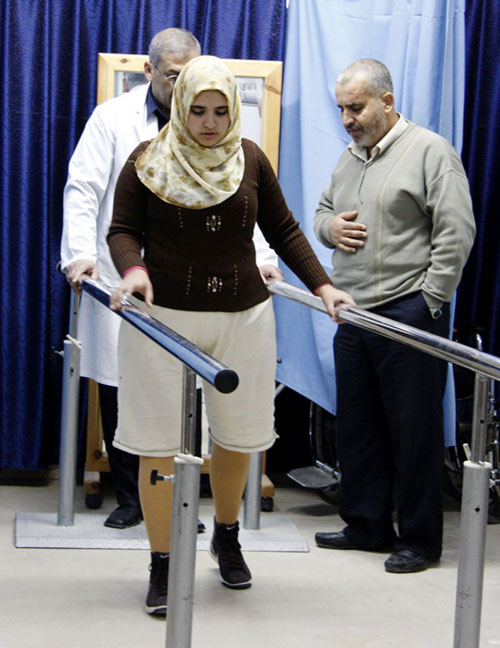
| Jamila al-Habbash, 15, lost both her legs in a missile strike by an unmanned Israeli drone as she played on the roof of her home in eastern Gaza. She receives training to wear her artificial legs. (Suhair Karam) |
|
GAZA CITY - A
half-finished two-story building in central Gaza City is one of the few
places providing support to amputees, most of them civilian victims of
the Israel-Palestinian conflict, as they try and come to terms with
their injuries.
Ten patients were waiting
to see Dr Hazem al-Shawwa, the director of the Artificial Limb and
Polio Centre, when IRIN visited. Mostly young, they had been caught in
the violence of Israel’s 23-day assault on Gaza at the end of 2008 and
beginning of 2009, and were still learning to use their new prosthetic
limbs.
“We have 250 new amputees
following the Israeli war to add to the 5,000 cases we had before the
war,” said al-Shawwa. “Some of the injured from the Gaza war are still
having problems with their amputated limbs as they were not treated
properly at the time due to the hectic situation; initial treatments
focused on saving lives.”
A new upper floor extension
to the centre is under construction, reflecting the demand for its
services, but a lack of funds has delayed work.
In the centre’s
ground-floor training room, 15-year-old Jamila al-Habbash took a firm
grip on the parallel bars and shuffled forward. She lost both her legs
in a missile strike by an unmanned Israeli drone as she played on the
roof of her home in eastern Gaza city: her sister and cousin were
killed in the blast.
Mohamed Ziada, one of five
specialists at the centre, said Jamila was making good progress since
her artificial legs were fitted in December, and may soon not need her
crutches. He pointed out that treating teenagers was expensive as they
quickly outgrow their prosthetics and need numerous re-fittings.
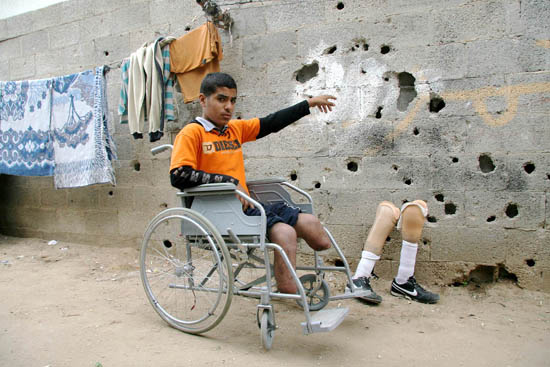 |
| Ghassan Matter, 15, points at holes which the Israeli missiles that hit him on 5 January 2009 made. He lost his legs in the incident and uses artificial limbs now. (Suhair Karam) |
|
"Worse than a nightmare"
Fifteen-year-old Ghassan
Mattar also lost his legs when an Israeli missile hit his home in
eastern Gaza City on 5 January 2009, an incident documented by the
Palestinian Centre for Human Rights (PCHR). “I still can’t believe I’ve
lost my legs. It’s worse than a nightmare,” he told IRIN.
The only rehabilitation
hospital with the capacity to treat amputee patients effectively is the
al-Wafaa Rehabilitation Centre in northern Gaza. Ghassan should have
been sent there directly but the hospital was hit by artillery fire
during Israel’s Gaza incursion, and its wards were evacuated, according
to PCHR.
Ghassan was able to leave
Gaza for Egypt and received six months of treatment at the Palestine
Hospital in Cairo. However, back in Gaza he found his artificial legs
were giving him problems as they did not fit properly so he visited the
artificial limb centre and got a better fitting pair.
A below-the-knee prosthetic
costs about US$800 at the centre. An above-the-knee limb is twice as
much, and an arm costs $1,200. Although seemingly expensive, Ziada told
IRIN it was a fraction of the cost charged in other countries.
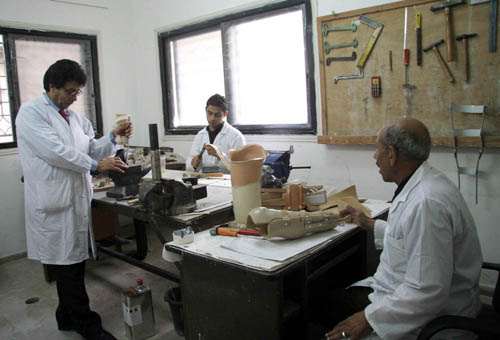 |
| Mohammed Ziada (left), a specialist at the Artificial Limb and Polio Centre, and his colleagues make artificial limbs for amputees. (Suhair Karam) |
|
Imports interrupted
The problem facing the
centre is that a blockade of the Gaza Strip by Israel since June 2007
has interrupted imports of both prosthetic limbs - mainly from Germany
- and the raw materials with which to make them.
“We use hundreds of
different parts, plastics and materials to make prosthetic arms and
legs. Without even just one of the materials, the limb cannot be made,”
said Ziada.
It takes about 30 hours to
manufacture a limb when all the parts are available. “The Red Cross
helps the centre to mediate between us and the Israelis to let
materials cross, which takes about three months,” Ziada added.
Prosthetics specialists
from other countries who had tried to come and train Gazan doctors had
been denied entry into Gaza, according to Ziada. “We need at least
another five specialists because of the large number of amputees from
the Gaza war.”
The centre is assisted by the UN agency for Palestinian refugees (UNRWA) and NGOs Handicap International and Islamic Relief.
Israel says the aim of its
27 December 2008-18 January 2009 incursion was to destroy the military
infrastructure of Hamas, the ruling party in Gaza, and to prevent the
firing of rockets into Israel. According to the PCHR, 5,303
Palestinians were injured in the conflict.
IRIN





 Print This
  Print This