 |
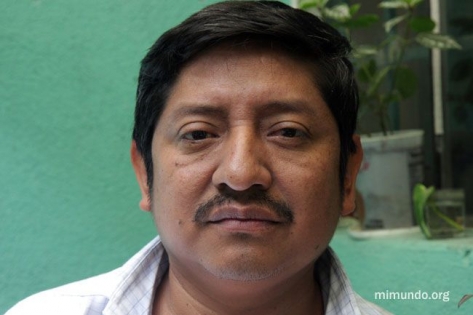
| Guatemalan coffee farmer Leocadio Juracan says the attacks against him are political acts. (James Rodriguez) |
|
HALIFAX—They call him “the Hurricane.”
Guatemalan coffee farmer Leocadio Juracan (his family name is close
to the Spanish word for hurricane) has had a special relationship with
many Nova Scotians—though most don’t even know it.
His coffee-farming cooperative—part of the Comite Campesino Del Altiplano
(CCDA), or Highland Peasant Farmers’ Committee—has been delighting Nova
Scotian palates with its fair trade, shade-grown organic coffee for
close to nine years, through a partnership with Just Us! Coffee
roasters in Wolfville, Nova Scotia.
Juracan is touring Nova Scotia this weekend, speaking to audiences
in Wolfville, Halifax, Tatamagouche and Antigonish. The agenda focuses
on more than just light versus dark roasts.
According to Kathryn Anderson, Maritimes Coordinator of the
Maritimes-Guatemala Breaking the Silence (BTS) Solidarity Network—a
long-time partner of the CCDA—the organization currently faces “perhaps
the greatest threat to its existence since its founding” in 1982.
In May 2008, Juracan explained, after signing an agreement with
Guatemalan president Alvaro Colom on a framework for rural development,
the CCDA’s car was shot at six times while driving down a rural road.
The car’s passengers thankfully escaped injury.
"CCDA coffee is about more than fair trade prices for local
producers," said Jackie McVicar, Coordinator of BTS Guatemala and
former BTS intern with the CCDA. McVicar believes the CCDA’s vehicle
was targeted. "CCDA coffee implies political advocacy and ongoing work
in the struggle for labour justice and access to land for thousands of
Guatemalan peasants. This work is happening at both the grassroots and
national level," she said.
Authorities chalked up the shooting to "common crime," an assessment
that may seem reasonable in a country with one of the highest violent
crime rates in Latin America. But since then, the organization has
suffered through two robberies in which a total of $40,000 worth of
coffee was stolen. Its leaders have received threats of murder and
violence by letter and by phone. A “climate of terror” surrounds the
CCDA, said Juracan.
“The robbery and threats the CCDA received reflect an attempt to
destabilize the organization and delegitimize the work they are doing,”
said McVicar. “CCDA coffee isn't just about better wages. It's about
changing structures of oppression."
In February, the threats started to target Juracan’s children. He
decided to leave Guatemala, at least until the danger subsided. With
the help of Canadian allies, he discreetly left the country with his
family, and they found their way to Vancouver.
“If [the threats] had been just toward me,” Juracan said, “I would have kept on.”
****
The coffee grown by the CCDA—known as “Café Justicia” and sold to
roasters around the world—provides capital for development projects and
a fair wage for the farmers, said Juracan.
He listed home construction, a rural hospital, health promotion,
training for midwives, teacher pay supplements and educational
scholarships as the CCDA’s ongoing projects.
But these “alternative” economic models are threatening to some, explained Juracan.
“Guatemala is not a poor country,” he said. “There is a sector of
society that is extremely rich, that has appropriated the wealth of the
country and excluded the majority of the population.”
This oligarchy has a vested interest in business as usual, said
Juracan. He dismissed the theory that threats and attacks against the
CCDA are the work of common criminals, noting they always take place
immediately after the group takes a public political
position—criticizing the government for lack of action on land reform,
for example, an issue for which resolution is decades overdue; or
condemning the murder of unionists. “We connect [the attacks against
us] to political acts,” he said.
Residual violence from Guatemala’s 36-year civil war may exacerbate
the current violence. The conflict, which divided communities and in
which more than 250,000 were killed—most of them by military and
government-backed paramilitary groups—left a legacy of violence that
has been hard for the country to shake. It is perfectly plausible,
according to Juracan, that his attackers would have connections to
wartime paramilitary groups.
****
Juracan and his family planned to return to Guatemala after two or
three months, hoping the security situation would improve.
Unfortunateley, in the few weeks since they arrived in Canada, there is
no encouraging news.
"There is more news of harassment and intimidation, hooded men roaming the community, gunshots at night,” said the campesino.
During his time in Canada, Juracan said he would like to generate
conditions for a return to his home country. Many CCDA member continue
to work hard in Guatemala for political change, and he plans to
strengthen solidarity between the CCDA and concerned Canadians.
Still, said Juracan, he would rather his stay be as short as
possible. Being forced out of his country for doing his work is a
difficult thing to swallow.
The Dominion





 Print This
  Print This