 |
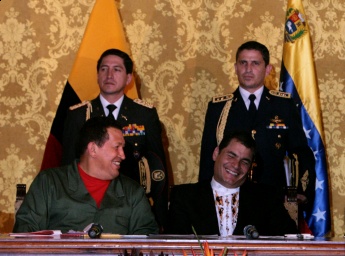
| Ecuadoran President Rafael Correa (left) and Venezuelan
President Hugo Chavez (YVKE) |
|
On Friday, Ecuadoran and Venezuelan officials created a series of
bi-national companies to produce automobile lubricant and food, and
progressed on plans for joint oil and gas exploration, in what the
leaders called a step forward for continental integration.
Presidents Rafael Correa of Ecuador and Hugo Chavez of Venezuela
headed the summit in Caracas, where they discussed joint projects in
energy, agriculture, communications, science, mining, culture, and
commerce. It was their seventh such meeting since regular meetings
began in 2007.
The two countries announced the creation of joint companies to
produce a new brand of automobile lubricant, fish, and cacao. A new
binational mining company was created, which will initially explore for
gold, phosphates, and emeralds in Ecuador, according to Prensa Latina.
They also smoothed out the framework for an Ecuador-Venezuela
Development Fund, to be operated by and for both countries.
President Correa announced that Venezuela had agreed to trade its
oil derivatives for Ecuador’s crude oil, saving refinery-deficient
Ecuador as much as $300 million in costly imports. Correa said the deal
was an example of “the solidarity and brotherhood of the Bolivarian
Revolution with the peoples of the world.”
In previous binational summits, Venezuela assisted Ecuador with the
creation of the public television channel EcuadorTV, invested $21
million in services for Ecuador’s disabled, and made a donation of
fighter jets to the Ecuadoran Air Force.
Correa said the two countries are planning to create what will be
the continent’s largest steel company. In addition, the countries
already have several energy-related joint projects underway. The state
owned oil companies PetroEcuador and PDVSA are conducting joint
drilling for oil in Venezulea’s Orinoco Oil Belt and for natural gas in
northern Ecuador. Over the last two years, PetroEcuador and PDVSA
announced plans for a $6.5 billion refinery and a possible $5 billion
petrochemical plant near the Port of Manta, Ecuador.
President Chavez said the deals were part of “a new model of
integration” marked by cooperation among nations and freedom from U.S.
imperialism. Venezuela and Ecuador are among the eight members of the
trade bloc ALBA, which stands for Bolivarian Alliance for the People of
our Americas and is an alternative to U.S.-dominated free trade.
“The energy axis is vital... it’s a matter of our independence,”
said Chavez. “ALBA has formed a space, a solid nucleus for a new
project... anti-imperialism has its axis in the ALBA.”
Among other issues discussed was the possibility of increasing
military cooperation, which the two presidents said was only for the
purpose of national defense, particularly against the United States,
which has reactivated its southern naval fleet and installed thousands
of new military personnel on seven bases in Colombia.
“With the advance of revolutionary movements in Latin America... the
empire has seen itself obligated to resort to the threat of military
force,” Chavez said on Friday. “We are obligated to increase our
capacity for defense.”
Venezuela has forged similar relations using binational development
funds and joint companies with countries such as Bolivia, China,
Russia, Portugal, South Africa, and Cuba in order to forge what the
government calls a “multi-polar” world that is not dominated by any
superpower.
Venezuelan Analysis





 Print This
  Print This