|

|
|
By Mike Giglio, The Daily Beast
TheDailyBeast.com
Tuesday, Jun 11, 2013
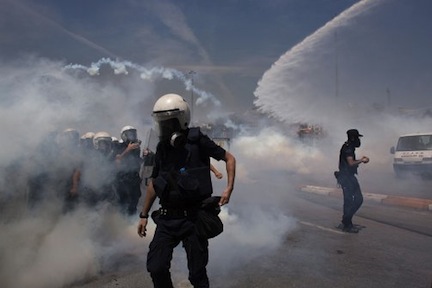 |
| Riot police use water cannons and tear gas to disperse the crowd during a demonstration near Taksim Square on June 11, 2013, in Istanbul, Turkey. (Lam Yik Fei/Getty) |
Riot police surged past barricades, filling the air
with tear gas, and ending the relative calm of Turkey’s Occupy movement.
What happened to peace?
For more than a week, protesters had
free rein of central Istanbul’s Taksim Square, massing daily in defiance
of the government as authorities kept away. Flags and political banners
hung from the square’s main monument—a statue of Mustafa Kemal Ataturk,
founder of the Turkish republic—and makeshift barricades blocked the
surrounding streets. But the tentative peace that had settled over the
area came to an abrupt end on Tuesday morning as riot police surged past
the barricades and back into the square. Onlookers interrupted their
morning commutes to film the chaos on their smartphones as police and
protesters resumed their clashes and tear gas once again filled the air.
The
hundreds of police who retook the square turned water cannons and tear
gas on pockets of demonstrators, some of whom threw rocks and
firecrackers, in scenes reminiscent of the clashes that led to the
Taksim occupation. As the clashes carried on, teams of clean-up crews
wearing surgical masks and orange vests worked quietly to remove the
flags and banners from the Ataturk statue and dismantle the barricades.
Many of the protesters, meanwhile, retreated to nearby Gezi Park.
The
tiny park has become the center of a countrywide push against Prime
Minister Recep Tayyip Erdogan. Turkey’s most popular politician, Erdogan
has won three straight elections, but protesters accuse him of
authoritarianism—and they hold up the park as an example of his
heavy-handed style. Despite opposition from residents, authorities had
planned to raze the park to make room for a shopping mall, the latest
affront in several controversial redevelopment plans that Erdogan is
pushing through in Istanbul. Activists staged a small sit-in to save the
park in late May, but police cracked down, helping the sit-in to
transform into a large-scale push against Erdogan, with like-minded
protests spreading across the country. Gezi Park is now home to a large
Occupy Wall Street–style encampment.
Police ceded Taksim on June
1, following days of clashes, in an effort to defuse tensions. And other
politicians from Erdogan’s Islamic-oriented Justice and Development
Party—such as the country’s president and a deputy prime minister—have
tried to strike a conciliatory tone. Erdogan, however, has been
increasingly defiant. He has derided the protesters as “looters” and
“terrorists” and insisted that the park will be razed as planned. He has
also suggested that the protests are a “plot” by foreign and domestic
agents to destabilize the country. And he has called his own supporters
to the streets for rival demonstrations this weekend, which could
further inflame the situation.
In what was initially seen as a
potential olive branch, the government had previously announced plans
for Erdogan to meet with Gezi Park representatives on Wednesday. But
some protesters saw Tuesday’s police action as a better indication of
his intentions. “They said they were going to negotiate. Is this the way
they negotiate?” said one protester, an engineer in Istanbul who gave
the nickname Devrim Atli. “The prime minister will try to gather his own
supporters. And he will assess his strength. And if he thinks he is
strong enough, then he will act accordingly.”
Since taking office
in 2003, Erdogan has won accolades for turning around Turkey’s economy
and for presiding over a massive expansion of the middle class. He has
also steered the country away from its military, which has a long
history of coups and political meddling. But Erdogan’s critics charge
that he has become authoritarian, concentrating power and forcing
through his agenda while the government weakens checks in the media and
judiciary. Erdogan has also been accused of imposing religious values on
society—shortly before the park protests erupted, the government
ordered new restrictions on alcohol that many Turks see as an affront to
their secular traditions.
Erdogan has roundly denied the charges
of Islamism and authoritarianism. But his combative response to the
protests has reinforced the perception among opponents of an
increasingly uncompromising leadership style. “He’s doing pretty much
everything [he can] to turn this small protest into a major standoff,”
says Kerem Oktem, a research fellow at the University of Oxford who
writes on modern Turkey. “I don’t think there’s any interest in finding a
conciliatory way. He’s closing down a lot of options and slowly
bringing himself to a position of complete polarization.”
Erdogan
didn't mince words Wednesday. "They say the prime minister is rough. So
what was going to happen? Were we going to kneel down in front of these
(people)?" he said. "If you call this roughness, I'm sorry, but this
Tayyip Erdogan won't change."
Istanbul’s governor, Huseyin Avni
Mutlu, appealed for calm on Tuesday, insisting that the police action in
Taksim was meant to clear the banners and barricades—and that the
protesters in Gezi Park would be allowed to remain. As intense clashes
continued around Taksim, the crowds in the park swelled, and protesters
massed on its edges to watch. Police had made no effort to advance on
the park by Tuesday afternoon, though tear gas canisters occasionally
sent people choking past the tents and information stalls. Many
protesters distanced themselves from the demonstrators involved in the
ongoing clashes—and also insisted that those shown on TV throwing
Molotov cocktails were provocateurs sent by police—and suggested that
calm could return if the park encampment was left alone. “It all started
from Gezi Park,” one 29-year-old filmmaker said. “We still have the
park, and we’re not going to leave it.”
Source URL
|
 Print This Print This
|
If you appreciated this article, please consider making a donation to Axis of Logic.
We do not use commercial advertising or corporate funding. We depend solely upon you,
the reader, to continue providing quality news and opinion on world affairs. Donate here
|
|
Featured

|




 Print This